
A few months back, one of our clients — a mid-size SaaS company selling to finance teams — told us something we hear a lot: “We’re on LinkedIn. We post. Nothing happens.” Turns out they were posting to an audience of mostly junior analysts and recruiters, while the people who actually sign off on a $60K software purchase never saw a single update. That’s not a LinkedIn problem. That’s a targeting problem, and it’s the exact thing tailored LinkedIn marketing is built to fix.
Why decision makers actually live on LinkedIn
LinkedIn isn’t just big — it’s big in the right way for B2B. With well over 800 million members, and a large chunk of them influencing or directly making purchasing decisions at their company (LinkedIn’s own lead generation data backs this up), it’s the only platform where “reach a VP of Operations at a 200-person manufacturing firm” is a targeting option, not a hope. Facebook can’t do that. Google Ads can get close through keyword intent, but it can’t hand you the person’s actual title and seniority the way LinkedIn can.
We’ve written before about why this makes LinkedIn Ads the gold standard for B2B lead generation — but reach alone doesn’t get you in front of decision makers. Precision does.
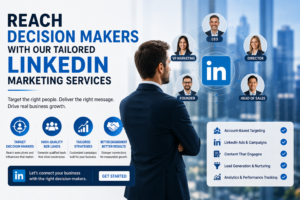
That’s the part generic social media management misses. Posting on a schedule and hoping the algorithm sorts out who sees it isn’t a strategy for reaching a CFO. Tailored LinkedIn marketing means building the campaign around the actual person you’re trying to reach — their industry, their company size, their seniority, and honestly, the specific problem keeping them up at night — instead of one message aimed at everyone.
What “tailored” actually looks like in practice
We build every engagement around four things: targeting, messaging, content, and cadence.
Targeting comes first, always. We layer job title, seniority, company size, and industry until the audience is small enough to be relevant and still large enough to work with LinkedIn’s algorithm. For a company selling into healthcare, that might mean VP-level and above at hospital systems with 500+ beds. For a smaller SaaS play, it might be founders at 20-50 person companies in a specific vertical.
Messaging comes next, and this is where a lot of outbound falls apart. Executives get pitched constantly. A message that opens with “I wanted to reach out about our solution” gets ignored, deservedly. What works is leading with something specific to their world — a trend in their industry, a problem their peers are dealing with, something that shows you did your homework before hitting send.
Content matters too. We mix formats depending on where someone is in the funnel — Sponsored Content and thought leadership posts for people who don’t know you yet, InMail for warmer, more direct conversations once there’s some familiarity. LinkedIn’s own Sponsored Messaging benchmarks show InMail-style outreach getting noticeably higher open and response rates than cold email at the executive level, but a cold InMail to a CEO who’s never heard of you still converts differently than one sent after they’ve seen your name in their feed three times. If the spend itself feels like the bigger question mark for your team, we’ve broken that down separately in Is LinkedIn Advertising Worth the High CPC for Your Business?
And cadence ties it together. One touch rarely does anything at the executive level. We typically plan a sequence — an ad impression, a connection request, a follow-up message, maybe a relevant post they see along the way — spread out over a few weeks, not fired all at once.
How we measure it
We track the things that actually matter to a business, not vanity numbers. Response rates on outreach, cost per qualified meeting, pipeline generated, and how those numbers trend over the length of a typical sales cycle for your industry. If a metric doesn’t tie back to revenue eventually, we don’t put much weight on it.
A few months back, one of our clients — a mid-size SaaS company selling to finance teams — told us something we hear a lot: “We’re on LinkedIn. We post. Nothing happens.” Turns out they were posting to an audience of mostly junior analysts and recruiters, while the people who actually sign off on a $60K software purchase never saw a single update. That’s not a LinkedIn problem. That’s a targeting problem, and it’s the exact thing tailored LinkedIn marketing is built to fix.
Why decision makers actually live on LinkedIn
LinkedIn isn’t just big — it’s big in the right way for B2B. With well over 800 million members, and a large chunk of them influencing or directly making purchasing decisions at their company, it’s the only platform where “reach a VP of Operations at a 200-person manufacturing firm” is a targeting option, not a hope. Facebook can’t do that. Google Ads can get close through keyword intent, but it can’t hand you the person’s actual title and seniority the way LinkedIn can.
That’s the part generic social media management misses. Posting on a schedule and hoping the algorithm sorts out who sees it isn’t a strategy for reaching a CFO. Tailored LinkedIn marketing means building the campaign around the actual person you’re trying to reach — their industry, their company size, their seniority, and honestly, the specific problem keeping them up at night — instead of one message aimed at everyone.
What “tailored” actually looks like in practice
We build every engagement around four things: targeting, messaging, content, and cadence.
Targeting comes first, always. We layer job title, seniority, company size, and industry until the audience is small enough to be relevant and still large enough to work with LinkedIn’s algorithm. For a company selling into healthcare, that might mean VP-level and above at hospital systems with 500+ beds. For a smaller SaaS play, it might be founders at 20-50 person companies in a specific vertical.
Messaging comes next, and this is where a lot of outbound falls apart. Executives get pitched constantly. A message that opens with “I wanted to reach out about our solution” gets ignored, deservedly. What works is leading with something specific to their world — a trend in their industry, a problem their peers are dealing with, something that shows you did your homework before hitting send.
Content matters too. We mix formats depending on where someone is in the funnel — Sponsored Content and thought leadership posts for people who don’t know you yet, InMail for warmer, more direct conversations once there’s some familiarity. A cold InMail to a CEO who’s never heard of you converts differently than one sent after they’ve seen your name in their feed three times.
And cadence ties it together. One touch rarely does anything at the executive level. We typically plan a sequence — an ad impression, a connection request, a follow-up message, maybe a relevant post they see along the way — spread out over a few weeks, not fired all at once.
What results actually look like
For that SaaS client I mentioned, we rebuilt their targeting around finance directors and VPs at companies with 100-500 employees, paired Sponsored Content with a short InMail sequence, and optimized their founder’s profile so it actually looked credible to someone doing due diligence before a call. Within about six weeks, their qualified pipeline meetings roughly doubled, and — maybe more importantly — their sales cycle got noticeably shorter, because the people booking calls were already the right fit instead of someone sales had to disqualify after the first conversation.
That’s really the whole point. It’s not about generating more leads. It’s about generating leads who were already worth talking to.
Let’s look at what you’re doing now
If your LinkedIn presence feels like it’s shouting into a mostly empty room, or your current agency is measuring success in likes instead of meetings booked, it’s worth a conversation. We offer a quick audit of your current LinkedIn approach — no cost, no obligation — where we’ll show you exactly who you’re actually reaching versus who you should be. Book a discovery call and we’ll walk through it together.