


If you cannot tie a marketing campaign to a number you cannot defend its budget. That is the truth behind every Return On Investment conversation in marketing. The good news is that the math is not complicated. The hard part is getting data and choosing the right way to attribute credit to your digital marketing campaigns. Here is a practical walkthrough of how to do it.
The Core Return On Investment Formula
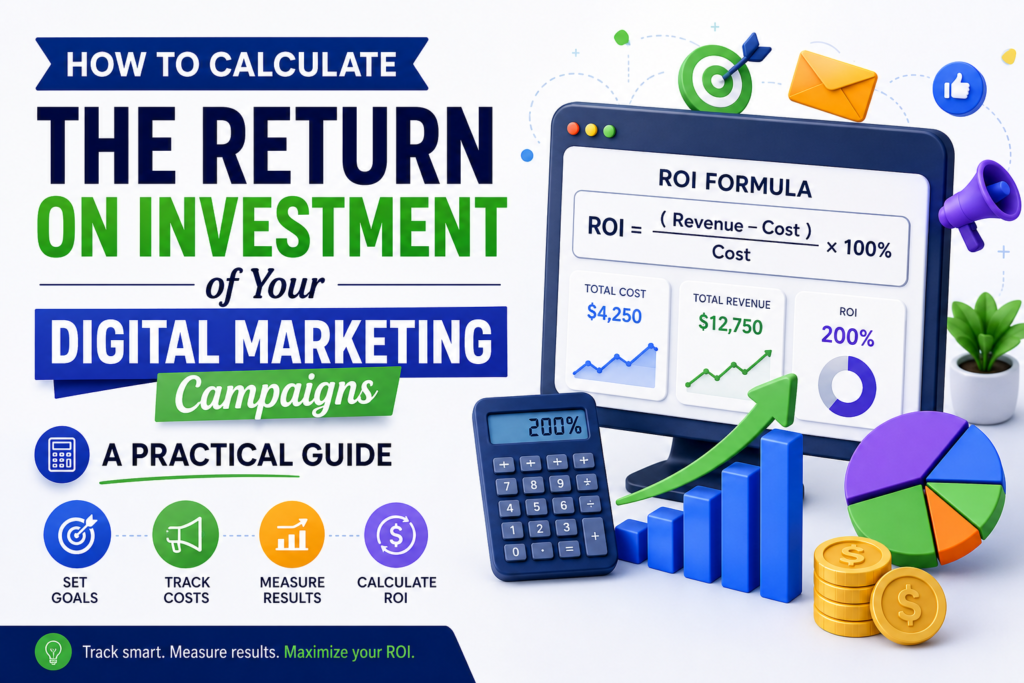
The standard formula for calculating the Return On Investment of your marketing campaigns is simple:
Return On Investment = (Revenue Generated − Digital Marketing Cost) / Digital Marketing Cost × 100

If a digital marketing campaign cost $5,000 and generated $20,000 in attributed revenue your Return On Investment is 300%. That means for every dollar spent on your marketing campaign you got three dollars back on top of your original investment in your digital marketing campaign.
Digital marketing cost should include everything: ad spend, tools, creative production, agency fees and staff time if you want a loaded number for your digital marketing campaign. Skipping these makes the Return On Investment of your marketing campaign look better than it really is.
Return On Investment vs. Return On Ad Spend: Do Not Confuse Them
Return On Ad Spend and Return On Investment get used interchangeably but they answer different questions about your digital marketing campaigns. Return On Ad Spend is revenue divided by ad spend. A top-line efficiency metric used for day-to-day optimization decisions like which creative to scale for your marketing campaign. Return On Investment factors in costs and measures whether the digital marketing campaign was actually profitable for the business. A digital marketing campaign can have a Return On Ad Spend and a mediocre Return On Investment if overhead and production costs eat into the margin of your digital marketing campaign.
For context on what “looks like: eCommerce Return On Ad Spend currently averages somewhere in the 2.87:1 to 4:1 range depending on the source and methodology with wide swings by channel for your digital marketing campaign. Google Search and Shopping campaigns tend to sit because they capture buyers who already have purchase intent while awareness-oriented placements like Display and TikTok trend lower for your digital marketing campaign. The number that actually matters is not the industry average. It is your break- Return On Ad Spend calculated as 1 divided by your gross margin for your digital marketing campaign. A business with a 40% margin needs at a 2.5:1 return just to break even; a 25%-margin business needs 4:1 for their digital marketing campaign.
Building the Calculation Step by Step for Your Digital Marketing Campaign
- Define the conversion for your marketing campaign. Sale, lead, signup or app install. Pick the outcome that maps to revenue for your marketing campaign.
- Assign a value to your marketing campaign. For sales use actual revenue. For leads use deal value × close rate for your digital marketing campaign.
- Total your costs for your marketing campaign. Ad spend, platform fees, content production, tools and labor for your marketing campaign.
- Choose an attribution model for your marketing campaign. This is where reported Return On Investment can swing the most for your marketing campaign.
- Run the formula. Compare against your break-even threshold for your digital marketing campaign, not a generic benchmark for your digital marketing campaign.
Attribution: The Variable Everyone Underestimates for Digital Marketing Campaigns
The same digital marketing campaign can show different Return On Investment depending on whether you use first-touch last-touch or multi-touch attribution for your digital marketing campaign. Last-touch gives all credit to the click before conversion. Usually search or email. Which tends to undervalue upper-funnel channels like social and display that built awareness earlier in the journey for your digital marketing campaign. First-touch does the opposite for your marketing campaign. Multi-touch models split credit across the path offering a balanced picture for your digital marketing campaign.
There is no correct” model for your digital marketing campaign. The practical advice from analysts working with ad accounts is consistency: pick one model apply it across digital marketing campaigns and use it to track trends over time rather than chasing precision you cannot actually verify for your digital marketing campaign. If you run -channel digital marketing campaigns this consistency matters even more since each channel will look better or worse purely based on where it sits in the customer journey for your digital marketing campaign.
Accounting for What the Formula Misses for Your Digital Marketing Campaign
Basic Return On Investment calculations struggle with two things: lift and long-term value for your digital marketing campaign.
- Incremental lift asks whether the sale would have happened anyway without the ad for your marketing campaign. Total conversions overstate impact; a holdout group or geo-test gets you closer to the incremental number for your digital marketing campaign.
- Customer Lifetime Value matters because a digital marketing campaign with a “first-purchase Return On Investment can still be a great investment if those customers stick around. Businesses with repeat-purchase behavior often deliberately accept a lower first-touch Return On Ad Spend evaluating digital marketing campaigns instead on a 90-day LTV-to-CAC ratio for their digital marketing campaign.
A useful sustainability check: keep your customer lifetime value least three times your customer acquisition cost for your digital marketing campaign.
Improving Return On Investment After the Digital Marketing Campaign Ends
- Kill creative early and reallocate budget to winners for your digital marketing campaign.
- Refresh ad creative every 2–3 weeks to fight fatigue especially on paid social for your digital marketing campaign.
- Tighten targeting with negative keywords and exclusion audiences for your digital marketing campaign.
- Build retargeting and post-purchase flows. They are consistently among the highest-Return On Investment activities because they work on warmer audiences for your digital marketing campaign.
- Revisit your attribution window; a window that is too short can undercount conversions that happen days later for your marketing campaign.
The Takeaway
Return On Investment is not a number you calculate once. It is a lens you apply consistently with the right costs, a defined attribution model and an honest look at incrementality and lifetime value for your digital marketing campaign. Get those four pieces for your digital marketing campaign and the formula does the rest, for your digital marketing campaign.