
Starting a digital marketing agency has never been more achievable. You don’t need a large office, expensive equipment, or a huge team to get started. If you have marketing expertise and the ability to deliver results, you already have the foundation.
The real challenge isn’t launching an agency—it’s growing one that consistently attracts clients, delivers great work, and remains profitable over time.
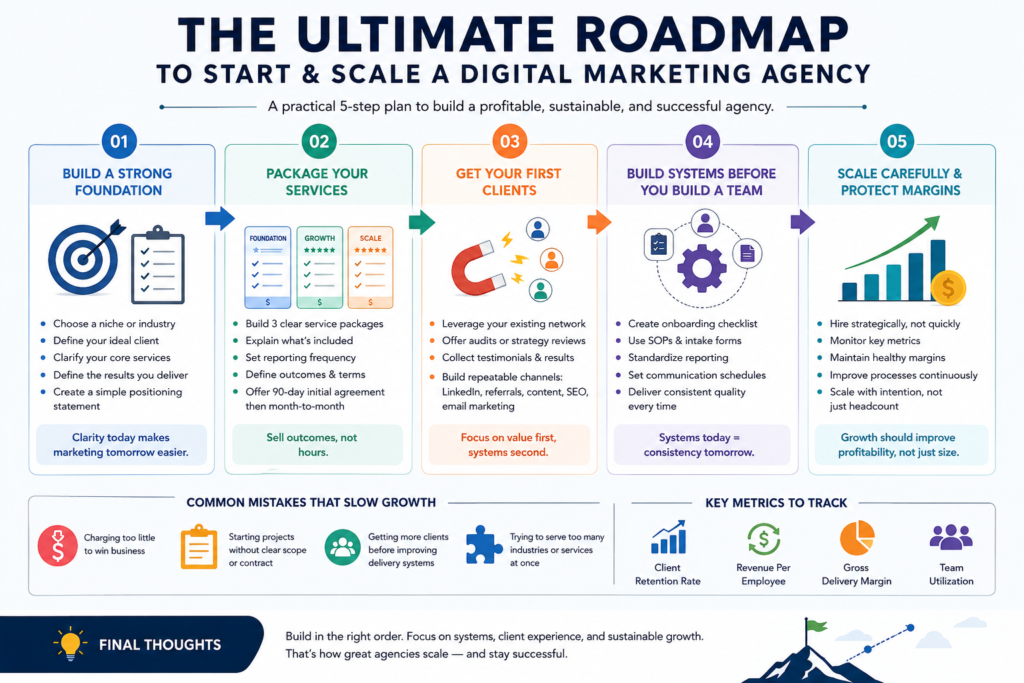
Many agency owners begin as freelancers. The agencies that successfully scale usually follow a clear progression: build a strong foundation, create valuable service packages, develop a reliable client acquisition system, streamline delivery, and then scale with intention.
Here’s a practical roadmap that can help.
1. Build a Strong Foundation Before You Build a Brand
One of the most common mistakes new agency owners make is trying to serve every type of business.
It sounds like the best way to attract more clients, but it often has the opposite effect. When your messaging is too broad, potential clients struggle to understand why they should choose you over dozens of other agencies.
Instead, choose a niche.
That could mean focusing on a specific industry like healthcare, SaaS, real estate, or e-commerce. You can also specialize in a particular service such as SEO, Google Ads, social media marketing, or email automation.
Specialized agencies generally position themselves more effectively because they understand the challenges of a particular market. Industry research also shows that niche agencies often command higher pricing and generate stronger revenue per employee than generalist firms.
Before creating a website or designing a logo, clearly define:
- Your ideal client
- Your core services
- The results you help clients achieve
- A simple positioning statement explaining who you help and why
Having this clarity makes every future marketing and sales effort much easier.
2. Package Your Services Instead of Selling Your Time
Many new agencies begin by charging hourly rates.
While this may work initially, it becomes difficult to scale because your income is tied directly to the number of hours you can work.
Today, monthly retainers have become the preferred pricing model for most digital marketing agencies. Industry reports indicate that retainer-based engagements continue to grow because they create predictable revenue for agencies and ongoing support for clients.
Rather than offering custom pricing for every inquiry, create three simple service packages.
For example:
- Foundation – Essential marketing services for smaller businesses
- Growth – Expanded campaigns with ongoing optimization
- Scale – Comprehensive marketing support for larger organizations
Each package should clearly explain:
- What’s included
- Reporting frequency
- Expected outcomes
- Contract terms
Many agencies also use a 90-day initial agreement followed by a flexible month-to-month arrangement. This gives clients confidence while allowing both parties to evaluate the relationship before making a long-term commitment.
3. Focus on Getting Your First Clients Before Automating Everything
Landing your first client usually doesn’t require complicated marketing funnels.
In most cases, your earliest opportunities come from people who already know you.
Reach out to:
- Former colleagues
- Previous freelance clients
- Friends in business
- Local companies
- Professional connections on LinkedIn
Offer something that provides immediate value, such as a website audit, a marketing review, or a brief strategy session.
Once you’ve delivered results, turn those wins into case studies and testimonials.
From there, begin building repeatable client acquisition channels such as:
- LinkedIn outreach
- Referral partnerships
- Educational content
- SEO-driven blogging
- Email marketing
Creating simple sales assets—like an intake questionnaire and a standardized proposal template—also helps your agency appear more professional while saving time during every sales conversation.
4. Build Systems Before You Build a Bigger Team
Growing agencies don’t usually struggle because they can’t find clients.
They struggle because they can’t consistently deliver great service as client numbers increase.
The first 90 days of a client relationship are especially important. A smooth onboarding process builds trust early and significantly improves retention.
Every agency should document essential processes, including:
- A client onboarding checklist
- Campaign intake forms
- Standard Operating Procedures (SOPs)
- Reporting workflows
- Communication schedules
When every project follows the same proven process, quality becomes consistent regardless of who performs the work.
Research also shows that agencies built around recurring retainers generally experience much lower client churn than businesses relying mainly on one-time projects. Consistent systems are a major reason why.
5. Scale Carefully and Protect Your Profit Margins
As your agency grows, it’s tempting to hire people as soon as the workload increases.
However, rapid hiring often creates unnecessary overhead before revenue has stabilized.
Instead, expand your team strategically.
Many agency owners first hire a project manager or operations specialist who keeps projects moving smoothly while freeing the founder to focus on sales, client relationships, and business growth.
As demand increases, add specialists only when individual service lines consistently reach capacity.
At the same time, monitor a small group of important performance metrics every month:
- Client retention rate
- Revenue per employee
- Gross delivery margin
- Team utilization
Healthy agencies often target gross margins around 50%, although maintaining that level depends largely on controlling scope creep and pricing projects appropriately.
Interestingly, many smaller agencies are actually more profitable than much larger firms because they operate with lower overhead and fewer management layers.
Growth should always improve profitability—not simply increase headcount.
Common Mistakes That Slow Agency Growth
Even experienced agency owners make avoidable mistakes. Some of the most common include:
- Charging too little simply to win new business
- Starting projects without a clear contract or defined scope
- Acquiring more clients before improving delivery systems
- Trying to serve too many industries or service categories at once
Avoiding these issues early creates a much stronger foundation for long-term success.
Final Thoughts
Building a successful digital marketing agency isn’t about growing as quickly as possible.
It’s about building each stage of the business in the right order.
Start with a clearly defined niche and a compelling service offering. Develop a reliable system for attracting clients, document your delivery processes, and measure the numbers that actually influence profitability.
Agency owners who prioritize systems, client experience, and sustainable growth consistently outperform those who chase rapid expansion without a plan.
While industry benchmarks for pricing, margins, and retainers provide useful guidance, every market is different. Use current data to inform your decisions, adapt your services to your niche, and refine your processes as your agency evolves.
“Package Your Services Instead of Selling Your Time”
Once you’ve created your service packages, Canva is a great tool for designing professional pricing guides, proposals, and presentation documents. Clear, well-designed sales materials help build trust with potential clients.