
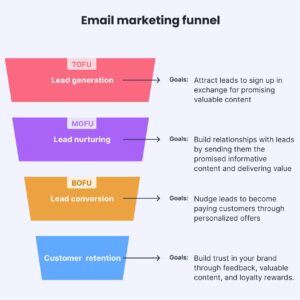
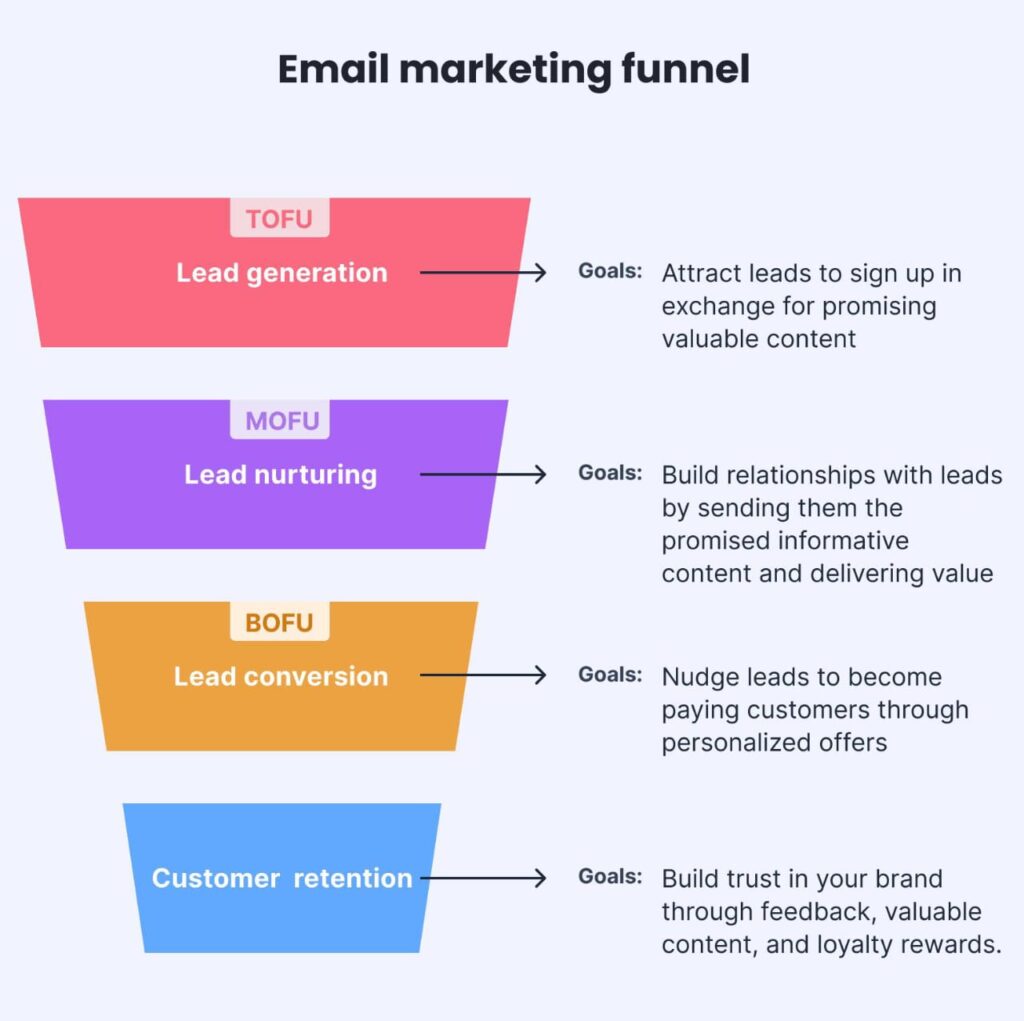
An email marketing funnel is a structured series of emails designed to guide subscribers through distinct stages of the buyer journey from first hearing about you to becoming a paying, repeat customer. Instead of one-off blasts, a funnel works automatically, sending the right message to the right person at the right time based on where they are in that journey.
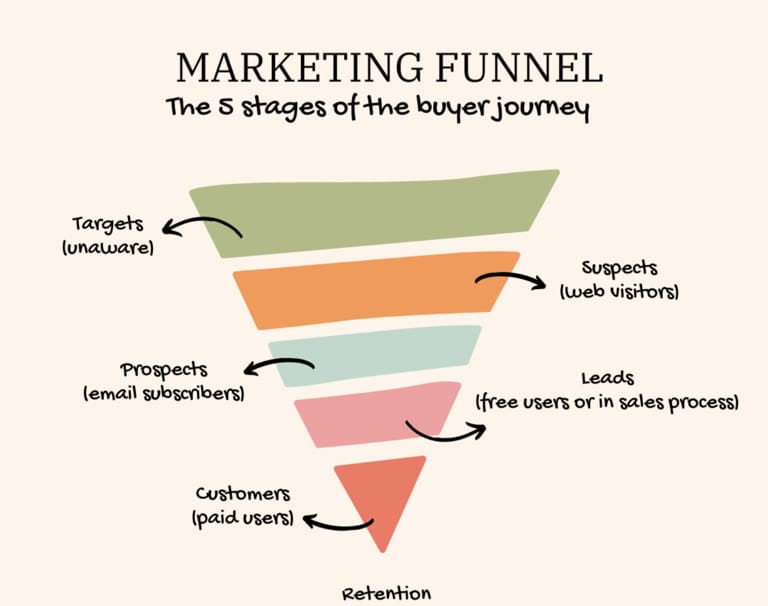
Most funnels follow five stages:
- Awareness: Someone discovers your brand and opts in (usually via a lead magnet).
- Interest: They start learning about your product, story, or value.
- Consideration: They compare options and weigh whether you solve their problem.
- Decision: They’re ready to buy, and need a nudge (offer, urgency, social proof).
- Retention: Post-purchase emails that build loyalty and drive repeat business.
Email Funnel vs. Regular Email Campaign
A regular campaign is a single email (or short series) sent to your whole list at once — a newsletter, a sale announcement, an update. A funnel is behavior-triggered and ongoing: it’s built once, then runs continuously, reacting to what each subscriber does (or doesn’t do). Campaigns are broadcasts; funnels are conversations tailored to individual timing and intent.
Why Your Business Needs One
1. It nurtures leads automatically.
Not everyone is ready to buy the moment they sign up. A funnel keeps your brand top-of-mind and builds trust while a lead decides — without you lifting a finger after setup.
2. It drives measurable conversions.
Automated nurture sequences consistently outperform one-off broadcasts in both lead conversion speed and customer retention, because timing and relevance do the heavy lifting that a single blast can’t.
3. The ROI is hard to ignore.
Email marketing is one of the highest-ROI channels available — industry benchmarks commonly cite around $42 in revenue for every $1 spent. A funnel is how you actually capture that return instead of leaving it to chance.
4. Welcome and triggered emails outperform everything else.
Welcome emails typically see 2–3x higher open rates and notably higher click-through rates than standard campaigns. Behavior-triggered emails — like cart abandonment or post-signup sequences — can see 3–10x higher CTR than non-triggered sends. If you’re not automating these moments, you’re missing your best-performing emails by default.
5. Segmentation multiplies results.
Segmented campaigns — sent based on behavior, interest, or lifecycle stage — consistently produce higher open rates and click-through rates than one-size-fits-all sends. A funnel is essentially segmentation in motion.
A Sample Funnel: SaaS Free Trial Signup
To make this concrete, here’s what a simple SaaS funnel might look like:
- Email 1 (Day 0) Welcome: Confirm signup, set expectations, one clear CTA (e.g., “Complete your setup”).
- Email 2 (Day 2) Value/Education: Show a key feature solving a common pain point.
- Email 3 (Day 4) Social Proof: Case study or testimonial relevant to their use case.
- Email 4 (Day 7) Objection Handling: FAQ-style email addressing common hesitations (pricing, integrations).
- Email 5 (Day 10) Decision: Trial-ending reminder with a time-limited incentive to upgrade.
- Email 6 (Post-purchase) Onboarding/Retention: Tips to get more value, plus an invitation to refer others.
An ecommerce funnel follows the same logic but swaps “trial” for “cart” welcome, product education, reviews/UGC, abandoned cart nudge, discount, and post-purchase upsell/loyalty emails.
How to Build Your Email Funnel: Step-by-Step
Step 1: Audit your current emails.
List every email you currently send. Identify gaps no welcome sequence? No abandoned cart flow? No post-purchase follow-up? These gaps are your starting map.
Step 2: Define your funnel stages.
Map awareness, consideration, decision, and retention to your actual customer journey. A B2B SaaS funnel looks different from a boutique ecommerce funnel tailor the stages to how your customers really buy.
Step 3: Create (or improve) your lead magnet and opt-in.
Your funnel starts with an opt-in a guide, discount code, free tool, or webinar in exchange for an email address. The stronger the lead magnet, the higher quality your funnel entries.
Step 4: Map the subscriber journey.
For each stage, decide: What does this person need to know or feel next? What’s the single next action you want them to take?
Step 5: Build your content plan.
Draft the emails for each stage. Keep each one focused on a single goal and a single CTA — don’t cram five asks into one email.
Step 6: Set up automated triggers.
Use your email platform to trigger sends based on actions: signup, purchase, cart abandonment, inactivity, downloaded resource, etc. This is where “campaign” becomes “funnel.”
Step 7: Add segmentation.
Split your list by behavior, source, or interest so messaging stays relevant. A trial user who used Feature A gets different follow-up than one who used Feature B.
Step 8: Test and iterate.
Run A/B tests on subject lines, send times, and CTAs. Review performance monthly and refine underperforming steps rather than rebuilding the whole funnel from scratch.
How Many Emails and How Often?
There’s no universal number, but a common starting range is emails across a funnel, spaced days apart for early stages (to build momentum) and stretching out for retention emails (weekly or monthly). The right cadence depends on your sales cycle a $20 impulse buy needs a shorter, faster funnel than a $20,000 B2B contract.
What Types of Emails Belong at Each Stage?
- Awareness: Welcome emails, brand story, lead magnet delivery
- Consideration: Educational content, comparisons, case studies, testimonials
- Decision: Offers, demos, limited-time incentives, FAQs/objection handling
- Retention: Onboarding tips, loyalty rewards, replenishment reminders, referral requests, win-back campaigns
How to Measure Funnel Success
Track these metrics at each stage, not just overall:
- Open rate is your subject line and sender name earning the click?
- Click-through rate (CTR) is your content compelling enough to act on?
- Conversion rate are clicks turning into signups, purchases, or bookings?
- Lead scoring are engaged subscribers being flagged as sales-ready?
- Drop-off points where in the funnel do people stop engaging? That’s where to optimize first.
Tools You’ll Need
- An email service provider with automation capability (e.g., workflows, triggers, tagging)
- A CRM integration to sync lead and customer data
- Segmentation tools to group subscribers by behavior or attributes
- A/B testing functionality to refine subject lines, content, and timing
- Basic analytics/reporting to track opens, clicks, and conversions by funnel stage
Quick-Start Funnel Checklist
- [ ] Define your funnel stages and goals for each
- [ ] Build or refresh your lead magnet and opt-in form
- [ ] Draft emails covering awareness through retention
- [ ] Set up automated triggers in your email platform
- [ ] Segment your list by behavior or source
- [ ] Add clear, single-focus CTAs to every email
- [ ] Launch and monitor opens, CTR, and conversions
- [ ] A/B test subject lines and send times
- [ ] Review and optimize monthly
Final Thoughts
An email marketing funnel isn’t a nice-to-have it’s the difference between hoping subscribers convert and building a system that converts them predictably. Start small: a welcome sequence and one triggered flow (like cart abandonment or trial follow-up) can already put you ahead of businesses still relying on one-off blasts. From there, layer in segmentation and testing to keep improving results over time.