
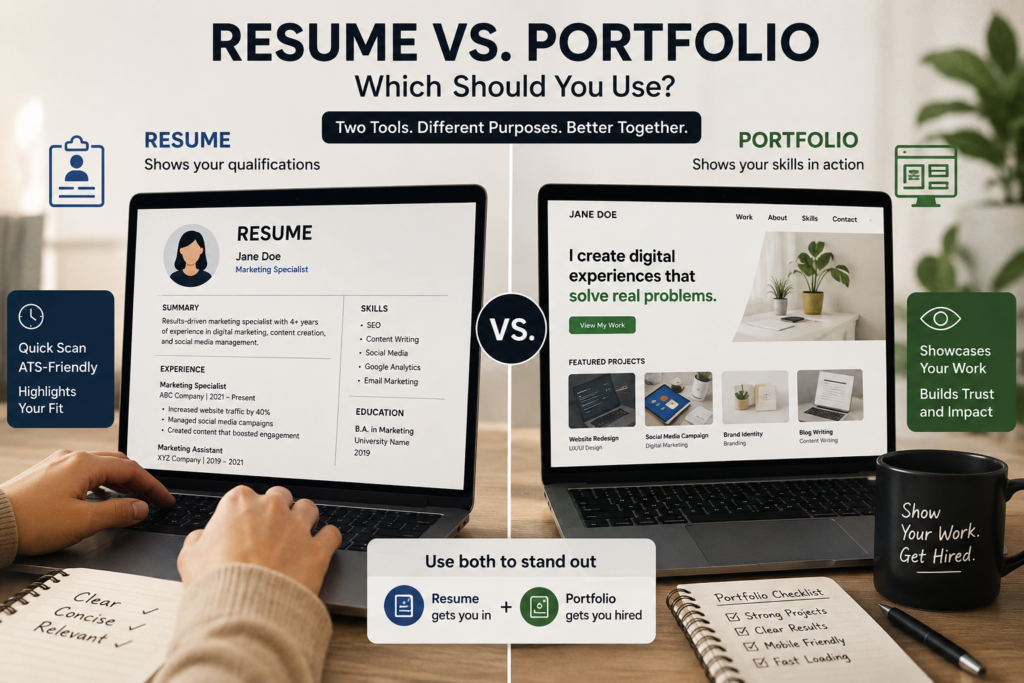
However, many job seekers assume they have to choose one over the other. Some believe a portfolio can completely replace a resume, while others think a resume alone is enough to land interviews. In reality, both serve different purposes, and together they create a much stronger job application.
Think of your resume as the introduction and your portfolio as the proof. One helps you get noticed, while the other helps convince employers that you’re the right person for the role.
If you’re applying for jobs, you’ve probably asked yourself this question:
“Should I spend more time perfecting my resume or building a portfolio website?”
The short answer is simple—you need both.
So, let’s take a closer look at what hiring managers actually expect from each one.
Your Resume Is Your First Impression
Imagine a recruiter opening hundreds of applications in a single day.
Naturally, they don’t have time to read every resume word for word.
Instead, they quickly scan each application to answer one simple question:
“Is this candidate worth learning more about?”
In fact, research often suggests that recruiters spend only a few seconds reviewing a resume before deciding whether to continue reading. Because of this, your resume shouldn’t try to tell your entire career story. Rather, it should highlight your most relevant qualifications in a clear and easy-to-read format.
A strong resume usually includes:
- A clear professional summary at the top
- Job titles and experience that match the role
- Measurable achievements instead of generic responsibilities
- Keywords taken from the job description
- A clean, organized layout that’s easy to skim
For example, compare these two statements:
❌ Responsible for social media marketing.
✅ Increased Instagram engagement by 42% in six months through targeted content strategy.
The second statement immediately demonstrates impact. As a result, it gives recruiters a much better understanding of your contribution.
Ultimately, hiring managers want to see results—not just responsibilities.
Your Portfolio Shows the Proof
While your resume says, “I can do this,” your portfolio says, “Here’s the evidence.”
That’s exactly why portfolios have become increasingly valuable, especially in today’s competitive job market.
Instead of simply reading about your skills, employers can actually see your work. Consequently, they gain more confidence in your abilities before inviting you for an interview.
A portfolio is particularly valuable if you’re applying for roles such as:
- Web Development
- UI/UX Design
- Graphic Design
- Content Writing
- Digital Marketing
- Video Editing
- Photography
- Product Design
- Software Development
However, hiring managers aren’t interested in seeing only the final product.
They also want to understand how you think, solve problems, and approach challenges.
For that reason, the best portfolios go beyond screenshots or finished designs.
Instead, each project should explain:
- The problem you were solving
- Your specific role
- Your approach and process
- The tools or technologies you used
- The measurable results or outcomes
Even if you’re a student or recent graduate, don’t worry.
For example, if you’re interested in digital marketing, creating a Marketing Agency Startup and Growth Guide can be an excellent portfolio project. It demonstrates your ability to research, plan strategies, and present practical business solutions
Personal projects, freelance work, hackathons, internships, certifications, or even college assignments can effectively demonstrate your skills. After all, employers care more about what you can do than where the project came from.
Don’t Forget About Your Personal Brand
Besides showcasing your work, your portfolio also gives employers a better sense of who you are.
That doesn’t mean adding flashy animations or unnecessary visual effects.
Instead, it means presenting yourself professionally while allowing a little personality to shine through.
For example, a short introduction, your career goals, your interests, and your professional values can help recruiters connect with you on a more personal level.
Think of your portfolio as your professional home on the internet.
Likewise, keeping your LinkedIn profile updated and linking your portfolio makes it even easier for recruiters to learn more about you. In fact, many recruiters check LinkedIn profiles before reaching out to candidates.
Therefore, maintaining a consistent online presence can strengthen your personal brand and improve your credibility.
When Should You Use a Resume, a Portfolio, or Both?
The right choice depends on the type of opportunity you’re pursuing.
| Situation | Best Choice |
|---|---|
| Applying through a job portal or ATS | Resume (required) |
| Applying for design, development, writing, or creative roles | Resume + Portfolio |
| Networking or sending cold emails | Resume with portfolio link |
| Student or fresher with limited work experience | Resume + Portfolio featuring projects |
| Most corporate or management roles | Resume is usually enough |
As you can see, the two formats complement each other.
Your resume attracts attention.
Meanwhile, your portfolio builds trust.
Together, they give hiring managers a more complete picture of your skills and experience.
Make Your Resume and Portfolio Work Together
One of the most common mistakes job seekers make is treating their resume and portfolio as two completely separate things.
Instead, they should support each other.
Here are a few simple ways to connect them:
- Add your portfolio link near your contact information instead of hiding it at the bottom.
- Mention projects on your resume that also appear in your portfolio.
- Use consistent project names, descriptions, and achievements across both.
- Update both whenever you complete a new project or gain new experience.
- Tailor your resume and portfolio for every job application.
By keeping both aligned, you create a stronger and more professional impression.
More importantly, consistency builds trust with recruiters.
Common Mistakes Hiring Managers Notice
Even strong candidates sometimes make avoidable mistakes.
Fortunately, fixing them is often quite simple.
Resume Mistakes
- Writing long paragraphs instead of concise bullet points
- Listing responsibilities without showing measurable results
- Using cluttered or difficult-to-read formatting
- Sending the same resume to every employer
- Forgetting to include important keywords from the job description
Portfolio Mistakes
- Uploading projects without explaining the process
- Including outdated or low-quality work
- Making visitors click through multiple pages to find your best projects
- Having a slow-loading or poorly designed website
- Leaving broken links or incomplete project descriptions
Remember, recruiters have limited time.
If your best work isn’t easy to find, they may never see it.
So, make the experience as simple and enjoyable as possible.
A Quick Checklist Before You Apply
Before submitting your next application, take a few minutes to review this checklist:
- ✅ Does my resume clearly explain who I am?
- ✅ Have I quantified my achievements wherever possible?
- ✅ Is my portfolio link easy to find?
- ✅ Does my portfolio include 3–5 high-quality projects?
- ✅ Does every project explain the problem, process, and results?
- ✅ Are my resume and portfolio consistent with each other?
- ✅ Have I customized both for this specific role?
If you can confidently answer “Yes” to each question, you’ll be in a much stronger position than many other applicants.
Final Thoughts
At the end of the day, a resume and a portfolio aren’t competitors—they’re teammates.
Your resume creates a strong first impression and helps you pass the initial screening. Meanwhile, your portfolio supports your claims by showing real examples of your work.
In today’s competitive job market, employers don’t just want to know what you’ve done. More importantly, they want to see what you’re capable of doing.
That’s why investing time in both is one of the smartest career decisions you can make.
So, don’t think of your resume and portfolio as separate tools. Instead, think of them as two parts of the same professional story.
A clear, well-written resume opens the door.
And a thoughtful portfolio gives hiring managers a compelling reason to invite you inside.