

If you have ever sat across a client and struggled to explain where their money went and what it actually achieved you are not alone. Marketing budget tracking and Return On Investment reporting are two skills a marketer can build.. Thankfully they are learnable with the right process and tools.
This guide breaks down how to plan, track and report on marketing budgets and how to turn numbers into a story that clients actually understand. Marketing budgets are a deal. You need to know how to track them and prove Return On Investment to clients.
Why Marketing Budget Tracking and Return On Investment Matter
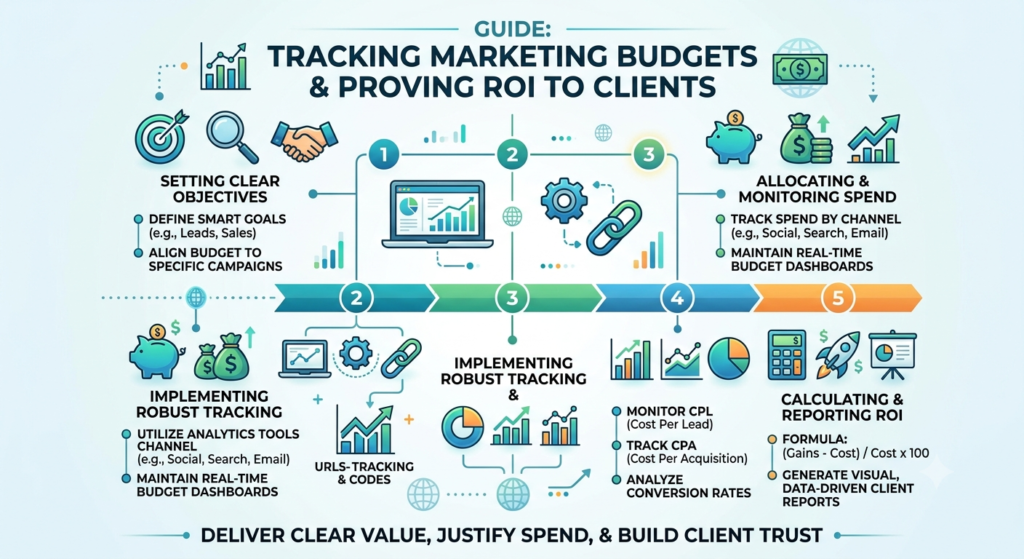
Clients do not just want campaigns. They want proof that their spend is working. A marketer who can clearly show marketing budget allocation spend efficiency and return builds trust faster. They retain clients longer. For freelancers and beginners especially this skill is often what separates a one-time project from a long-term retainer. Marketing budget tracking and Return On Investment reporting are key to building trust with clients.
Core Concepts to Know
Before diving into the process get comfortable with these terms:
- Return On Investment (ROI): ROI is a formula: ROI equals Revenue minus Cost divided by Cost, times 100. It tells you how profit you made relative to what you spent on marketing budgets.
- Return On Ad Spend (ROAS): ROAS is Revenue generated per rupee spent on ads. Unlike ROI it does not subtract cost. It is a ratio of revenue to spend on marketing budgets.
- Customer Acquisition Cost (CAC): CAC is spend divided by the number of customers acquired through marketing budgets.
- Lifetime Value (LTV): LTV is the revenue a customer generates over their relationship with a business, which is affected by marketing budgets.
- Attribution: Attribution is the method used to decide which touchpoint, like an ad or email gets credit for a conversion, which’s important for tracking marketing budgets.
Knowing the difference between ROI and ROAS will save you from a lot of client conversations about marketing budgets.
Step-by-Step: Tracking Marketing Budget to Return On Investment
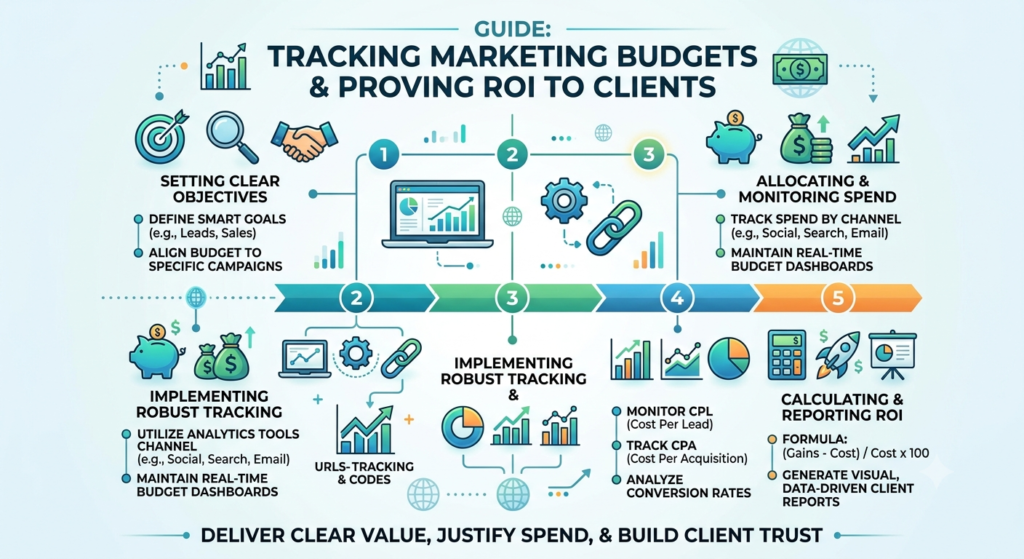
1. Define goals and allocate marketing budget by channel
Start by mapping the clients objectives like leads or sales to channels. Paid search, social, email, influencer, etc. Assign a marketing budget to each based on performance or industry benchmarks.
2. Set up tracking before you spend a rupee on marketing budgets
Use UTM parameters on every campaign link set up conversion events and connect ad platforms to a dashboard like Google Sheets. Tracking set up after launch means lost data you can never recover which is bad for marketing budgets.
3. Collect data and assign costs to marketing budgets
Log spend against each channel and campaign weekly. Even a simple spreadsheet works if updated consistently. Consistency matters more than sophistication at this stage of tracking marketing budgets.
4. Calculate ROAS for marketing budgets
Once revenue data comes in run the formulas. For example if a client spent ₹50,000 on a campaign that generated ₹2,00,000 in revenue ROI equals 300%.
5. Choose the attribution model for marketing budgets
click attribution is simple but often overvalues bottom-funnel channels. Multi-touch attribution gives a picture across the customer journey. Requires more setup, which can be hard for marketing budgets.
6. Build a client report on marketing budgets
Clients rarely care about numbers. They care about outcomes. Structure reports around: what was spent on marketing budgets what it achieved and what happens next. Use charts over tables, which are easier to understand for marketing budgets.
7. Optimize based on insights from marketing budgets
Use ROI and ROAS data to shift marketing budget toward whats working and cut what isn’t. This is where tracking earns its keep. Insight without action is a report nobody reads about marketing budgets.
Tools Worth Using in India for Marketing Budgets
Google Sheets and analytics tools remain the starting point for beginners and freelancers. As marketing budgets grow, tools like Looker Studio or paid dashboards can automate reporting. They cut the time spent building reports manually which’s a real advantage when managing multiple clients and marketing budgets.
Best. Common Pitfalls for Marketing Budgets
- Do: Report on a schedule. Monthly is standard, weekly for spend or fast-moving campaigns with marketing budgets.
- Do: metrics into plain language for non-technical clients so they understand marketing budgets.
- Avoid: Relying on an attribution model without acknowledging its limitations for marketing budgets.
- Avoid: Waiting until reporting day to start tracking. Set it up before launch every time for marketing budgets.
Final Thoughts on Marketing Budgets
Marketing budget tracking and Return On Investment reporting are not tasks. They are how marketers build credibility with clients. Start simple: a clean spreadsheet, consistent tracking and honest reporting will take you further than any tool used inconsistently for marketing budgets. As you grow more comfortable with the numbers, layer, in attribution models and automated dashboards to save time and sharpen your insights on marketing budgets.