
There’s a specific feeling every marketer knows: you post something, expect the usual quiet trickle of likes, and instead watch the numbers do something they’re not supposed to do. Comments pile up. Someone screenshots it into a group chat you’ll never see. By the next morning it’s not your post anymore it belongs to the internet.
It’s tempting to write that off as luck. Sometimes it is. But when you go back and look at campaigns that actually broke through not the ones brands claim went viral, but the ones that genuinely did you start noticing the same fingerprints again and again. Virality has a shape. It’s worth understanding that shape, full-service-social-media-management
What going viral really means
- People throw the word viral around loosely, but underneath it’s a fairly specific mechanism: peer-to-peer spread that compounds on itself. A brand doesn’t pay to put something in front of a million people one person shows it to ten friends, a few of those friends show it to ten more, and the audience grows without anyone spending another dollar on media. That compounding is the whole trick. Marketers call it the amplification effect, and it only kicks in when three things line up at once.
Patterns hiding in plain sight
Think about the campaigns that stuck in your head this past year or two. Duolingo’s owl acting completely unhinged on TikTok. Ocean Spray’s cranberry juice guy skateboarding to Fleetwood Mac. The Stanley cup obsession that somehow turned a water bottle into a status object. Ryanair’s customer service account being weirdly, deliberately rude on X.
None of these were expensive productions.
The part nobody talks about: algorithms need proof first
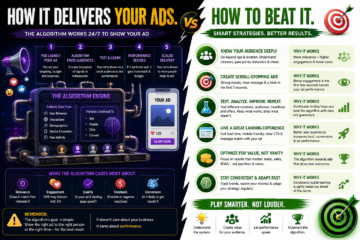
Here’s the piece that trips people up. Nothing goes viral in one big leap platforms test it in small batches first. TikTok, Instagram, and YouTube all watch how a piece of content performs with an initial, modest audience completion rate, comments, saves, shares usually within the first hour or two. If that early signal looks strong, the algorithm hands it to a bigger group and tests again. Fail that first test and the content just. stops, quietly, with no one ever knowing it existed. http://full-service-social-media-management
- And each platform is looking for something slightly different. TikTok cares about whether people watch to the end or rewatch, so the first three seconds carry enormous weight. Instagram leans heavily on saves and shares content people want to come back to later. YouTube Shorts rewards how long someone stays in a session, not just whether they finished one clip. X rewards arguments, basically replies and quote-tweets drive it more than likes ever will.
Getting people from watching to doing something
Here’s where a lot of viral moments quietly fall apart: attention and results are not the same thing. A video can rack up five million views and move the business forward by exactly zero dollars if there’s nothing catching that attention on the way down.
The campaigns that actually convert treat the viral spike as the top of a funnel, not the finish line. That usually means one clear action instead of five competing ones, placed somewhere people will actually see it a bio link, a pinned comment, full-service-social-media-management
Ironically, going viral starts small
The content that ends up looking like it was for everyone almost never started that way. It usually started inside one specific, tightly-knit audience a niche with people who actually talk to each other and share things constantly and spread outward from there. Aim at everyone from day one and you tend to lose the specificity that made the thing shareable in the first place. Virality is really a chain reaction that starts in one small room.
It’s still just a story, underneath everything
Take away the algorithm talk, the funnel diagrams, the platform specifics what’s actually being passed around is a story. Nobody shares a spec sheet. People share things that let them say something about who they are: this is funny, this is my taste, I noticed this before you did. Every viral campaign that’s held up over time has a narrative spine strong enough for people to want to attach themselves to it.
A rough playbook, if you’re trying to build one
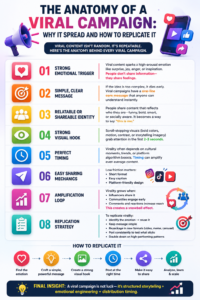
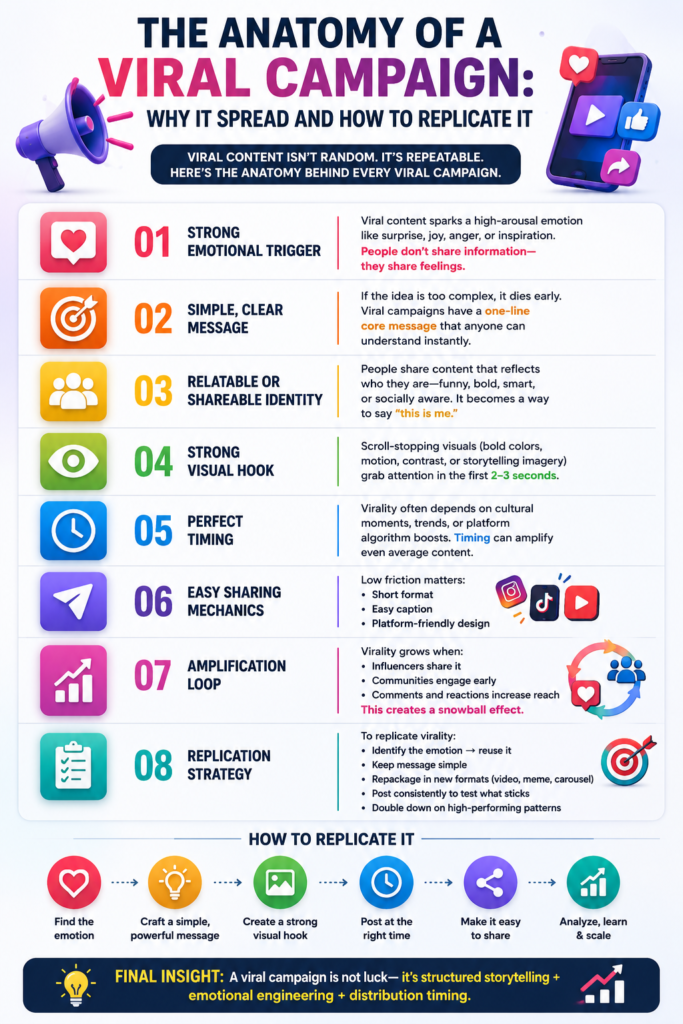
Pick one platform and actually design for how it behaves, rather than adapting something built for somewhere else. Build around a single emotional hook simple enough to explain in one sentence. Seed it with a small, real audience first and let genuine engagement happen before you push it wider. Leave room for people to remix or riff on it instead of locking the format down. Time it to something already happening in culture instead of inventing your own moment. Give it one clear next step, and make sure that next step doesn’t feel like a bait-and-switch. And have your follow-up ready before you need it because if this works, you won’t have time to build it after.
None of this makes virality predictable. But it’s not a coin flip either. The campaigns that keep happening, over and over, to the same kinds of brands are the ones that treated all of this as something you can actually design for not something you wait around and hope for.