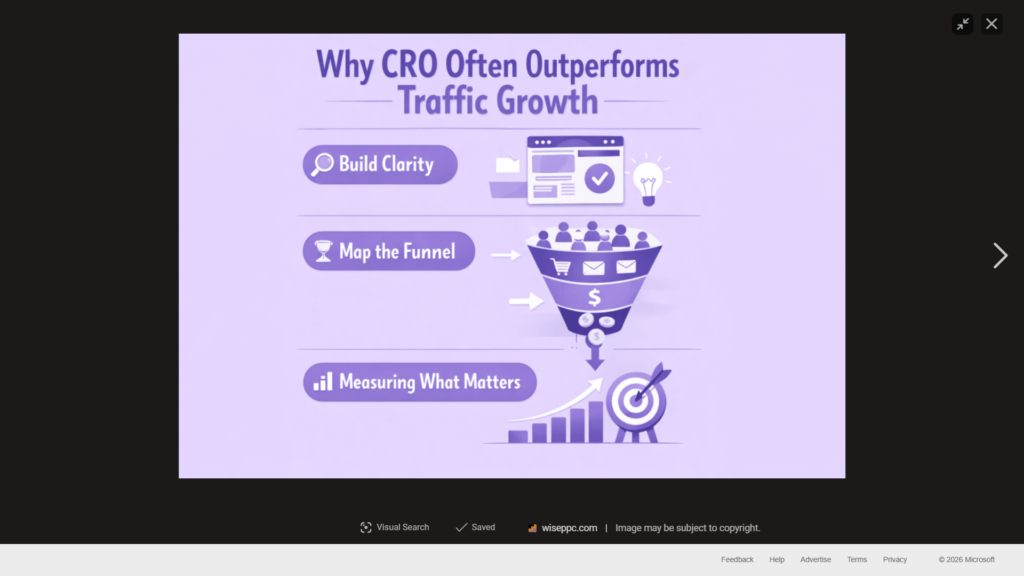

You’ve spent weeks driving traffic to your website. Your analytics show thousands of visitors every month. However, here’s the hard truth: if those visitors aren’t converting, you’re simply burning money. This is exactly where Conversion Rate Optimization (CRO) makes all the difference. It transforms browsers into paying customers and makes every click count.
What Is Conversion Rate Optimization?
At its core, CRO is straightforward. It increases the percentage of website visitors who take a desired action. For example, this could mean making a purchase, filling out a form, or signing up for a newsletter. In other words, conversion rate optimization makes your existing traffic work much harder for your business.
To illustrate, imagine 1,000 people visit your site and 20 make a purchase. Your conversion rate is 2%. However, with a solid CRO strategy, you could improve that to 4%. As a result, you double your revenue without spending a single extra dollar on ads.
Why Traffic Alone Doesn’t Work
Many businesses fall into the same trap. They focus entirely on getting more traffic. Therefore, they spend heavily on Google Ads, Facebook campaigns, and SEO. They assume more visitors automatically means more sales. Unfortunately, the reality is very different.
Traffic quality matters far more than quantity. To put it simply, imagine you own a store. Would you prefer 1,000 people walking past your window, or 100 people who actually walk inside and buy? Moreover, CRO is what turns those window shoppers into real buyers.
Industry data also supports this. The average website conversion rate sits at just 2-3%. E-commerce sites typically see rates around 1-2%, while B2B landing pages can convert at 5-10%. Therefore, the gap between low and high performers is enormous. That’s precisely where CRO creates its biggest impact.
Why CRO Makes Strong Business Sense
Let’s talk about the numbers. Acquiring new customers is expensive. In fact, it costs 5-25 times more to attract a new customer than to improve your existing conversion rate.
For example, suppose you spend $5,000 monthly on ads with a 2% conversion rate. If you improve that rate to just 3%, you gain 50% more customers without increasing your budget. As a result, you get real, sustainable growth. Furthermore, better conversions lead to lower acquisition costs, higher customer lifetime value, and ultimately a much healthier business.
Top CRO Techniques That Actually Work
1. A/B Testing
A/B testing is the foundation of any strong CRO strategy. Essentially, it compares two versions of a page to see which one performs better. You can test headlines, button colors, images, or layouts. Even small changes can boost conversions by 10-30%. Therefore, never underestimate the power of testing.
2. Landing Page Optimization
Your landing page has one clear job — to convert visitors. However, many landing pages fail because they are cluttered and confusing. In contrast, a well-optimized page removes distractions, communicates value clearly, and matches the message to what brought the visitor there. As a result, landing page optimization often delivers some of the quickest wins in CRO.
3. User Experience Optimization
Slow-loading pages kill conversions. Similarly, confusing navigation and poor mobile experiences drive visitors away. User experience optimization removes these obstacles. Consequently, visitors can find what they need quickly and complete actions without frustration.
4. Behavioral Analytics
Tools like heatmaps and session recordings are incredibly valuable. They reveal exactly how users interact with your site. Moreover, this behavioral analytics data shows where people drop off, which helps you guide your funnel optimization with real evidence rather than guesswork.
5. Micro-Conversions
Not every visitor is ready to buy immediately. However, that doesn’t mean they aren’t valuable. Instead of focusing only on final purchases, track smaller actions such as video views, add-to-cart clicks, and time spent on page. These micro-conversions help you understand the full customer journey so you can optimize every single step along the way.
How to Start CRO: Simple Steps to Follow
Step 1: Audit Your Current Numbers
First, review your key CRO metrics. Look at conversion rate, bounce rate, exit pages, and funnel drop-offs. In particular, identify pages that receive high traffic but produce low conversions. These are your biggest opportunities.
Step 2: Form a Hypothesis
Next, use your data to create a testable idea. For example, you might hypothesize: “Shortening our checkout form will reduce cart abandonment because the process becomes easier.” A clear hypothesis makes testing more focused and effective.
Step 3: Set Up Your Test
After that, use reliable A/B testing tools to build your variations. Always test one element at a time. Otherwise, you won’t know which change actually made the difference.
Step 4: Run the Test Properly
Most tests require at least 2-4 weeks and several hundred conversions to produce statistically reliable results. Therefore, be patient. Rushing this step leads to misleading data and poor decisions.
Step 5: Analyze and Apply
Finally, review your results carefully. If your variation wins, roll it out across your site. If it doesn’t, treat it as a learning opportunity and move on to the next test. Remember, CRO is an ongoing process, not a one-time fix.
Key CRO Metrics You Should Always Track
Instead of chasing vanity metrics, focus on what truly matters:
- Conversion rate (primary goal completions)
- Bounce rate and exit rate
- Average session duration
- Pages viewed per visit
- Cart abandonment rate (typically around 70% — a huge opportunity)
- Form completion rate
- Call-to-action click-through rate
Quick Wins vs. Long-Term CRO Strategy
Some improvements deliver fast results. For instance, fixing broken forms, improving page speed, and making call-to-action buttons more visible can show results within weeks. These quick wins build momentum and prove the value of CRO early on.
On the other hand, long-term CRO involves deeper funnel optimization, personalization strategies, and systematic testing programs. These efforts build compounding results over months. Therefore, the smartest approach is to start with quick wins while building toward a long-term strategy simultaneously.
What You Should Do Next
Stop chasing more traffic before optimizing what you already have. Instead, audit your top pages, identify weak spots, and run your first test this week. Even one small improvement can create a meaningful impact on your bottom line.
At Pixicon Digital, we help businesses turn traffic into real revenue through smart conversion rate optimization. In today’s competitive digital landscape, success isn’t about how many people visit your site. Moreover, it’s about how many of those visitors actually take action.
Ready to make your traffic count? Start optimizing today.
https://support.google.com/analytics
https://pixicondigital.com/conversion-rate-optimization