
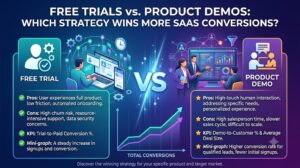
If you’re running a B2B SaaS company, you’ve probably debated this with your co-founder more than once: should new prospects get a self-serve trial, or should every lead go through a live demo first? Free trials vs. product demos isn’t really a question with a universal winner — it’s a question that depends on how complex your product is, how big your deals are, and how much hand-holding your buyers actually need. Let’s get into the real trade-offs, because most of the advice out there picks a side without asking what kind of SaaS company you’re actually running.
What each approach is really optimizing for
A free trial is built for speed and volume. Someone signs up, pokes around, and (ideally) reaches an “aha” moment on their own, with no salesperson in the loop. This works best when your product is intuitive enough that value shows up fast — usually within the first week — without much guidance.
A demo, on the other hand, is built for context. A human walks the prospect through the product and handles objections in real time. That’s slower and pricier per lead, but it tends to convert better once someone shows up, especially for products with more moving parts or bigger price tags.
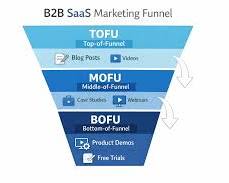
Neither is “better” in the abstract. They’re solving different problems at different points in your funnel — which is exactly why so many growth teams eventually land on a hybrid onboarding approach instead of picking one and sticking with it forever.
The numbers, roughly speaking
Trial activation — meaning someone actually does the thing that shows them value — tends to land somewhere between 30% and 60% of signups, depending heavily on how clear your onboarding is. From there, trial-to-paid conversion commonly sits in the 15–25% range for a lot of B2B SaaS products, though that swings a lot based on your ideal customer profile and product complexity.
Demos tend to post stronger close rates once a prospect attends — often 25–40% — but you’re working with a smaller, more filtered pool who booked time in the first place. It’s not really apples-to-apples. A trial funnel is wide and shallow; a demo funnel is narrow and deep.
One number that matters more than almost anything else here is time-to-first-value. Products that get someone to a real “this is useful” moment within the first seven days consistently see better trial-to-paid numbers than products that take longer to click. If your onboarding flow is the bottleneck, fixing that will usually move the needle more than switching strategies entirely.
When each one actually makes sense
Trials tend to win when your product is simple enough to “get” without explanation, your price point is low enough that buyers don’t need executive sign-off, and your ideal customer is comfortable self-serving through software in general — think SMBs and individual users.
Demos tend to win when your product solves a more complex problem, your deal sizes are big enough to justify a sales conversation, or your buyer is evaluating you alongside a handful of competitors and wants someone to answer specific questions. Enterprise and mid-market deals lean this way almost by default.
The hybrid middle ground
A lot of the more mature SaaS companies aren’t purely trial-led or purely demo-led anymore — they’re running guided trials, where a self-serve signup is paired with an optional live walkthrough offered at the moment someone seems stuck or highly engaged. This tends to lift both activation and conversion compared to either pure approach, because it gives fast-moving users the speed of self-serve while still catching the prospects who need a nudge.
If you’re not sure where to start, a good first move is auditing your current trial activation metrics to see where people are actually dropping off — that tells you whether your real problem is discovery (fix with guidance or a demo option) or friction (fix with better onboarding).
A quick way to decide
Ask yourself:
- Can a new user reach real value within a week without help?
- Is my average deal size big enough to justify a sales conversation?
- Does my buyer typically need to loop in other stakeholders before paying?
- Am I seeing high signups but low activation, or low signups in the first place?
If most answers point to “simple, cheap, self-explanatory” — lean trial-first. If they point to “complex, expensive, multiple stakeholders” — lean demo-first. And if you’re somewhere in between, that’s usually the strongest signal to test a hybrid model rather than force a single path.
The bottom line
The real goal isn’t picking the trendier motion — it’s matching your conversion strategy to how your specific buyers actually make decisions. Track activation, time-to-value, and close rate closely enough, and the data will tell you which lever to pull next.