
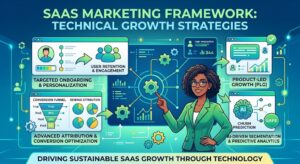
Most SaaS companies don’t have a marketing problem. They have a framework problem. Ads and cold outreach can fill a pipeline, but if nobody sticks around past the trial, none of it matters. That’s the gap a proper SaaS marketing framework is meant to close — one that connects product-led growth, onboarding, and the handful of metrics that actually predict whether a customer sticks or churns.
This guide covers what that looks like in practice: how PLG changes the marketing job, how activation maps to retention, which numbers to watch, and how growth loops compound over time. If you want to work through this with real product data instead of just reading about it, our institute’s SaaS growth module is built around exactly this framework.
What product-led growth means for a SaaS marketing framework
Product-led growth (PLG) puts the product in front of the sales pitch. A user tries the tool, gets value fast, and often invites a teammate before anyone from sales ever reaches out — think Notion, Figma, or Calendly. PLG companies tend to see faster time-to-revenue and a larger share of that revenue coming from existing accounts expanding, rather than new logos alone. The exact lift varies a lot by segment and pricing model, so treat any single stat here as directional, not gospel.
For marketers, PLG means the job shifts from generating leads to shaping the trial itself — the first-run flow, the “aha” moment, the nudge that turns a signup into a paying customer.
Mapping the funnel: AARRR still works, if you use it right
The AARRR framework — acquisition, activation, retention, referral, revenue — gets criticized as outdated, but the stages themselves haven’t changed. What’s changed is where the leverage sits. In a PLG motion, activation is usually the highest-leverage stage: get it wrong, and everything downstream (retention, referral, revenue) suffers no matter how good acquisition is.
This is also where go-to-market (GTM) strategy and product-market fit (PMF) intersect with marketing. A GTM plan built for a product that hasn’t found PMF yet will optimize the wrong funnel stage — usually acquisition, when the real leak is activation.
Activation, retention, and the metrics that actually matter
Higher activation rates are consistently linked to better retention and lower CAC, because you’re not constantly replacing users who churned before ever seeing value. Cohort analysis is the clearest way to see this: compare 30/60/90-day retention across signup cohorts, and you’ll usually find that whichever cohort had the strongest onboarding also holds up best three months later.
A few numbers worth tracking on a regular cadence:
- Activation rate — the share of signups reaching a real first-value moment
- Trial-to-paid conversion — commonly low-to-mid single digits, though this swings hard by vertical and product quality
- CAC payback period and LTV — how long it takes to earn back acquisition spend, and what a customer is worth over time
- Monthly churn — often targeted in the low single digits for enterprise-style products, higher for SMB-focused ones; benchmarks shift with ARR, pricing, and onboarding quality
- Cohort retention curves — whether newer signups are retaining better or worse than older ones
Growth loops: compounding what funnels can’t
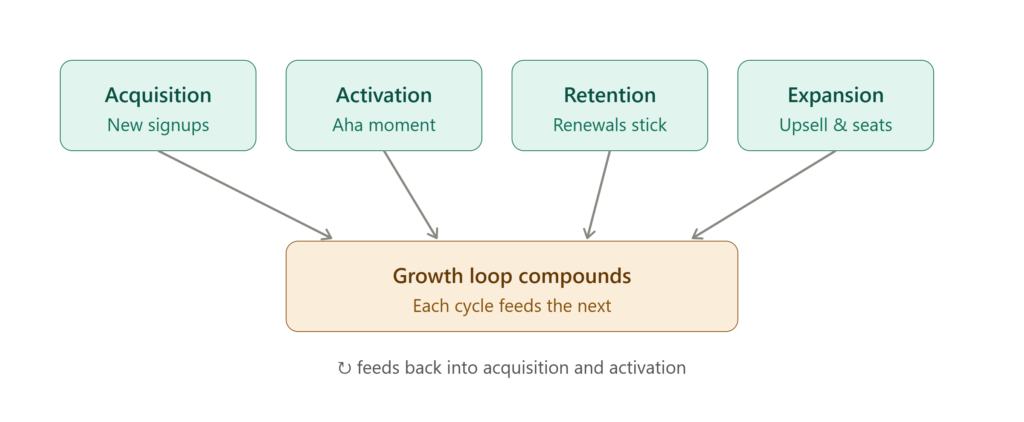
A funnel runs in one direction and eventually runs dry. A growth loop feeds itself — referral loops, content loops, or collaboration loops where inviting a teammate is part of using the product. The output becomes the next input, and growth compounds instead of resetting every campaign cycle.
The catch is that growth loops only work with real discipline. You need a hypothesis, a fast experiment, and a clear metric to know if it worked — a redesigned invite flow, a tweaked onboarding email, a referral incentive test. This is where product analytics earns its keep: without event-level data on where users drop off, you’re guessing at which loop even fits your product.
Turning the framework into practice
Frameworks are easy to read and hard to apply without a real product and real data in front of you. If you want a quick reference, grab the growth frameworks cheat sheet. For a deeper walkthrough with practitioners, join our live webinar and Q&A, or browse case studies from past program cohorts to see how this framework plays out in actual SaaS roles.