
Here’s something most advertisers figure out the way: two nearly identical campaigns, same budget, same offer can produce very different results. One scales well. The other wastes money. Fails.
This guide explains how the algorithm decides who sees your ads what you can control and what smart advertisers do differently.
Why Understanding the Algorithm Matters
Many business owners treat Meta Ads like a game of chance.. There’s a consistent logic to how ads are chosen ranked and shown. Once you understand this logic many campaign problems solve themselves.
It’s not about finding a trick. It’s about understanding the rules of the game.
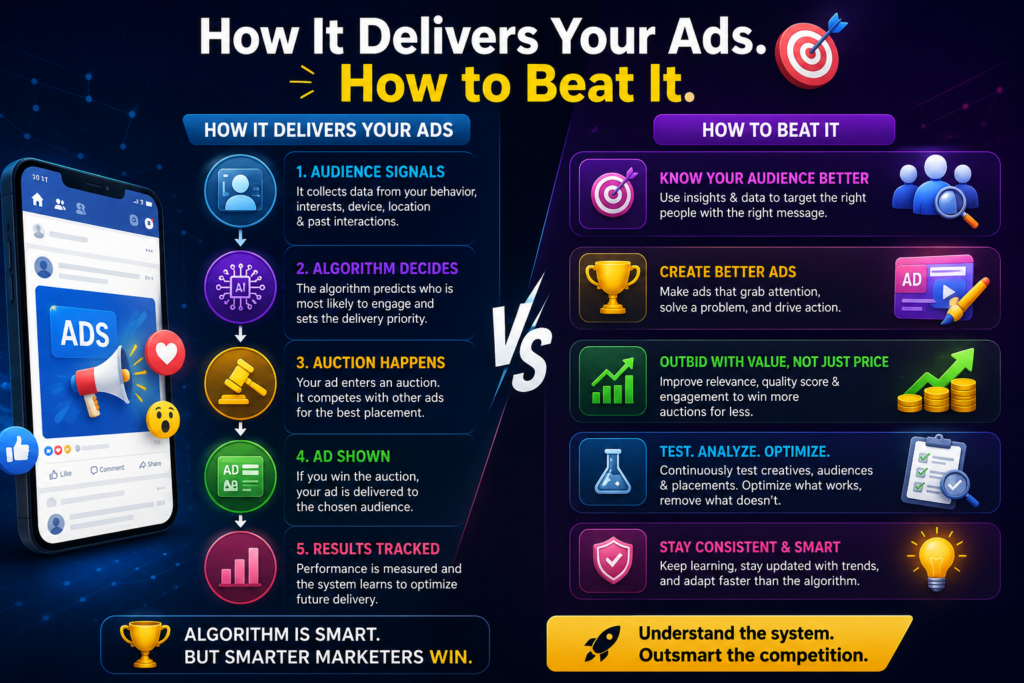
How the Meta Ads Algorithm Works
Every time someone opens Facebook or Instagram an ad auction happens. Your ad competes with every advertiser trying to reach that person.
Metas system considers three things:
* Bid. How much you’re willing to pay for the optimization event.
* Estimated action rates. How likely Meta thinks the person is to take the action.
* Ad quality. Meta scores ads based on user feedback and creative quality.
The algorithm multiplies these factors to get a ” value” score. Better ads can outcompete budgets.
The Learning Phase
When you launch an ad set it enters the learning phase. During this time delivery is unstable. Meta wants to see around 50 optimization events per ad set per week.
The practical takeaway: don’t make changes to your campaign. Every significant change can reset the learning phase.
What iOS 14+ Changed
Since Apples App Tracking Transparency rollout Meta has had a time tracking user behavior. Attribution windows. Conversion data became invisible.
The practical effect: campaigns take longer to optimize. Server-side tracking through Conversion API has become essential.
The Factors You Control
You have leverage over the inputs that decide whether you win the auction:
* quality. Strong hooks and native-feeling formats get rewarded with delivery.
* Relevance and quality signals. Positive engagement helps, while negative feedback hurts.
* Audience signals. Custom audiences and lookalikes give the algorithm a picture.
* Bidding strategy. This shapes how aggressively the system chases your optimization event.
* Budget structure. Campaign Budget. Ad Set Budget Optimization.
Practical Tactics to Beat the Algorithm
It’s discipline applied consistently:
* Test creative like its your job. Run tests on hooks and thumbnails.
* Feed the algorithm clean data. Ensure your Pixel and Conversion API are firing correctly.
* Don’t over-segment your audiences. Fewer broader ad sets usually outperform.
* Watch frequency like a hawk. Refresh creative every 2-4 weeks.
* Scale gradually, not aggressively. Bump budgets 10-20% at a time.
Common Mistakes That Sabotage Performance
* Editing campaigns constantly
* Running the ads for months
* Ignoring frequency data
* Skipping Conversion API setup
* Treating every audience the
The 30-Day Optimization Playbook
Week 1: Audit your pixel and Conversion API setup. Launch a few ad sets. Let them run.
Week 2: Narrow down based on signals. Kill underperforming ads. Introduce new creative.
Week 3: Shift budget toward whats converting. Gradually. Build lookalike audiences.
Week 4: Refresh review cost-per-result trends.
Metrics Worth Watching
Key Metrics to Monitor
- CTR (Click-Through Rate): Shows whether your creative is resonating with the right audience.
- Frequency: Indicates how often people are seeing your ads and whether creative fatigue is starting to set in.
- Cost per Result: Provides a clearer view of your campaign’s efficiency over time.
- Video Completion Rate: Acts as an early indicator of whether your opening hook is capturing attention.
Quick Reference: Diagnosing a Campaign
If something feels off, work through this checklist in order:
Confirm that your Conversion API is working correctly, and verify whether your Meta Pixel is functioning properly on its own.
Check whether your creative and audience are a good match.
Review your bidding strategy and budget structure.
Make sure you’re feeding the algorithm clean, accurate data.
Verify whether your ad set is still in the learning phase.
Check if your frequency has climbed above 3–4 without introducing fresh creatives.
Have you made any changes in the last 3 days that might have reset learning?
Is your audience too small or too big to get data?
Has your ad been running too long without a change?
Nine times out of ten the answer is in one of these six spots.
Final Thoughts
Beating the Meta algorithm is not about beating it. It’s about understanding what its trying to do and giving it information to work with. You need ads, accurate data and to be patient when scaling up. You also need to pay attention to the results of getting upset, about a bad day of spending. That’s most of it.
Want help checking your account or making a plan to test and scale your ads that works for your business? A quick call can help find two or three things that can make a difference. It’s worth taking 20 minutes to talk about your account right now.