
Marketing budgets get scrutinized more than they used to. CFOs want revenue tied to every dollar spent, growth teams have pipeline targets that don’t leave room for guesswork, and CMOs are increasingly asked to justify spend in the same breath as sales and product.
Here’s the thing though: the marketers pulling ahead aren’t necessarily the ones with the biggest budgets. They’re the ones who can show, with real numbers, exactly how a campaign turns ad spend into revenue.
That’s what data-driven performance marketing is really about — swapping guesswork for evidence, and moving from “let’s try this and see” campaigns toward systems that optimize themselves continuously around revenue.
What It Actually Means
At its core, this is about using hard signals — clicks, conversions, attribution data, lifetime value — to plan and continuously adjust paid media. Instead of launching a campaign and checking back at month’s end, teams doing this well build feedback loops where every click and conversion feeds back into decisions about budget, targeting, and creative.
The real shift is in mindset. It’s not “how do we run a good Google Ads campaign” anymore — it’s “given our target CAC and LTV, which channels are actually delivering profitable revenue, and how fast can we shift budget toward them?” That applies whether you’re in search, social, programmatic, or newer territory like connected TV.

How Data Moves ROAS
There are really three levers here. Audience precision — using behavioral and first-party data to stop paying for people who were never going to convert. Bid and budget optimization — machine-learning bidding that reallocates spend in near real time instead of waiting for someone to spot a trend in Monday’s report. And creative testing — letting actual data settle the “which ad looks better” debate instead of opinions in a Slack thread.
Teams that get disciplined about this typically see ROAS improve somewhere in the 15–30% range, paired with CPA drops of roughly 10–25%. The compounding effect is real: you’re not just spending smarter, you’re converting more of what you already spend.
The Metrics Worth Watching
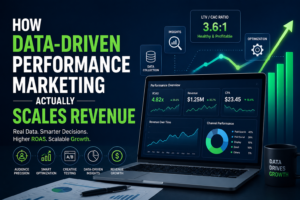
Not every metric deserves your attention. The ones that connect directly to revenue: ROAS, CPA, the LTV/CAC ratio, and marketing-sourced pipeline for longer B2B cycles. Underneath those sit diagnostic metrics — CTR, conversion rate, CPC, incrementality — that explain why the top-line numbers move.
A healthy LTV/CAC ratio, generally 3:1 or better, tells you the engine is sustainable rather than just busy. And here’s a useful gut check: a CFO reviewing marketing ROI cares far more about LTV/CAC than about CTR. That’s exactly why reporting should live in two layers — an executive view built around revenue, and an operational view built around the diagnostics underneath it.
Getting Attribution Right
This is where a lot of programs quietly fall apart. Last-click attribution tends to overvalue bottom-funnel channels like branded search, while undervaluing the upper-funnel channels that actually introduced the customer to your brand.
A more realistic path: get conversion tracking and CRM integration right first, move to data-driven or algorithmic attribution instead of last-click, layer in marketing mix modeling for channels that are hard to track at the individual level, then validate everything with incrementality testing — geo-holdouts or platform-native lift studies that confirm conversions were actually caused by the spend, not just correlated with it.
Get this right and organizations typically see 10–35% improvement in overall media efficiency, mostly because budget stops flowing toward channels that look great on paper but aren’t contributing much unique value.
The Stack
A reasonably modern setup usually includes GA4 and server-side tagging for analytics, an attribution tool like Triple Whale or Northbeam (or an in-house model), native optimization inside platforms like Google Ads and Meta, a CRM for tying spend to closed revenue, and a BI tool like Looker or Tableau so everyone’s looking at the same numbers.
Honestly, the specific tools matter less than most people think. What matters is whether data flows cleanly from the ad click to closed revenue. Fragmented, siloed data is still the biggest thing holding teams back.
Testing at Scale — and How Long Results Take
The difference between data-driven marketing and marketing that just references data occasionally comes down to whether testing is systematic. A program that scales has a testing roadmap prioritized by revenue impact, real sample sizes, and automated budget shifts toward winners rather than waiting on manual review.
Solid testing commonly delivers conversion lifts of 20–50%, though where you land depends on how optimized your baseline already is. As for timeline — most test cycles reach statistical significance within 2–6 weeks, while bigger, program-level shifts in blended ROAS usually show up within 60–90 days, once attribution models stabilize.
Pitfalls Worth Watching For
A few issues trip up even well-resourced teams: chasing CTR or CPC in isolation and losing sight of the revenue metric; ending A/B tests before they reach real significance; comparing attribution numbers from different models and eroding trust in the reporting; and letting paid social, paid search, and lifecycle marketing run off separate dashboards with different definitions of “conversion.”
Avoiding most of this isn’t about sophistication — it’s discipline. Consistent definitions, real sample sizes, one shared source of truth.
Build In-House, or Bring in Help?
Building in-house gives you full control, but realistically takes a 6–12 month runway before the internal engine is fully running. Partnering with a specialized team speeds up time-to-impact since the measurement architecture and testing playbooks already exist — often the faster route to those 15–30% ROAS gains without pulling headcount away from strategy and creative.
Bringing It Together
Data-driven performance marketing isn’t one tactic — it’s clean measurement, cross-channel attribution, disciplined testing, and predictive optimization working together. The teams seeing the strongest results treat this as a continuous system, not a campaign that launches and waits for a monthly report.
Ready to turn your marketing data into revenue? Schedule a free performance marketing audit to see exactly where your current campaigns are leaving revenue on the table, and what a data-driven roadmap could deliver in your first 90 days.