

Executive Summary
Choosing between a social media agency and an in-house manager is one of the most
consequential staffing decisions a marketing leader makes. Agencies typically cost
$4,000–$7,000 per month and bring instant scalability, specialized skills, and process
maturity, but offer less day-to-day control over your brand voice. In-house managers, with average salaries of $60,000–$95,000 per year, give you tighter brand alignment
and institutional knowledge, but require time to hire, train, and scale, and rarely cover
the full skill set (strategy, design, copy, paid media, analytics) on their own. There’s no universal right answer — the best choice depends on your budget, growth
stage, internal bandwidth, and how much creative control you need to retain. This guide
breaks down the costs, tradeoffs, and a practical framework to help you decide, plus a
quick checklist you can use today. Why This Decision Matters
Social media is no longer a nice to have channel it’s often a primary driver of brand
awareness, customer service, and even direct revenue. But it’s also resource-intensive:
consistent posting, community management, paid campaigns, creative production, and
reporting all require ongoing attention. Get the staffing model wrong, and you either
overpay for capacity you don’t use, or you under-resource a channel that’s quietly losing
ground to competitors. The decision isn’t purely financial. It touches brand control, speed to market, internal
politics, and how quickly you need to show results to leadership.
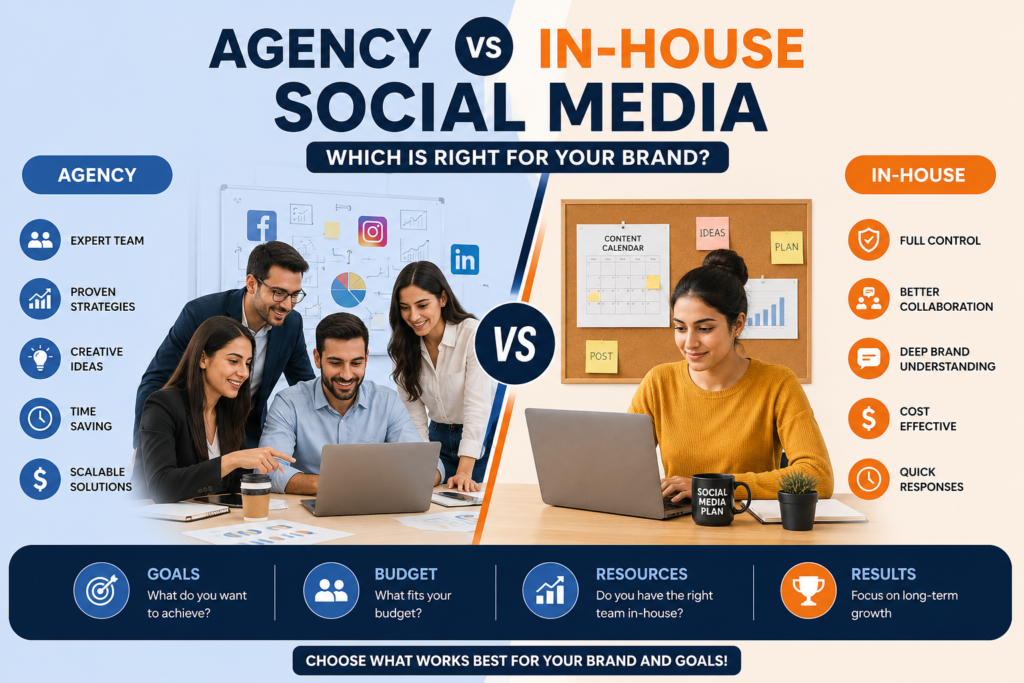
Agency vs. In-House: The Core Tradeoffs
Cost
An in-house social media manager typically costs $60,000–$95,000 per year in base
salary alone, before benefits, software tools, and any additional hires (designers, copywriters, paid media specialists) needed to round out the function. Add benefits and
overhead, and a single in-house hire can easily cost $80,000–$120,000+ fully loaded
and that’s often just one person covering strategy, content, and community management. Agencies typically charge $4,000–$7,000 per month for ongoing social media
management, which translates to roughly $48,000–$84,000 per year. For that fee, you
usually get a small team (strategist, content creator, community manager) rather than a
single individual, plus access to tools and platforms the agency already owns. The math favors agencies for businesses that need broad coverage without building a full
internal team. It favors in-house hiring for businesses that need deep, sustained focus on
a single brand and can amortize the cost across a larger marketing function.
Control and Brand Voice
In-house managers live inside your company. They sit in meetings, absorb informal
context, and build institutional knowledge that’s hard to replicate externally. This
usually translates into tighter brand voice consistency and faster response times for real-
time moments (customer service issues, trending topics, executive announcements). Agencies, by contrast, manage multiple clients simultaneously. They bring process
discipline and outside perspective, but there’s an inherent translation layer — they need
documented brand guidelines, regular check-ins, and approval workflows to stay aligned. This can slow down time-sensitive content unless the relationship is well-structured.
Expertise and Skill Coverage
Social media now spans far more than scheduling posts. A mature program needs
content strategy, copywriting, graphic design, video production, paid social/ROAS
optimization, analytics, and community management. Assembling all of that in-house is
expensive and slow — most companies start with a generalist in-house manager who
does a bit of everything, often well, but without deep specialization in any one area. Agencies are built around specialized roles. A single retainer often gives you access to a
paid media specialist, a designer, and a strategist — expertise that would otherwise
require three or four separate in-house hires. This is one of the clearest advantages of
the agency model for small and midsize teams.
Scalability
This is where the models diverge most sharply. Agencies can scale content volume, add
platforms, or ramp up campaign activity around a launch or seasonal push without a
hiring cycle. In-house teams, by comparison, often hit a ceiling — one or two people can
only produce so much content, and scaling up requires recruiting, onboarding, and
ramp time, typically a 60–90 day process before a new hire is fully productive. If your social media needs are relatively stable and predictable, in-house scalability
constraints matter less. If they’re seasonal, growth-driven, or unpredictable, agency
flexibility becomes a meaningful advantage.
Speed to Results
Most social programs — agency or in-house — need three to six months before you see
meaningful growth and optimization, regardless of staffing model. Agencies sometimes
move faster initially because they bring established workflows and benchmarks from
other clients. In-house teams often move faster on culture-specific content (since they understand the brand instinctively) but slower on technical optimization (since they’re
building paid media and analytics expertise from scratch). Set expectations accordingly: neither model is an overnight fix.
Risk and Continuity
In-house hiring carries turnover risk. Social media manager roles have above-average
turnover compared to other marketing positions, and losing a manager means losing
institutional knowledge and facing another 60–90 day ramp period for a replacement. Agencies offer more continuity — if one team member leaves, the agency typically
backfills without disrupting your account. The tradeoff is less direct oversight: you’re
relying on a third party’s internal processes and account management quality, which
varies significantly between agencies. A Practical Decision Framework
Use these five questions to guide your decision:
- What’s your monthly budget? Under $5,000/month with no existing marketing team:
an agency usually delivers more capability per dollar. Above $80,000/year with room to build a small internal team: in-house may offer better long-term value and control. - How fast do you need to scale? Launching a new product, entering new markets, or
running seasonal campaigns: agencies flex faster. Steady-state, predictable content
needs: in-house works fine.agency-vs-in-house-social-media - How much brand-sensitive, real-time content do you need? Heavy customer service interaction, executive thought leadership, or fast-moving industry commentary: in- house control is valuable. Primarily scheduled content and campaigns: agency oversight is sufficient.
- Do you have internal capacity to manage the relationship? Agencies still require
oversight — someone needs to approve content, share brand context, and review
performance. If you have no one to manage that relationship, an in-house hire might
actually be lower-friction. - What’s your tolerance for specialized skill gaps? If you need paid social, video
production, and analytics from day one, an agency likely covers more ground faster than a single in-house hire can.
Hypothetical Scenarios
Scenario A: Early-stage startup, 10 employees, no marketing team. An agency makes
sense here. The founder doesn’t have time to manage a hire, doesn’t yet have brand
guidelines mature enough to onboard someone internally, and needs broad skill
coverage (strategy, design, copy) without committing to multiple salaries.
Scenario B: Midsize retail brand, $50M revenue, existing marketing department of 8. A hybrid or in-house approach often works better. The brand has enough volume and
brand-specific nuance (customer service, real-time promotions, local market voice) that
an in-house hire embedded in the existing team produces better alignment, supplemented by an agency or freelancers for paid media and design overflow. Scenario C: B2B SaaS company scaling rapidly after a funding round. This is where
hybrid models shine: an in-house social lead who owns strategy and brand voice, paired
with an agency or freelance specialists for paid social and video production — combining
control with scalability. Cost Estimate Snapshot
Model Typical Monthly
Cost Typical Annual Cost Skill Coverage
Model Typical Monthly
Cost Typical Annual Cost Skill Coverage
In-house manager (1
person) $5,000–$7,900 $60,000–$95,000 Generalist; limited
specialization
Agency retainer $4,000–$7,000 $48,000–$84,000 Team-based; multiple
specialties
Hybrid (in-house lead +
agency support) $8,000–$12,000+ $96,000–$144,000+Broadest coverage;
highest cost
Note: figures are general estimates and vary significantly by region, industry, and scope
of work. Use these as a starting point for budgeting conversations, not a quote. Measuring Success in Each Model
Regardless of which model you choose, track the same core metrics: engagement rate, follower growth relative to industry benchmarks, conversion rate from social-driven
traffic (often 2–5% for engaged leads, though this varies widely by industry and channel
mix), and return on ad spend (ROAS) for any paid component. Agencies should provide
regular reporting against agreed KPIs, often tied to contractual SLAs. In-house teams
should be held to the same reporting discipline — it’s easy for internal hires to default to
activity metrics (posts published) rather than outcome metrics (leads, conversions, revenue influence) without external accountability.
Signs It’s Time to Switch Models
Consider moving from in-house to agency if your current hire is consistently behind on
output, you’re struggling to cover paid social or design without additional headcount, or
you need rapid scaling that hiring can’t keep pace with. Consider moving from agency to in-house if you’re paying premium retainer fees for
work that’s become repetitive and template-driven, your brand voice consistently feels
generic or off-brand, or your social program has matured to the point where dedicated, embedded ownership would outperform an external team’s bandwidth-shared attention.
Quick Decision Checklist
Before you commit to either model, confirm the following:
You’ve defined your budget range, including fully loaded costs (salary, benefits, tools) for in-house, or total retainer plus ad spend for agency
You know which skills you need covered (strategy, copy, design, paid media, analytics, community management) and which model covers them without major
gaps
You’ve identified who internally will manage the relationship, whether that’s an in
-house hire’s manager or an agency point of contact
You have realistic expectations for time to results (3–6 months minimum) You’ve decided how you’ll measure success, with specific KPIs tied to business
outcomes, not just activity
You’ve considered a hybrid model if neither pure option fully covers your needs
Final Thoughts
The agency-versus-in-house decision isn’t permanent. Many companies move between
models, or blend them, as they grow. What matters most is matching the staffing
approach to your current budget, brand control needs, and growth trajectory andrevisiting that decision as your business changes. If you’re still weighing the tradeoffs for your specific situation, a structured cost-benefit analysis or a short consulting conversation can help you avoid an expensive misstep. Whether that means drafting an agency RFP, building an internal budget case, or simply pressure-testing your assumptions, getting outside input at this stage often pays for itself many times over.