
As a freshman, you might think you need internships, certifications, or years of experience before applying for remote jobs. However, every freshman can start building a strong portfolio today.
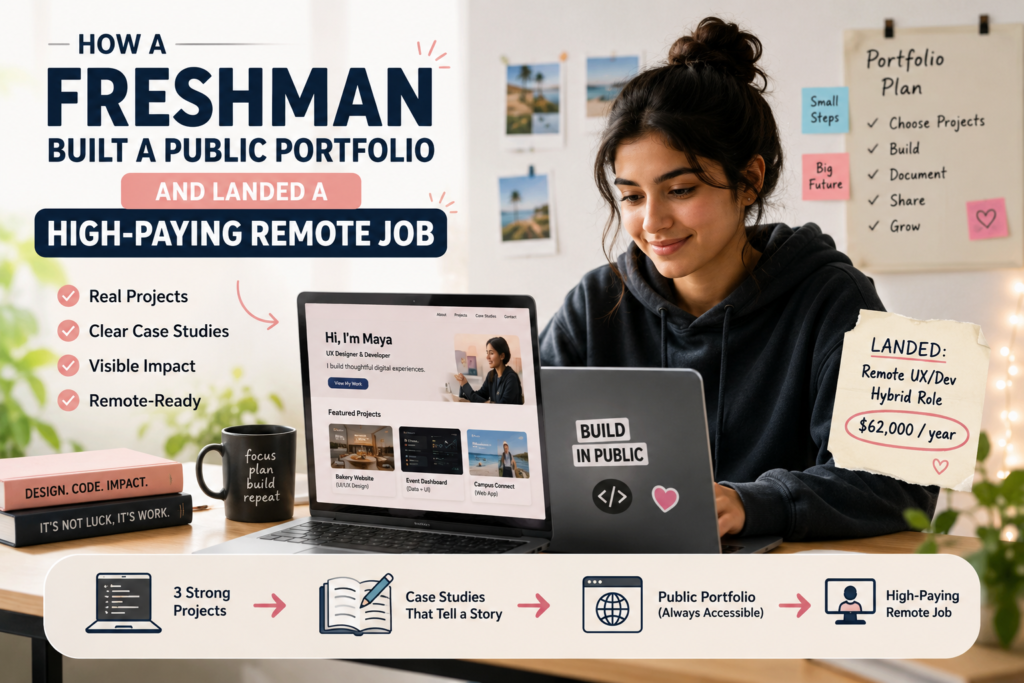
Take Maya, for example. She entered her first year of college with no internship, no professional network, and only a few classroom projects. Even so, she decided to spend eight weeks of her summer building a public portfolio instead of waiting for opportunities to come to her.
The result? By the end of the summer, Maya landed a remote UX and development hybrid role with a salary of $62,000 per year.
Although her story sounds impressive, it isn’t based on luck. Instead, it’s proof that a smart strategy can often matter more than years of experience. By choosing meaningful projects, documenting her work, and presenting everything professionally, she gave recruiters a clear reason to notice her.
Why Every Freshman Needs a Public Portfolio
Your resume tells employers what you’ve learned.
Your portfolio shows them what you can actually do.
In other words, a resume introduces you, while a portfolio backs up your claims with real evidence. Instead of simply listing skills like React, Figma, or Python, you can demonstrate exactly how you used them to solve problems.
Moreover, a portfolio is especially valuable for remote jobs. Employers want people who can work independently, communicate clearly, and complete tasks without constant supervision.
As a result, recruiters often feel more confident interviewing candidates who can show real projects, thoughtful explanations, and measurable outcomes rather than just a list of skills.
What This Freshman Did Differently
1.How This Freshman Focused on Quality Instead of Quantity
Many students believe that adding every college assignment to their portfolio will make them look experienced.
In reality, the opposite is often true.
Rather than uploading everything she had, Maya carefully selected only three projects that best represented her skills:
- A classroom project redesigned with a better user experience
- A website and logo created for a local bakery
- A personal dashboard that organized public event information
Because each project had a clear purpose and outcome, recruiters could quickly understand what she was capable of doing.
2. She Told the Story Behind Every Project
A screenshot might look nice, but it rarely tells the full story.
That’s why Maya wrote a case study for every project.
Each one answered four simple questions:
- What problem was she solving?
- What was her role?
- How did she solve it?
- What happened after the solution?
For example, instead of writing, “I designed a bakery website,” she explained that the redesign increased online order clicks by 40% during the first month.
That single statistic made her project much more believable and memorable.
3. She Made Everything Easy to Find
Recruiters usually spend only a few minutes reviewing each application.
Because of that, Maya kept everything simple and organized.
Her code lived on GitHub, complete with clear README files. Meanwhile, her design work was displayed on a clean portfolio website. Every platform linked back to one central homepage, making it easy for recruiters to explore her work without searching through multiple websites.
The easier you make the hiring process, the more likely recruiters are to stay interested.
4. She Proved She Was Ready for Remote Work
Technical skills are important.
However, communication skills matter just as much when you’re working remotely.
Knowing this, Maya included screenshots of asynchronous project updates, a short video walkthrough explaining one of her projects, and a brief section describing how she communicates while collaborating with others.
These details might seem small. Nevertheless, they helped employers imagine what it would be like to work with her every day.
As a result, her portfolio demonstrated both technical ability and professionalism.
A Simple Portfolio Structure Any Freshman Can Follow
Thankfully, you don’t need a complicated website to impress recruiters.
Instead, keep your portfolio simple by including these five sections:
- About – Introduce yourself and explain what you’re passionate about.
- Projects – Showcase three to five projects with a short outcome for each.
- Case Studies – Describe the challenge, your process, the result, and your key learning.
- Skills – Group your technical, design, and communication skills together.
- Resume & Contact – Include a downloadable resume and an easy way for recruiters to contact you.
This simple structure is clean, easy to navigate, and much more effective than an overloaded website.
A Practical 30-Day Plan
Day 1
First, choose your three strongest projects.
Next, write one sentence describing the main outcome of each project.
Week 1
After that, create detailed case studies for two projects.
Then, build a simple portfolio website or publish your work using GitHub Pages.
Finally, upload your resume and make sure your contact information is easy to find.
By the End of the Month
Finish writing your third case study.
Then, ask a professor, mentor, or client for a short testimonial.
Meanwhile, start sharing your progress on LinkedIn once every week. Over time, those updates can help more recruiters discover your work.
Remember, consistency usually produces better results than chasing perfection.
Common Mistakes to Avoid
Even a strong portfolio can lose its impact because of a few avoidable mistakes.
Try to avoid the following:
- Listing programming languages without showing how you used them
- Uploading screenshots without adding context
- Leaving unfinished pages marked “Coming Soon”
- Including broken or outdated links
- Ignoring communication and collaboration when applying for remote jobs
Instead, focus on showing evidence of your work. After all, recruiters are interested in results, not just claims.
How Many Projects Are Enough For Freshman?
Many freshmen ask the same question:
“How many projects should I include in my portfolio?”
Fortunately, the answer is simple.
Three well-documented projects with clear outcomes are usually more valuable than ten unfinished or poorly explained ones.
Since recruiters often spend only a few minutes reviewing applications, depth matters much more than quantity.
Whenever possible, highlight measurable improvements such as:
- Faster page load times
- Higher user engagement
- Hours saved through automation
- Positive client or user feedback
Numbers make your work easier to understand. More importantly, they make your achievements easier to remember.
Platforms Worth Using
Fortunately, creating a professional portfolio doesn’t require expensive tools.
You can start with free platforms like:
- GitHub for hosting code and writing project documentation
- A personal portfolio website to bring everything together
- Behance or Dribbble for design-focused projects
- A one-page PDF resume that matches the story told throughout your portfolio
Rather than trying to be active everywhere, focus on keeping your best work organized in one place.
That way, recruiters can find what they need in just a few clicks.
Final Thoughts
Maya didn’t wait until graduation to build experience.
Instead, she made the most of the projects she already had. She improved them, documented her process, and shared her work publicly.
As a result, recruiters saw much more than classroom assignments. They saw someone who could solve problems, communicate clearly, and deliver meaningful results.
If you’re wondering whether you’re experienced enough, remember this:
You don’t need years of professional experience to build an impressive portfolio.
You simply need a few strong projects, thoughtful explanations, and the confidence to share your work with the world.
So, start with one project today. Then keep building from there.
Your next opportunity could begin with a portfolio that tells your story better than any resume ever could.