
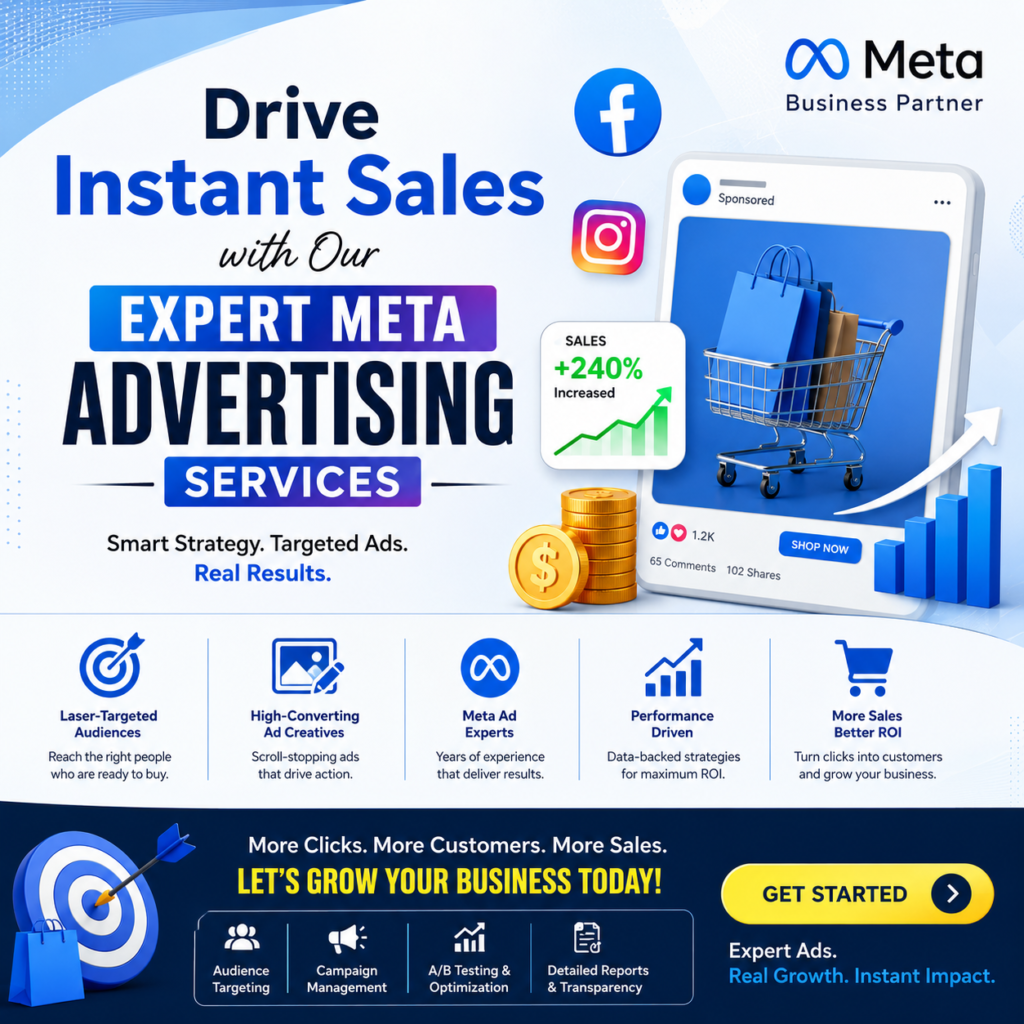
Running an ecommerce store or a service business takes real work, and you don’t have months to wait for advertising to kick in. You need sales this week, this month, and the month after that. That’s exactly what a well-run Meta advertising campaign delivers.
Why Meta Ads Convert Faster Than Most Channels
Facebook and Instagram remain two of the most powerful platforms for turning strangers into paying customers. However, that only happens when a campaign is built with precision. A messy account burns through budget and shows nothing for it. A tight one, run by people who understand Meta Ads strategy inside and out, can generate revenue within days of going live.
This guide walks through how Facebook Ads management and Instagram Ads optimization produce fast, measurable results, and how you can borrow the same playbook for your own business.
The Meta advertising platform gives advertisers something most other channels can’t: pinpoint targeting combined with an audience that’s already scrolling with intent to buy. Ecommerce advertisers commonly report Meta Ads returning 3x–7x on ad spend, and where you land in that range depends on your product category, your offer, and how well the account is managed.
What Makes Meta So Effective for Conversion-Focused Advertising
A few factors set Meta apart:
- Audience precision. Layered targeting, lookalikes, and interest signals let you reach people who are statistically likely to buy, not just people who might glance at an ad and scroll past.
- Retargeting. Warm audiences — site visitors, cart-abandoners, engaged followers — convert at far higher rates than cold traffic, since the intent is already there.
- Catalog sales. For ecommerce brands, dynamic product ads pull straight from your catalog and show shoppers the exact items they were just browsing. This consistently beats generic awareness creative.
Together, these three elements turn Meta from a brand-awareness tool into a genuine sales engine.
DIY vs. Expert-Managed Campaigns
Plenty of business owners start out running their own ads, and that’s a fine place to begin. Still, there’s a measurable line between a campaign that just spends money and one that makes money.
DIY campaigns tend to fall into familiar traps:
- One broad audience and a single piece of creative running for far too long
- No proper Meta Pixel setup
- Performance checked once a week, if that
- Zero retargeting layer separating warm leads from cold strangers
Expert-managed accounts look different. Structured A/B testing runs across creative, copy, and audiences simultaneously. A clear funnel — cold, warm, hot — carries different messaging at each stage. Budget shifts daily, sometimes hourly, based on real performance data, and creative gets refreshed before it goes stale, not after costs have already crept up.
None of this is glamorous. It isn’t one trick — it’s the compounding effect of small, consistent adjustments. That’s really what separates a 2x return on ad spend account from a 6x one.
Quick-Win Examples
- An ecommerce apparel brand: once the Meta Pixel setup was fixed and the catalog reconnected, dynamic retargeting ads went live to cart-abandoners within 48 hours. Two weeks in, retargeting ROAS hit 5.8x.
- A local home renovation company: a conversion-focused lead campaign paired with instant-form ads generated leads within 72 hours of launch. Cost-per-lead dropped 42% within the month, largely from aggressive A/B testing on copy and creative angles.
- A D2C skincare brand: a structured 90-day plan combining dynamic creative ads with a tiered retargeting sequence grew monthly ad revenue by 63%, while cost per acquisition actually dropped thanks to weekly bid and budget tweaks.
Different industries, different budgets — yet the same pattern shows up every time: solid tracking, layered audiences, and constant, unglamorous optimization. Not one lucky ad.
The Instant-Sales Setup Checklist
Before a campaign can perform, the foundation needs to be solid. Here’s what we confirm before a single dollar gets spent:
- Meta Pixel setup and verification — firing on every key page, not just the homepage
- Event mapping — Purchase, Add to Cart, Initiate Checkout, and Lead events all configured to match real site activity
- Catalog connection — product feed uploaded and synced properly for catalog sales
- Conversions API — server-side tracking running alongside the browser pixel as a backup
- Audience structure — custom audiences and lookalikes already built and ready to go
- Creative library — at least 3–5 ad variations, not just one hero ad you’re hoping performs
- Budget and bidding strategy — set up around real goals, whether that’s sales volume or efficiency
Skipping even one of these is usually the reason an account underperforms. It’s rarely a single mistake — it’s small gaps adding up.
5 Ad Formats That Actually Drive Purchases
- Dynamic Creative Ads — Meta automatically tests combinations of images, headlines, and copy to find the best-performing pairing
- UGC-style video — a little rough around the edges, shot on a phone, feels like a customer or founder talking, and builds trust faster than a polished studio ad
- Carousel product ads — great for showing off multiple products or use cases from your catalog in one ad unit
- Testimonial or social proof ads — real reviews and real results, shown directly in the creative
- Offer-led static ads — clear, benefit-first copy paired with a strong time-bound offer
Strong creative, paired with disciplined budget management, is what turns impressions into income.
The 30/60/90-Day Optimization Plan
- Days 1–30: Foundation and Testing. Multiple creative and audience combinations go live at once. The goal isn’t perfection — it’s data. A/B testing reveals what’s actually working, and underperformers get killed fast.
- Days 31–60: Scaling What Works. Budget shifts toward the ad sets that proved themselves in month one. Retargeting sequences expand, lookalikes get built from purchaser data, and creative gets refreshed before fatigue sets in.
- Days 61–90: Growth. Advanced retargeting segments come into play, bidding gets refined further, and new offers or creative angles get tested to keep momentum going. Most accounts see meaningfully better cost efficiency here compared to where they started.
This phased approach is intentional. Campaigns built this way tend to deliver both the early wins everyone wants and the kind of scalable growth that doesn’t fizzle out after three weeks.
How We Measure Success and Adjust in Real Time
Nobody worth their salt waits for a weekly report to make a call. Cost-per-result, return on ad spend, and frequency get checked daily, sometimes more often. Underperforming ads get paused within 24–48 hours, while winners get more budget almost immediately. It’s a simple loop: check, adjust, reallocate, repeat — and that loop is what lets performance compound instead of flatlining after the first good week.
Ready to Build Your Meta Ads Plan?
Whether you run a Shopify store, a WooCommerce brand, a local service business, or you’re a coach trying to fill your calendar, the fundamentals stay the same: solid tracking, sharp creative, smart audiences, and someone actually paying attention every day.
Want a Meta Ads audit or a quick strategy call? We’ll review your account, flag the wins, and map out a 30/60/90-day plan built around your actual goals.
👉 Schedule your diagnostic call today and see how fast Meta Ads can start driving sales for your business.