
Running a small business means every dollar has to earn its place. That’s exactly why “affordable” and “scalable” shouldn’t be treated as opposites when it comes to marketing. The right digital marketing package lets you start small, prove what works, and grow your investment only as your revenue grows — no oversized retainers, no long-term guesswork.
This guide breaks down what makes a marketing package truly budget-friendly, how to think about pricing tiers, and how to tell if a package will actually scale with you instead of locking you into something you’ll outgrow in three months.
Why Small Businesses Need a Different Marketing Model
Most small businesses invest in some form of digital marketing to reach local customers, and for good reason: it’s often the only way to compete with bigger players on visibility rather than budget. Businesses that adopt digital channels tend to see stronger engagement and lead generation than those relying solely on offline tactics like flyers or local print ads.
But there’s a catch. Agencies built for enterprise clients often price and structure their services around big budgets and big teams — quarterly strategy offsites, dedicated account teams, minimum spends that don’t make sense for a five-person shop. Small businesses need something different: a package that assumes a lean budget and a lean team from day one, and that’s built to expand only when the business is ready.
What Makes a Package Actually “Affordable”
Affordability isn’t just a low sticker price — it’s about aligning cost with realistic outcomes. A genuinely affordable package usually has a few things in common:
- Transparent, flat-fee pricing. No hidden hourly overages or vague “custom quote” pricing that changes every month.
- Bundled essentials. Core services — content, social posting, basic SEO, email — grouped together rather than sold piecemeal at a markup.
- No long-term lock-in. Month-to-month or short-term commitments so you’re not stuck paying for a strategy that isn’t working.
- Right-sized deliverables. A package built for a business with 500 email subscribers looks different from one built for a business with 50,000 — the deliverables should match your actual scale, not a one-size-fits-all template.
The goal is a package where the cost reflects the size of the business it’s serving, not the size of the agency selling it.
The Case for Tiered, Scalable Packages
Scalability means the package can grow — or shrink — with you, without forcing you to rebuild your entire marketing plan from scratch. A tiered structure is the clearest way to deliver this.
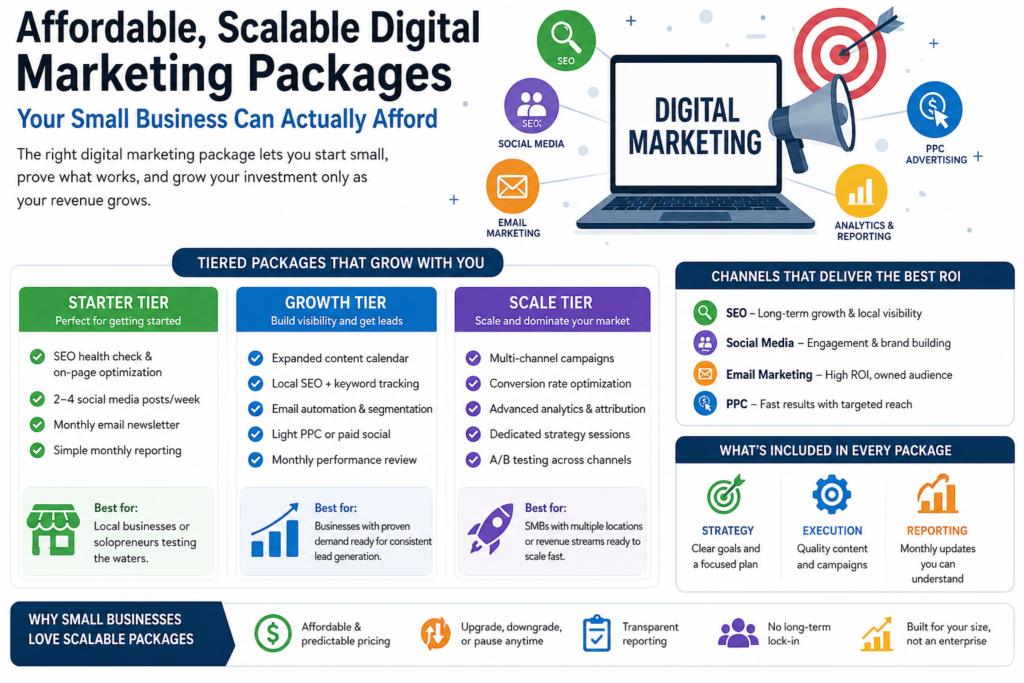
Starter Tier
Designed for businesses just getting serious about digital marketing. Typically includes:
- A basic website/SEO health check and on-page optimization
- 2–4 social media posts per week on one or two platforms
- A monthly email newsletter
- Simple monthly reporting (traffic, followers, opens/clicks)
Best for: a local service business or solo shop testing the waters, with a limited but consistent monthly budget.
Growth Tier
Adds strategy and consistency on top of the basics:
- Expanded content calendar (blog posts, more frequent social)
- Local SEO plus targeted keyword tracking
- Email segmentation and automated sequences (welcome series, abandoned cart, etc.)
- Light paid social or PPC management
- Monthly performance review with recommendations
Best for: a business with proven demand that’s ready to invest in consistent lead generation rather than one-off pushes.
Scale Tier
Built for businesses ready to compound their growth:
- Multi-channel campaigns (SEO + social + email + paid working together)
- Conversion rate optimization on landing pages
- Advanced analytics and attribution reporting
- Dedicated strategy sessions and quarterly planning
- A/B testing across channels
Best for: an SMB with multiple revenue streams or locations that needs marketing to run like a coordinated system, not a set of separate tactics.
The key feature across all three tiers isn’t just what’s included — it’s the ability to move between them. A well-designed package lets you pause, upgrade, or downgrade as your revenue and needs shift, whether that’s scaling up before a seasonal rush or dialing back during a slow quarter.
Which Channels Give SMBs the Best Return
Not every channel deserves equal budget. For most small businesses, a few channels consistently punch above their weight:
- SEO — compounds over time and keeps working long after the initial investment, especially for local search visibility.
- Social media — low-cost content distribution and direct engagement with your existing customer base.
- Email marketing — one of the most cost-effective channels available, since you already own the audience and aren’t paying per impression.
- PPC — useful in smaller, targeted doses for immediate visibility, but best layered on top of organic channels rather than relied on alone.
SEO, social, and email are generally considered the most cost-effective channels for SMBs when properly scaled, which is why most affordable packages lead with these three before layering in paid media.
What Should Be Included in a Scalable Package
Regardless of tier, a package worth paying for should include three components:
- Strategy — even a lightweight one. A single page outlining goals, target audience, and priority channels keeps execution focused.
- Execution — the actual content, campaigns, and posting/sending cadence.
- Reporting — regular, plain-language updates on what happened and what it means, not just raw numbers.
Packages with clear milestones and built-in reporting tend to earn more buyer confidence, simply because the business owner can see progress instead of taking it on faith.
A Mini Scenario: How This Plays Out in Practice
Consider a hypothetical local bakery owner, Maria. She starts on a Starter package: a cleaned-up Google Business Profile, weekly social posts, and a monthly newsletter. Within a few months, foot traffic and online orders tick up enough that she upgrades to Growth — adding email automation for repeat customers and a small local PPC budget around holidays. A year later, with two locations open, she moves to Scale, where reporting shifts from “did people open the email” to “which channel is actually driving repeat visits at each location.”
Maria never had to switch agencies or start over. The package structure did the growing for her.
How Long Before You See Results
Timelines vary by channel. Paid social and PPC can show early traffic within weeks, but qualified leads and conversions usually take longer to stabilize. SEO is the slowest to start (often 3–6 months for meaningful movement) but the most durable over time. Email marketing tends to show measurable engagement fastest, since you’re working with an audience that already knows you.
Because of this, businesses that commit to a recurring monthly package — rather than one-off campaigns — tend to see more consistent results. Marketing compounds; stop-start campaigns don’t give channels like SEO and email enough runway to build momentum.
How to Measure ROI on a Marketing Package
ROI isn’t just “did I make more money this month.” For a small business, a useful ROI framework looks at:
- Cost per lead relative to your average customer value
- Channel-level conversion rates, not just total traffic
- Retention and repeat purchase rate among marketed customers vs. non-marketed
- Time-to-payback — how many months of the package cost it takes for the resulting revenue to cover it
A package with transparent reporting should make these numbers easy to pull each month, rather than requiring you to reconstruct them yourself.
A Simple Framework to Evaluate Any Package
Before signing up for any digital marketing package, run it through these questions:
- Does the pricing scale with my business size, or is it a flat enterprise-style fee?
- Can I move up or down a tier without penalty?
- Are strategy, execution, and reporting all included — or just execution?
- Which channels are prioritized, and do they match where my customers actually are?
- What will I be shown each month to prove it’s working?
- Is there a minimum commitment, and does it match my comfort level?
If a package can’t answer these clearly, it’s likely built for someone else’s business, not yours.
Bottom Line
Affordable doesn’t have to mean bare-bones, and scalable doesn’t have to mean expensive. The best digital marketing packages for small businesses are the ones built around how SMBs actually operate — tight budgets, evolving needs, and a preference for proof over promises. Start with a tier that matches where you are today, keep an eye on the reporting, and let your own growth decide when it’s time to move up.