

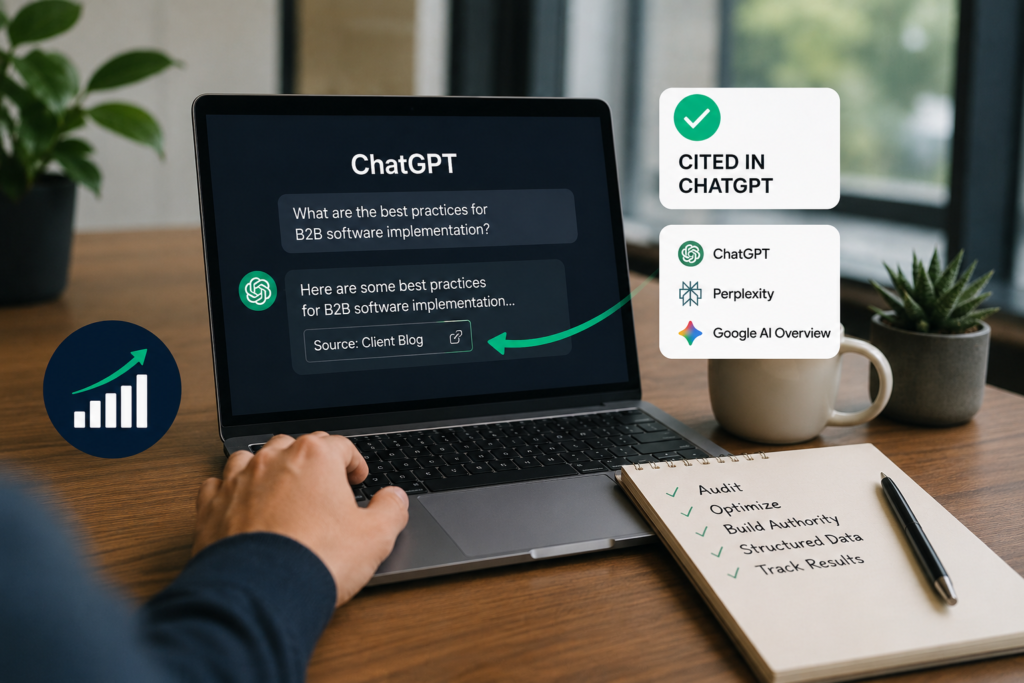
A client came to us with a familiar problem: solid Google rankings, steady organic traffic, but zero visibility whenever their industry came up in ChatGPT or Perplexity answers. Getting an actual ChatGPT citation became the clear goal, and within 60 days of applying a focused GEO strategy, their content started showing up as a cited source in AI-generated answers for several of their target topics. Here’s exactly what we did.
The Starting Point For ChatGPT Citation
The client is a sized company that makes software for other businesses. This company is usually at the top of Google when people search for words.
When we tried searching for those same words in ChatGPT and Perplexity the clients company name did not show up. Instead other companies that are not as high up on Google were being mentioned.
This was a problem, for the client because people who are looking for information and ask AI tools questions before going to a website could not find them.
The client was missing out on being seen by the kind of people who are looking for information and might want to buy something from them.
Step 1: Auditing Content for Better ChatGPT Citation Opportunities
We started by reviewing their top-performing blog posts through the lens of how an AI model would read them.
Most of the content buried its actual answers under long introductions and marketing language before getting to the point exactly the kind of structure AI models tend to skip over when picking what to cite.
Step 2: Restructuring for Clear, Citable Answers
We rewrote key pages so the direct answer appeared within the first two sentences of each section, followed by supporting detail and data. Vague claims like “many companies see improved results” were replaced with specific numbers and sourced statistics the kind of concrete, quotable statements AI models are more likely to lift directly.
Step 3: Strengthening Source Authority
We added original data points, named case examples, and clearer citations throughout the content.
AI models tend to favor sources that already read as credible and well-supported, so this step mattered as much as the writing itself.
Step 4: Structured Data Implementation
We implemented schema markup across the updated pages, making the content’s structure explicit for crawlers including the ones AI search tools rely on to parse and index information.
Step 5: Tracking AI Citation Performance
We ran weekly test queries across ChatGPT, Perplexity, and Google AI Overviews for the client’s priority topics, logging whenever their brand was mentioned or cited, and refining underperforming pages along the way.
ChatGPT Citation Results After 60 Days
- The client’s content was cited as a source in ChatGPT answers for 6 of their 10 priority topics
- Perplexity began surfacing their brand name in 4 additional topic areas
- Inbound leads mentioning “I saw this mentioned by ChatGPT” started appearing in sales conversations within the first month.
For more on how this case fits into the bigger picture, our guide comparing SEO vs GEO explains why these results required a different approach than standard SEO alone.
What This Case Study Shows
Ranking well on Google doesn’t automatically translate to AI search visibility the two require overlapping but distinct strategies. For readers curious about how large language models select and weight sources more generally, Google’s own documentation on how AI Overviews work is a useful technical reference.
If your brand ranks well but stays invisible in AI answers, our GEO optimization services are built to close exactly that gap.