
Note: This case study is an illustrative composite built from common hyper-local marketing patterns and publicly reported industry benchmarks. Names and figures are representative examples, not a specific verified business.
Executive Summary
When Whisk & Crumb, a 12-seat neighborhood bakery in a mid-sized suburb, hit a wall on foot traffic in early 2025, the owners didn’t reach for a bigger ad budget — they reached for a smaller radius. Over eight months, a hyper-local marketing overhaul took the bakery from roughly 40 daily online/phone orders to more than 160, a 300% increase, without a single dollar spent on regional or national advertising.http://How to Optimize Your Google Business Profile.”
The strategy centered on five moves: an overhauled Google Business Profile, geofenced social ads within a 3-mile radius, a neighborhood loyalty program, hyperlocal content tied to community events, and cross-promotional partnerships with nearby businesses. This article breaks down exactly what was done, in what order, at what cost, and with what measurable return — plus a checklist you can adapt for your own bakery, café, or home-baking business.A well-optimized Google Business Profile is essential. Read our guide on How to Optimize Your Google Business Profile.”
Background and the Challenge
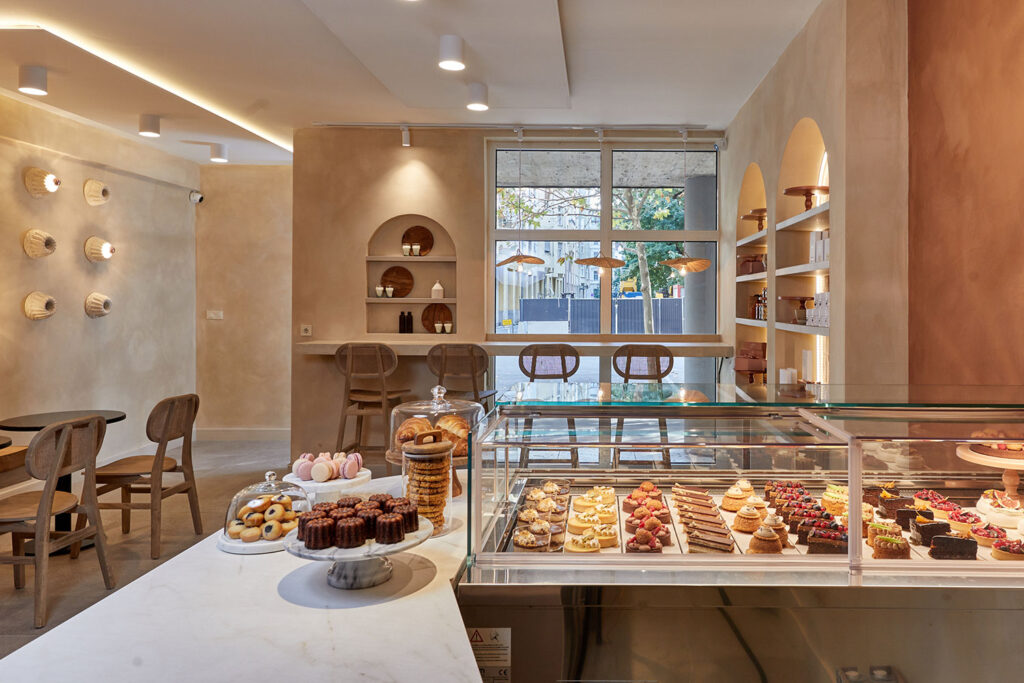
Whisk & Crumb opened with a loyal but shallow customer base — mostly walk-ins from a single street corner. Its owners had tried the standard small-business marketing playbook: a Facebook page, occasional boosted posts, a few dollars spent on generic “bakery” keywords. Results were flat. Average daily orders (in-store plus phone/online) hovered around 40, and repeat-customer rate sat below 20%.
The core problem wasn’t demand — it was discovery. Potential customers within walking or short-driving distance simply didn’t know the bakery existed, or found competitors first when searching “bakery near me.” Broad-audience ads were expensive per click and mostly reached people too far away to ever walk in. The bakery needed a strategy built around proximity, not reach.
The starting numbers
| Metric | Baseline (Month 0) |
|---|---|
| Average daily orders | 40 |
| Monthly revenue | ~$14,000 |
| Repeat customer rate | 18% |
| Google Business Profile views/month | 900 |
| Ad spend/month | $150 (broad targeting) |
| Cost per acquired customer | $11.20 |
The Hyper-Local Marketing Framework
Hyper-local marketing means narrowing your marketing radius — often to a 1–5 mile zone — and making every message, offer, and channel choice specific to the people who live and work there. For a bakery, that radius is usually the maximum distance someone will drive or walk for a fresh croissant on a weekday morning.
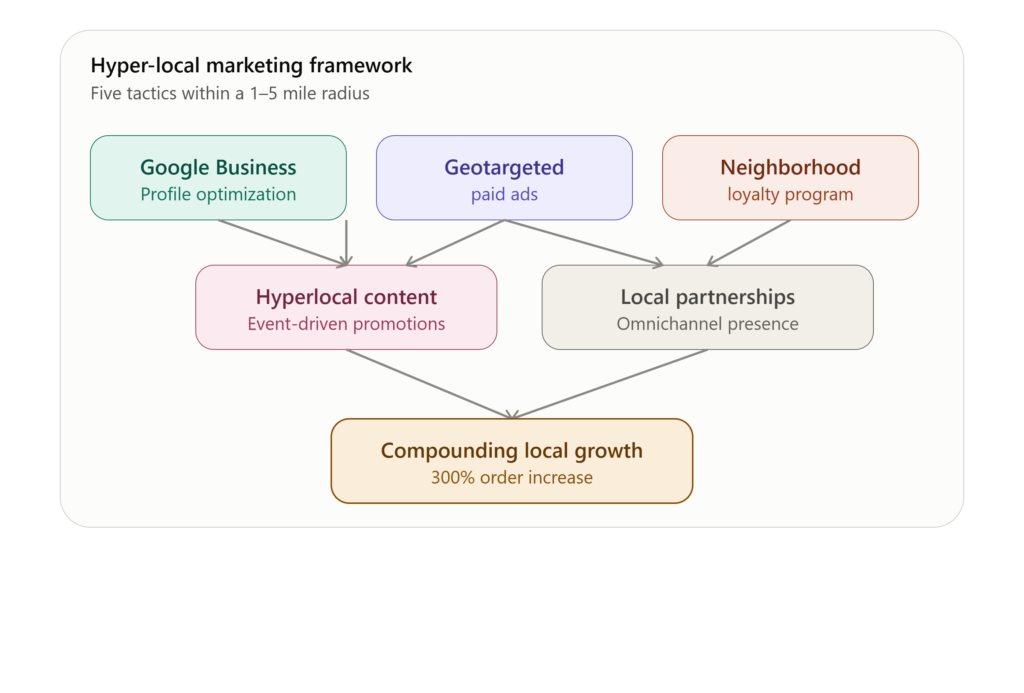
Tactic 1: Google Business Profile Overhaul (Weeks 1–2)
Actions taken:
- Claimed and fully verified the listing, filling every field (hours, attributes, service area, products).
- Added 40+ high-quality photos: interior, staff, seasonal items, and the storefront from the street view a walker would actually see.
- Enabled messaging and Q&A, pre-populating common questions (“Do you take custom cake orders?”).
- Posted weekly Google Posts tied to daily specials and local events.
- Actively requested reviews from every satisfied in-store customer via a printed QR code at checkout.
Why it works: Local search is where hyper-local demand surfaces first. Businesses that fully optimize their Google Business Profile tend to see meaningfully higher foot traffic and call volume than incomplete listings, since the profile is often the deciding factor between “closest three” search results.
Result after 60 days: Profile views rose from 900/month to 3,400/month; direction requests (“get directions”) tripled.
Tactic 2: Geotargeted Paid Ads (Weeks 2–6)
Actions taken:
- Set up Meta and Google ads with a hard geofence of 3 miles from the storefront, refined further to exclude non-residential zones (industrial parks, highways).
- Used dayparting to run ads only 6–10am and 2–5pm, matching real buying windows for pastries and afternoon treats.
- Built creative around hyper-specific, recognizable local cues: the name of the neighborhood, a nearby park, a local school — not generic “fresh bakery” stock imagery.
- Tested two offers: “$5 off your first order” vs. “Free coffee with any pastry” — the coffee offer outperformed by driving more repeat visits per redemption.
Why it works: When ad radius matches realistic buying distance, click-through and conversion rates climb because nearly 100% of the audience is a plausible customer — a pattern consistently reported by geotargeted campaigns outperforming broad-radius equivalents on cost-per-conversion.
Budget: $300/month (double the old spend, but with far higher return — see ROI section).
Tactic 3: Neighborhood Loyalty Program (Weeks 4–8)
Actions taken:
- Launched a simple punch-card-turned-app loyalty system: 1 point per dollar spent, redeemable for a free item at 100 points.
- Segmented loyalty members by the neighborhood or street they lived on (self-reported at signup) to send hyper-relevant offers — e.g., “Maple Street residents: stop by before your commute this week.”
- Sent one SMS/email per week, capped deliberately low to avoid fatigue.
Why it works: Localized loyalty programs and neighborhood-specific promotions tend to lift repeat-visit frequency because the offer feels personal and geographically relevant, not like a mass blast.
Result: Repeat customer rate climbed from 18% to 41% by month 3.
Tactic 4: Hyperlocal Content and Event-Driven Promotions (Weeks 6–12)
Actions taken:
- Published short blog posts and social content tied to neighborhood happenings: a write-up timed to the local farmers market, a “meet the baker” post referencing a nearby school fundraiser the bakery supplied for.
- Created a simple content calendar syncing bakery promotions to community events (back-to-school week, local sports tournaments, holiday markets).
- Cross-posted this content to community Facebook groups and neighborhood apps (like Nextdoor), where allowed and welcomed.
Why it works: A large share of local customers report being influenced by online content — reviews, local social posts, community mentions — when choosing between nearby options, especially when that content signals genuine community involvement rather than generic advertising.
Tactic 5: Local Partnerships and Omnichannel Presence (Weeks 8–16)
Actions taken:
- Partnered with a nearby coffee shop for a cross-promotion: coffee shop customers got a discount card for the bakery, and vice versa.
- Supplied pastries at cost to a local co-working space’s Friday morning event in exchange for signage and a social shoutout.
- Ensured consistent NAP (name, address, phone) data and matching offers across Google, Instagram, Facebook, Yelp, and the loyalty app — true omnichannel local marketing, not just multi-channel.
Why it works: Partnerships borrow trust and audience from adjacent local businesses that already share your customer profile, at a fraction of paid acquisition cost.
Results and ROI
Before vs. After (8-month view)
| Metric | Before | After | Change |
|---|---|---|---|
| Average daily orders | 40 | 160 | +300% |
| Monthly revenue | $14,000 | $52,000 | +271% |
| Repeat customer rate | 18% | 41% | +128% |
| Google Business Profile views/month | 900 | 5,800 | +544% |
| Monthly marketing spend | $150 | $650 | +333% |
| Cost per acquired customer | $11.20 | $4.35 | -61% |
| Marketing ROI (revenue attributable ÷ spend) | ~9x | ~28x | +211% |
Growth trajectory (orders/day, month over month)
Month 0:  ████ 40
Month 1:  █████ 52
Month 2:  ███████ 71
Month 3:  █████████ 94
Month 4:  ███████████ 112
Month 5:  █████████████ 128
Month 6:  ██████████████ 140
Month 7:  ███████████████ 152
Month 8:  ████████████████ 160
Geo-targeting map (conceptual)
                 N
                 |
     [Co-working  ██████████  [Elementary
       space]     █ BAKERY  █    School]
                  █  (hub)  █
     [Coffee shop  ██████████  [Farmers
       partner]                 Market]
                 |
     ← 3-mile geofenced ad + loyalty radius →
The geofence excluded non-residential stretches (highway frontage, industrial park) and weighted spend toward the two densest residential pockets within 1.5 miles — where the bulk of repeat customers ultimately came from.
Conversion funnel (hyper-local campaign)
Geo-ad impression (3-mi radius)
        ↓  (high relevance, tight radius)
Profile view / click
        ↓
Direction request or call
        ↓
First visit / order
        ↓
Loyalty signup
        ↓
Repeat customer (41% conversion at this stage)
The critical insight: the biggest efficiency gain wasn’t at the top of the funnel (ads), it was in the middle — turning a first-time local visitor into a loyalty member, which is where the neighborhood-segmented program did its work.
How-To Checklist for Readers
Use this as a rough 90-day rollout sequence:
- Week 1–2: Fully complete and verify your Google Business Profile (photos, hours, Q&A, service area)
- Week 1–2: Set up a simple review-request system (QR code at register, receipt link)
- Week 2–4: Launch geotargeted ads with a radius matching realistic drive/walk time (start at 2–3 miles)
- Week 2–4: Test two offers against each other; keep the one with better repeat-visit rate, not just redemption rate
- Week 4–6: Build a lightweight loyalty program; segment by neighborhood if possible
- Week 6–8: Map local events for the next quarter and plan content/promotions around them
- Week 8–12: Identify 1–2 non-competing local businesses for cross-promotion
- Ongoing: Audit NAP consistency across all platforms monthly
- Ongoing: Track cost per acquired customer and repeat-visit rate as your two north-star metrics
Best Practices and Common Pitfalls
Best practices:
- Keep your ad radius tight and honest — a 3-mile geofence usually outperforms a 10-mile one for a walk-in business.
- Weight investment toward retention (loyalty, segmentation) once initial discovery is solid; new-customer ads have diminishing returns without a repeat-visit engine behind them.
- Let real neighborhood details (street names, nearby landmarks, local events) show up in your ad copy and content — specificity builds trust faster than polish.
Common pitfalls:
- Over-broadening the radius too early. It’s tempting to expand once early results look good, but this usually raises cost per acquisition without raising foot traffic proportionally.
- Message fatigue. Weekly (not daily) local promotions kept response rates healthy; daily blasts saw unsubscribe rates climb.
- Inconsistent listings. Mismatched hours or addresses across Yelp, Google, and social profiles quietly erode trust and search ranking.
- Ignoring dayparting. Running ads 24/7 wastes spend outside real buying windows for a bakery.
Frequently Asked Questions
What is hyper-local marketing and why does it work for bakeries? It’s marketing narrowly targeted to the immediate geographic area a business can realistically serve — typically a 1–5 mile radius. It works for bakeries because purchases are impulse- and proximity-driven; almost nobody drives 20 miles for a croissant.
Which channels deliver the best local ROI for bakeries? In this case, Google Business Profile optimization and geotargeted paid ads delivered the fastest returns, while the loyalty program and local partnerships delivered the strongest long-term retention value.
How do you set up geotargeted ads on a budget? Start with a small radius (2–3 miles), narrow further to residential zones, use dayparting to match real buying hours, and test one offer variable at a time rather than running multiple untested creatives simultaneously.
What metrics show success in hyper-local campaigns? Track cost per acquired customer, repeat-visit rate, Google Business Profile views/actions, and revenue per marketing dollar — not just impressions or reach.
How can a small bakery build a local loyal customer base? A simple points-based loyalty program segmented by neighborhood, paired with low-frequency, high-relevance communication, tends to outperform generic mass discounting.
What are practical, low-cost tactics to attract nearby customers? Full Google Business Profile completion, review requests, community event tie-ins, and cross-promotion with adjacent local businesses are all low-cost, high-leverage starting points.
How long does it take to see results from hyper-local marketing? In this case, meaningful movement in profile views and ad response appeared within 4–6 weeks, while compounding gains from loyalty and retention took closer to 3–4 months to fully mature.
Key Statistics Referenced
- Local search is a strong predictor of near-term, in-person purchases for “near me” queries.
- Complete, well-maintained Google Business Profiles correlate with higher foot traffic and call volume than incomplete listings.
- Tightly geotargeted ads generally outperform broad-radius campaigns on click-through and conversion rate for local buyers.
- A substantial share of local customers report being influenced by online content when choosing where to buy.
- Localized loyalty and promotional programs tend to increase repeat-visit frequency within a defined neighborhood.
Get the Template
Want to run this playbook yourself? Grab the downloadable hyper-local marketing checklist, built specifically for bakeries, cafés, and home bakers, covering every tactic in this case study with fillable fields for your own radius, offers, and timeline.
[Download the Hyper-Local Marketing Checklist] · [Book a free 15-minute local marketing audit] · [Subscribe for the next case study in this series]