
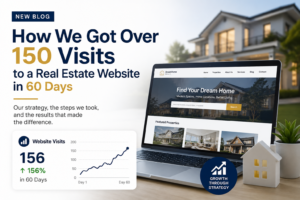
Sixty days ago, we sat down with a small real estate developer who had a genuinely good project decent location, fair pricing, solid amenities Real Estate Website and almost no one visiting the website to learn about it. Sound familiar? If you’re a small developer, a local agent, or a one-person marketing team trying to launch a project without a Fortune 500 budget, this is probably the exact problem you’re wrestling with right now.
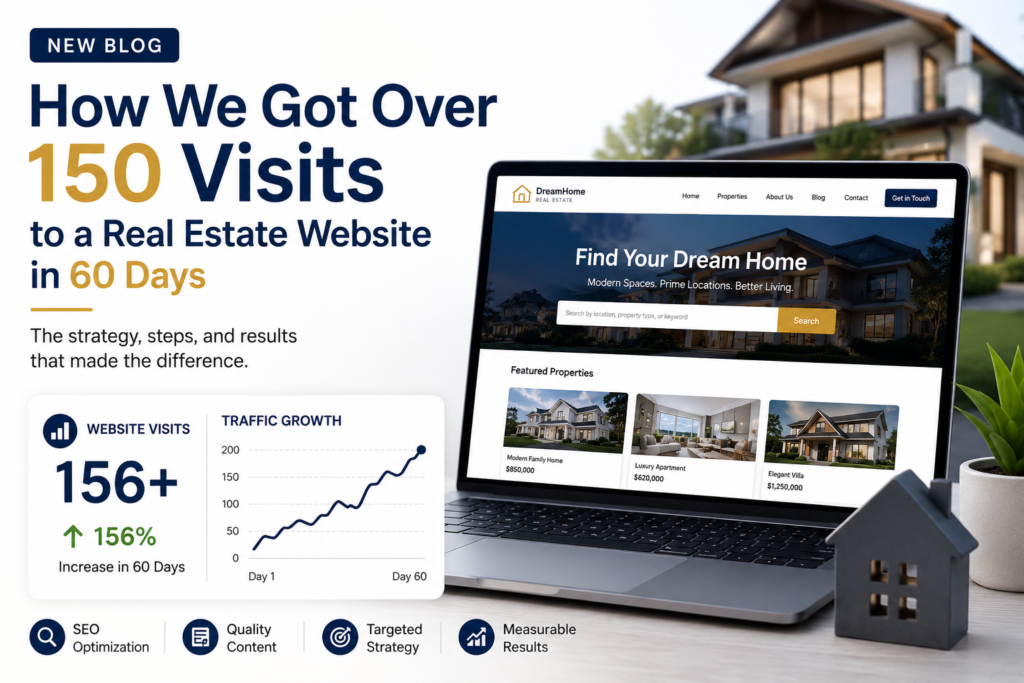
This isn’t a theory post. Instead, it’s the actual playbook we used to take that project from near-zero traffic to 150+ qualified site visits in two months, without burning through a huge ad budget or hiring an agency army. Below, we’re breaking down exactly what we did, in what order, what it cost, and what we’d change if we did it again.would do differently time.
The Starting Point
The project had a website, a Google Business listing that hadn’t been touched in months, and a couple of half-finished social profiles Real Estate Website. There was no tracking, no clear audience definition, and no content plan. In other words, Real Estate Website this was a completely normal starting point for most small real estate teams.
Our goal for the 60-day sprint was simple: generate enough qualified web traffic that the sales team had a steady stream of people to actually talk to. Not vanity traffic. Instead, we wanted people who were close to a decision.
The 8 Tactics That Actually Moved the Needle
1. Local SEO First, Everything Else Second
Before spending a rupee (or dollar) on ads, we fixed the basics: Google Business Profile, local keywords in page titles, location-specific landing pages, and NAP (name, address, phone) consistency across directories. Admittedly, local SEO for real estate isn’t glamorous, but it’s the foundation everything else sits on Real Estate Website. Because location-based searches convert at a noticeably higher rate than generic ones, Real Estate Website cleaning this up alone started nudging organic visits upward within the first two weeks.
Time to set up: 3–4 days Cost: Near-zero (mostly time)
2. A Landing Page Built to Convert, Not Just Inform
Next, we replaced the generic “About the Project” page with a dedicated landing page: one clear headline, a short benefits list, floor plan previews, and a single call-to-action — book a site visit. There was no navigation menu to distract visitors and no five competing CTAs pulling attention in different directions. Real Estate Website In short, Real Estate Website the page had just one job to do.
Time to set up: 5 days Cost: Design time only, no paid tools required initially
3. Content Marketing That Answered Real Buyer Questions
From there, we published a handful of blog posts answering the exact questions buyers were already typing into Google — things like “is this locality good for investment,” “hidden costs when buying property,” and neighborhood comparisons. Since content marketing tends to be dramatically cheaper than traditional advertising while still pulling in a healthy volume of leads for smaller businesses, this approach paid off quickly. Real Estate Website In fact, these posts became one of our steadiest, lowest-cost traffic sources by week four.
Time to set up: Ongoing, roughly 2 posts/week Cost: Low (writer’s time)
4. Beginner-Friendly Paid Ads (Google + Meta)
Rather than going big on paid ads, we went targeted: small daily budgets on Google Search (high-intent keywords only) and Meta (lookalike audiences based on past inquiries). Although real estate paid search generally sees click-through rates in the low single digits, the visitors who do click tend to be far along in their decision process. Real Estate Website Real Estate Website That’s exactly the quality-over-quantity trade small budgets need to make.
Time to set up: 2 days Cost: Modest daily spend, Real Estate Website scaled up only after we saw which ads converted
5. Email Nurture Sequences for Repeat Visits
Meanwhile, every inquiry, download, or form-fill went into a simple nurture sequence — five emails over two weeks, each with a specific next step, such as scheduling a call, downloading a brochure, or checking the site visit calendar. Even though email doesn’t always get the credit it deserves, with typical open rates hovering in the 20–25% range and healthy click-through numbers, Real Estate Website it turned out to be one of our most reliable ways to pull past visitors back to the site.
Time to set up: 1 week (sequence + automation setup) Cost: Cost of the email tool only
6. Short-Form Video for Social Reach
At the same time, we filmed simple walkthrough clips on a phone — no production crew, no drone footage, just an honest tour and a clear voiceover. Interestingly, these performed better than static images across every social channel we tried, Real Estate Website and a few even became small viral moments within the local audience.
Time to set up: 1–2 days per video, filmed in batches Cost: Time only
7. A/B Testing the Landing Page
Once traffic started flowing, we didn’t stop at “good enough.” Instead, we tested two headline variations and two CTA button colors and placements. Since A/B testing landing pages routinely improves conversion by a meaningful margin, Real Estate Website our test was no exception — the winning variant lifted our visit-booking rate noticeably within the first week.
Time to set up: Ongoing, reviewed weekly Cost: Free (using existing tools)
8. WhatsApp and Direct Follow-Up
Finally, because WhatsApp is often the fastest way to close the loop in this market, we added a click-to-WhatsApp button on every landing page and ad. As a result, this shortened the gap between “interested” and “site visit booked” more than almost any other single change we made.
Time to set up: 1 day Cost: Free
The 60-Day Campaign Timeline
- Days 1–7: Local SEO cleanup, landing page build, tracking setup
- Days 8–14: First content pieces published; ad accounts built and launched at low budget
- Days 15–30: Email nurture live, video content batch #1 released, first A/B test launched
- Days 31–45: Scale ad spend on winning campaigns, publish content batch #2, refine nurture emails based on open/click data
- Days 46–60: Push testimonials and social proof, run second A/B test, WhatsApp direct outreach to warm leads, Real Estate Website final push toward site visit bookings
What Channels Actually Generated the Most Visits?
So, which of these tactics carried the most weight? Overall, organic and local search brought in the steadiest volume over time, while paid search delivered the fastest early wins. Meanwhile, email and WhatsApp did the heavy lifting in converting warm interest into actual booked visits. Real Estate Website Social video, by comparison, was smaller in raw numbers but strong for brand trust and reach.
Measuring and Optimizing for Quality, Not Just Quantity
Throughout the sprint, we tracked more than just visit counts. Time on page, scroll depth on the landing page, and whether a visitor came back a second time all mattered more than raw traffic. Since a visitor who converts from organic search typically converts at a higher rate than one who lands cold from an ad, Real Estate Website we weighted our reporting toward source quality rather than volume alone.
Tools We Actually Used
- Analytics: Google Analytics + Google Search Console
- SEO: Google Business Profile, a basic keyword research tool
- CRM/Lead tracking: A lightweight CRM to log every inquiry source
- Email: A simple email automation tool for the nurture sequence
- Ads: Google Ads and Meta Ads Manager
- Landing page: A no-code landing page builder
Overall, nothing here was exotic. Rather, the tools mattered less than the discipline of actually using them consistently.
What We’d Do Differently Next Time
Honestly, we’d start the email nurture sequence earlier, since we lost some momentum in the first two weeks by treating it as a “later” task. Additionally, we’d begin A/B testing from day one instead of waiting until traffic picked up, Real Estate Website because even small early data helps you avoid guessing.
Quick Win Checklist
If you only have time to do three things this week, focus on these:
- Fix your Google Business Profile and confirm your NAP is consistent everywhere
- Build one focused landing page with a single, Real Estate Website clear call-to-action
- Add a click-to-WhatsApp or direct-call button to every page and ad
Ready to Run Your Own 60-Day Sprint?
Ultimately, you don’t need a massive budget or a big team to generate real, qualified traffic for your project. What you do need is the right sequence of tactics, applied consistently and measured honestly.
Download the 1-page 60-day traffic checklist to get this entire plan in a format you can act on today — or contact us for a personalized traffic sprint plan built around your specific project and market Real Estate Website.