


Most SaaS churn reduction stories start the same way: a good product, a leaky funnel, and a team that can’t quite agree on where users are dropping off. This is the story of one mid-market SaaS platform that fixed both sides of that problem at once — cutting churn while growing trial signups by 35% in a single quarter.
Quick summary:
- Trial signups grew 35% after a redesigned onboarding and lifecycle sequence
- Monthly churn dropped by roughly a fifth, without discounting or contract lock-ins
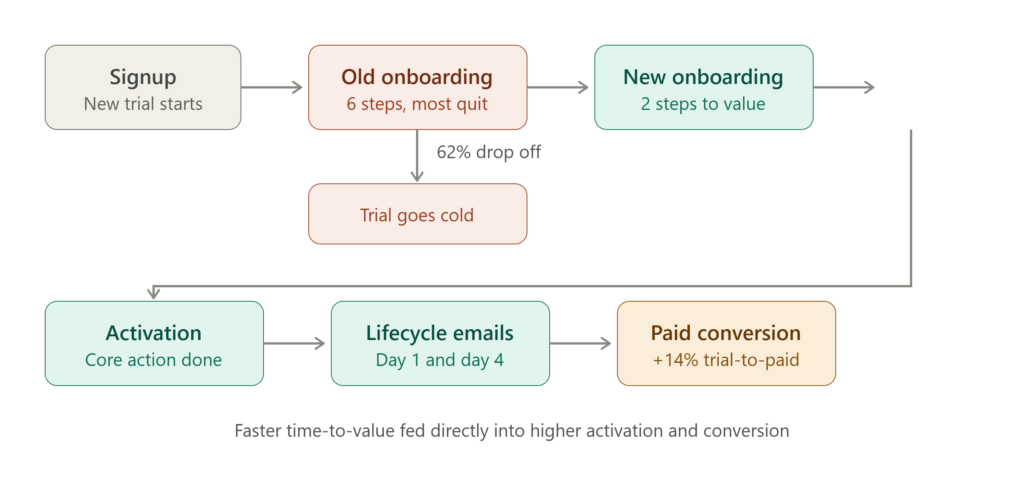
- Trial-to-paid conversion improved as a direct result of faster time-to-value.
The problem: growth that wasn’t sticking
The client — a project management SaaS serving mid-market teams — had a familiar issue. Marketing was hitting its trial targets. But a large share of those trials never activated, and a chunk of paying customers were quietly churning within their first two billing cycles. Growth looked fine on a top-line chart. Underneath it, the engine was leaking.
Interviews with the customer success team surfaced the real culprit: new users weren’t reaching their first meaningful “aha” moment fast enough. The product had value, but the path to it was buried behind a multi-step setup flow most people abandoned halfway through.
What we tested
Rather than rebuild the product, the team ran a sequence of smaller, measurable experiments:
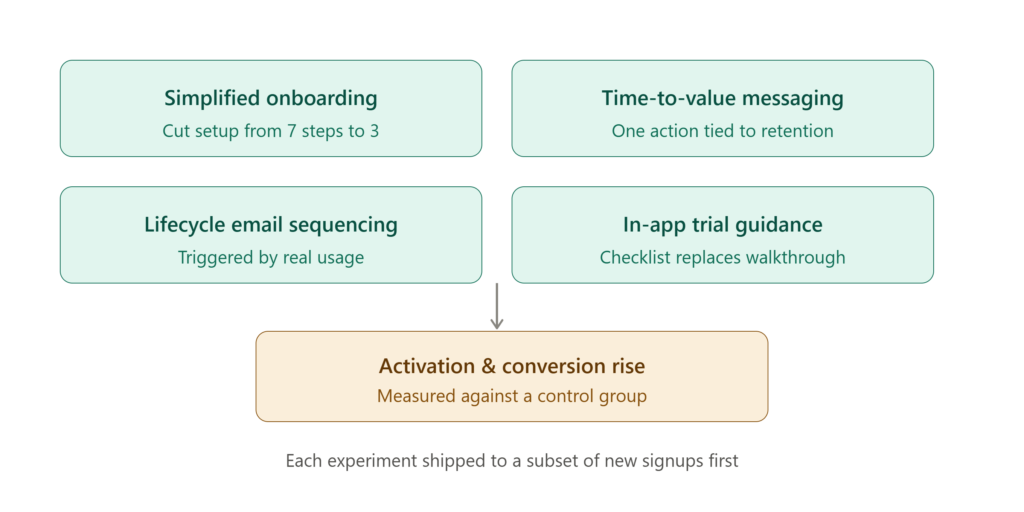
- Simplified onboarding — cut the initial setup from seven steps to three, moving optional configuration to later in the lifecycle
- Time-to-value messaging — in-app prompts and emails built around one specific action tied to retention, not a generic feature tour
- Lifecycle email sequencing — triggered nudges based on actual usage behavior instead of a fixed day-1/day-3/day-7 schedule
- Trial-specific in-app guidance — a lightweight checklist replacing a longer product walkthrough
Each change shipped to a segment first, measured against a control group, before rolling out fully — the same testing discipline covered in our SaaS marketing framework guide.
The results
Within one quarter:
- Trial signups rose 35%, largely from improved word-of-mouth referrals once activation improved
- Activation rate (time-to-value) improved by roughly a third, measured as the share of new users completing the core action within 48 hours
- Monthly churn dropped from the high single digits into the low single digits — a meaningful shift for a mid-market product at this price point
- Trial-to-paid conversion improved by double digits, directly tied to the faster path to value
As the client’s VP of Growth put it: “We stopped treating onboarding as a checklist and started treating it as the actual product experience. That mindset shift is what moved the numbers, not any single feature.”
Why it worked
None of these changes were dramatic on their own. What mattered was sequencing and measurement — testing one variable at a time, tying every change back to a specific retention or activation metric, and being willing to kill ideas that didn’t move the number. Onboarding completion rate, daily active trial users, and cohort retention curves were the three dashboards the team checked weekly, not vanity metrics like raw signups.
Lessons learned
A few things generalize well beyond this one company:
- Activation, not acquisition, was the real bottleneck. More trials wouldn’t have mattered if the leak stayed the same size.
- Small, sequenced tests beat one large onboarding redesign. Each change was reversible and measurable on its own.
- Churn and growth are the same problem viewed from different ends. Fixing time-to-value moved both numbers simultaneously.
This approach isn’t unique to project management tools — the same sequencing works across most B2B SaaS categories, though the specific “aha moment” will differ by product.
Put this playbook to work
If your trial numbers look healthy but your retention curve tells a different story, the fix is rarely a bigger ad budget — it’s usually in the first 48 hours of the product experience. Our growth frameworks cheat sheet breaks down the exact testing sequence used here, and if you want to see whether this applies to your product, book a demo or browse more case studies from other SaaS teams we’ve worked with.