
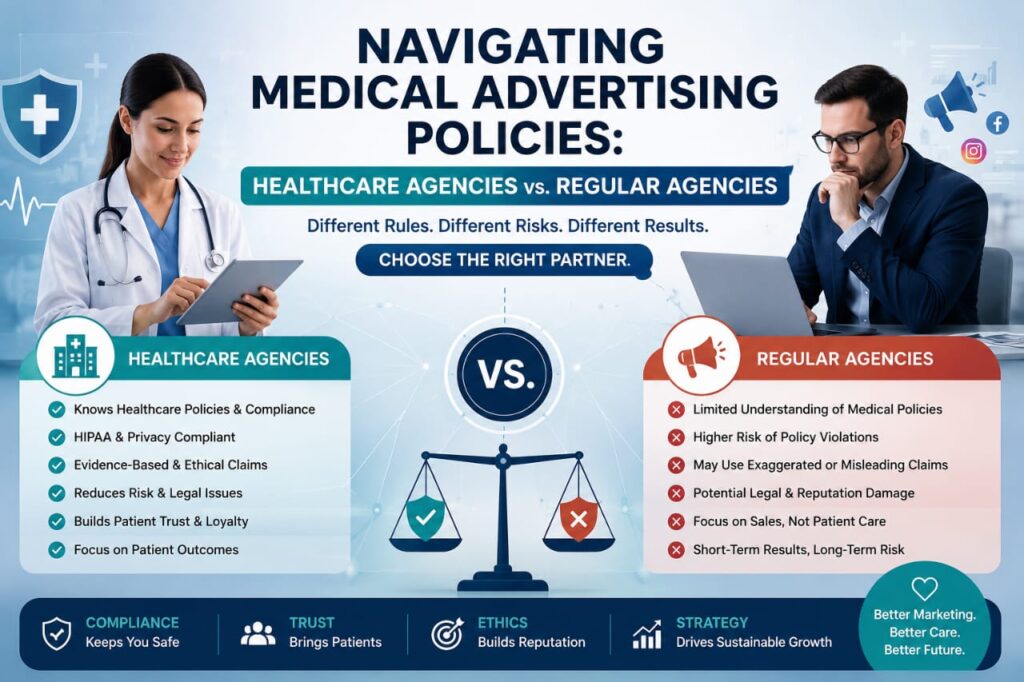
Why Healthcare Ads Play by Different Rules
Picture this. Your clinic runs a Facebook ad with one bold claim. That single claim triggers an investigation. Then comes a fine. This happens because healthcare advertising isn’t just “regular advertising, but stricter.” Instead, it’s a completely different game with its own rulebook.
So, what makes it so different? Let’s break it down.
General Advertising vs. Healthcare Advertising
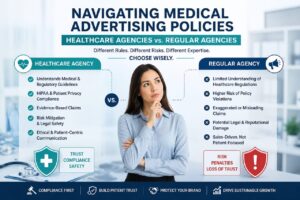
General ad agencies chase attention. They want clicks, conversions, and a strong brand voice. That’s their job, and they’re good at it.
However, healthcare advertising demands more. Every claim needs proof. Additionally, every claim must be accurate. On top of that, every claim must avoid misleading patients. Because these ads touch people’s health and safety, regulators hold them to a much higher standard.
In short, general agencies optimize for engagement. Meanwhile, healthcare agencies optimize for engagement and compliance. If you’d like a deeper look at how we structure compliant campaigns, see our guide to healthcare marketing compliance for more detail.
The Regulatory Bodies You Need to Know
Several agencies oversee healthcare marketing, and each plays a different role. As a result, a single campaign can touch more than one set of rules at once.
- FDA (Food and Drug Administration): Regulates labeling and promotional claims for drugs and medical devices. You can review their advertising guidance directly on FDA.gov.
- FTC (Federal Trade Commission): Meanwhile, this agency makes sure all advertising, not just healthcare, stays truthful and non-misleading. The FTC’s advertising and marketing resources explain these requirements in detail.
- HIPAA (enforced through HHS): This law governs how you use and share protected health information.
- CMS and State Medical Boards: Together, these bodies set rules for provider advertising, especially around credentials and scope-of-practice claims.
Because so many bodies are involved, it helps to map your campaign against each one before launch.
How to Verify Your Claims
Every health-related claim needs solid backing. Specifically, marketers must support claims with reliable scientific evidence, not assumptions or anecdotes.
For example, you’ll need substantiation for:
- Safety claims
- Comparative claims
- Claims implied through product names, imagery, or context
Even so, indirect suggestions still count. For instance, if your imagery implies a guaranteed cure, you still need evidence to back it up. Otherwise, you risk a compliance violation. For related guidance, check out our internal resource on claim substantiation.
Protecting Patient Privacy in Testimonials
Testimonials build trust, but they also carry risk. Therefore, to use one safely, you need:
- Documented, informed consent from the patient
- Clear disclosure when results aren’t typical
- No editing that implies a guaranteed outcome
On top of that, digital healthcare ads come with data-privacy requirements. Therefore, your tracking pixels and retargeting tools need just as much scrutiny as your creative.
A Compliance Workflow That Actually Works
Instead of treating compliance as a final checkbox, build it into every stage of your campaign. Below is a simple five-step flow:
- Claim mapping – First, identify every claim you plan to make.
- Evidence gathering – Next, collect the science that supports each claim.
- Compliance and legal review – Then, have qualified reviewers check the campaign.
- Creative revision – After that, adjust messaging based on feedback.
- Final sign-off – Finally, get formal approval before launch.
This way, compliance becomes part of the process, not an afterthought.
Choosing the Right Agency: A Vendor Checklist
Before you sign a contract, ask your prospective agency these questions:
- Can they name the regulatory bodies that apply to your service line?
- Do they have a written claim-substantiation process?
- Have they worked with clients in your specific healthcare niche?
- Do they build legal or compliance reviews into their workflow?
- Can they show you how they manage testimonials and disclosures?
If an agency struggles to answer these clearly, that’s a red flag. For a full walkthrough, see our agency evaluation checklist.
Your Pre-Publish Compliance Checklist
Before you hit publish, confirm the following:
- Every claim has documented substantiation on file
- No absolute or guaranteed-outcome language appears anywhere
- Testimonials include required disclosures and documented consent
- No protected health information leaks through tracking or targeting
Running through this list takes minutes. Skipping it, on the other hand, can cost you months of legal cleanup.
A Cautionary Case Study
One clinic picked an agency based purely on a strong campaign pitch. Unfortunately, the agency didn’t understand healthcare advertising rules. As a result, the campaign ran into compliance problems almost immediately. Consequently, the clinic had to spend extra money on legal review and corrective messaging, on top of what they’d already paid for the campaign itself.
So, what’s the lesson here? A great creative pitch means nothing if it can’t survive a compliance review.
Best Practices for Clinics and Healthcare Businesses
To keep your marketing both effective and compliant, follow these habits:
- First, build compliance reviews into your campaign schedule from day one.
- Also, maintain a claim-substantiation library you can reuse across campaigns.
- In addition, require documented consent for every single testimonial.
- Furthermore, audit your tracking and ad-tech stack for HIPAA exposure at least once a year.
- Similarly, loop in your compliance team whenever a claim involves results, comparisons, or safety.
- Finally, train your internal marketing staff on basic advertising regulations, so they catch risks early instead of after legal review.
Frequently Asked Questions
Which regulatory agencies oversee medical advertising in the United States? The FDA, FTC, HHS, CMS, and state medical boards all play a role. However, the FDA and FTC handle most advertising and labeling regulations.
What separates healthcare-focused agencies from general agencies? Healthcare agencies build claim substantiation, disclosure requirements, and privacy protections into every workflow. General agencies, in contrast, typically treat compliance as just one phase of the process.
Which medical claims require supporting evidence? Any claim about a health product or service’s effectiveness, safety, or comparison to competitors needs documented evidence before you publish it.
How should healthcare ads handle testimonials? First, get documented consent. Then, clearly disclose atypical results. Finally, never edit testimonials in a way that implies a guaranteed outcome.
What penalties come with non-compliant healthcare advertising? Enforcement can include cease-and-desist orders, mandatory corrective advertising, consumer refunds, civil fines, and lasting reputational damage.
How does HIPAA affect marketing strategy? HIPAA restricts how you use data in testimonials, retargeting, and audience segmentation. Consequently, you must configure your tracking tools carefully to prevent any disclosure of protected health information.
When should compliance teams get involved in ad creative? Ideally, bring them in whenever a claim touches results, safety, comparisons, or patient data, before you even finalize the creative brief.
The Bottom Line
Choosing between a healthcare-specialized agency and a general advertising agency isn’t really a budget decision. Instead, it’s a risk decision. Of course, general agencies can deliver strong creative work. But, healthcare advertising demands extra substantiation, privacy safeguards, and regulatory expertise that most general agencies simply don’t have.
For healthcare business owners, marketers, and administrators, the smarter path is clear. Ultimately, work with a team that builds compliance into the process from the start, not one that treats it as damage control. If you’re looking for expert guidance on healthcare advertising and compliant digital marketing strategies, visit our Contact Us page to connect with the Pixicon Digital team.