

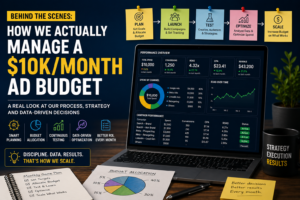
Ten thousand dollars a month sits in a weird middle spot. It’s too much money to manage casually a couple of bad days can burn through a meaningful chunk of it but it’s not big enough to just shrug off inefficiency the way a much larger enterprise account might. At this level, discipline matters more than scale does. The process has to carry the weight, not the budget size.
This is a real look inside how our team manages a $10k/month ad budget the planning, the pacing, the testing rhythm, and the decision points that keep spend efficient without moving so slowly that we miss what’s actually working. No client numbers here, just the workflow itself.
Why Process Matters So Much at This Level
At $10k a month, every decision compounds fast. Pace the first week poorly and you’re scrambling by week three. Under-test your creative and you might quietly cap your ROAS for an entire month before anyone even notices. There’s just not much room for “we’ll figure it out as we go” which is exactly why we run this through a structured, repeatable process instead of reacting day to day.

Planning: Allocation, Pacing, and Leaving Room to Experiment
Before a single dollar goes out, we settle three things: how the budget’s split across channels, how it’s paced, and how much we’re holding back for testing.
Pacing is where a lot of accounts quietly lose ground. We typically front-load spend putting roughly 60–70% of the month’s budget out in the first half to capture early signal, then holding the remaining 30–40% for the back half once there’s real data to optimize against. That avoids the common trap of spreading spend evenly across 30 days regardless of what the numbers are actually saying.
We also set aside a smaller reserve, usually 10–15% of the total, specifically for testing new audiences, new creative angles, an emerging channel worth exploring. Without that dedicated reserve, experimentation has a way of quietly getting squeezed out by the instinct to protect what’s already working.
Channel Mix: Every Channel Earns Its Spot
At this budget level, we rarely spread spend evenly across every available channel. Concentration usually beats dilution. Instead, each channel gets a specific job to do.
Search tends to anchor the budget for accounts with clear purchase intent it’s catching people who are already looking to buy. Paid social handles discovery and retargeting, introducing the brand to new people and re-engaging warmer audiences. Retargeting gets a deliberately smaller slice the ROAS is usually strong, but audience size limits how much budget it can absorb effectively.
The exact split shifts depending on the business. E-commerce usually leans on search and paid social together; B2B lead gen often weights more heavily toward LinkedIn and search. But the underlying principle stays the same budget follows intent and funnel stage, not an even split just for the sake of it.
Setup: The Unglamorous Part That Prevents Headaches
This is the least exciting part of the process, and also where most future problems get either prevented or quietly baked in. Before anything launches, every campaign gets a consistent naming convention channel, objective, audience, date so performance can be filtered and compared later without a manual cleanup job. UTMs get standardized across every channel so everything feeds into one analytics view. And conversion tracking gets validated before spend goes live, not after something looks off in a report a week in.
On attribution, we keep expectations realistic at this budget size leaning on platform-level data-driven attribution rather than building out a heavy custom model, with a basic multichannel review layered on top so no single channel ends up over- or under-credited.
Bidding and Optimization: Waiting for Real Signal
We treat bid and budget changes as decisions that need enough data behind them to actually trust not daily impulse reactions. The general rule: at least 1–2 weeks of data before making significant shifts on newer campaigns, and 2–4 weeks for mature ones. Pulling budget on day three because of one slow morning is one of the most common and most expensive mistakes we see in mid-size accounts.
Within that window, the rhythm looks roughly like this: daily pacing checks and anomaly spotting for things like sudden CPC spikes or tracking issues, a weekly review against KPI targets with minor adjustments, and larger reallocation or channel-mix decisions happening on a bi-weekly to monthly basis.
Creative Testing: Built on a Hypothesis, Not a Hunch
Every test we run starts with an actual hypothesis, not a vague guess. “This audience responds better to a problem-first message than a feature-first one” is testable. “Let’s just try a different image” usually isn’t specific enough to learn much from.
During an active testing phase, we typically run 1–2 new creatives a week, with clear decision points every 7–14 days enough time to gather meaningful data at this budget level, without letting something underperforming run indefinitely. Winners get folded into the core rotation; losers get retired, with the specific reason documented rather than just quietly dropped.
Reporting: Keeping It Simple on Purpose
At $10k a month, simplicity in reporting isn’t a shortcut it’s the point. We track a small, consistent set of KPIs rather than building a sprawling dashboard nobody actually reads: ROAS or CPA depending on the goal, spend pacing against budget, and conversion rate trends by channel.
For rough context not as hard rules, more as sanity checks we tend to watch for search CTRs around 0.9–1.5%, social CTRs closer to 0.5–1.0%, and ROAS somewhere in the 3x–5x range for a lot of e-commerce accounts, with B2B running on a different scale depending on deal size. Reporting happens weekly, with a deeper monthly review covering channel mix, testing outcomes, and the plan for the month ahead.
Knowing When to Scale, Pause, or Shift
Three questions guide every scale-or-pause call. Is there actually enough data to trust this decision? Is the trend real, or a short-term blip seasonality, a competitor’s promotion, or a platform glitch can all look like a genuine trend if you’re not careful. And does scaling this channel come at the expense of one that’s already performing better? At this budget level, spend is essentially zero-sum scaling one line usually means pulling from another.
We also build seasonality into the plan from the start, flagging known high- or low-demand periods upfront rather than reacting mid-month, which keeps forecasting a lot tighter than the wider 10–20% variance that’s common without that groundwork.
Where Accounts Usually Go Wrong
The same handful of mistakes tend to show up again and again: spreading spend across too many channels and diluting the signal on all of them, reacting to daily noise instead of waiting for real data, skipping the experiment reserve and slowly capping growth once known performers plateau, and inconsistent tracking that quietly corrupts reporting for weeks before anyone catches it.
A Quick Checklist
- Set channel allocation by funnel role, not an even split
- Pace 60–70% of budget in the first half of the month, hold the rest for optimization
- Reserve 10–15% for testing
- Standardize naming conventions, UTMs, and tracking before launch
- Wait 1–2 weeks (new campaigns) or 2–4 weeks (mature ones) before major shifts
- Test 1–2 new creatives a week with a 7–14 day decision point
- Review KPIs weekly, do a deeper channel-mix review monthly
- Flag seasonality in the plan, not after it hits
Want This Process Running on Your Budget?
This is the same disciplined process our team runs on client accounts every month planned, paced, and optimized around real data instead of guesswork. If you’re managing a $10k/month budget, or working toward one, and want a second set of eyes on how it’s being run, schedule a free consultation with our team.