
Marketing used to rely on gut feeling. You’d launch a campaign, hope for the best, and find out months later whether it actually moved the needle. Today, however, that’s no longer how smart businesses operate. Instead, they use performance marketing to track results in real time and make data-driven decisions.
Today, brands want proof. They want to know exactly how many people clicked, signed up, or bought something — not just how many people saw the ad. That shift is what performance marketing is built for.
What Is Performance Marketing?
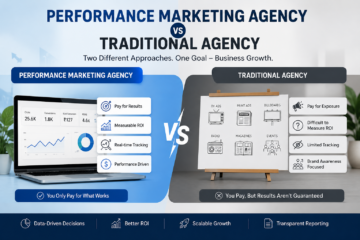
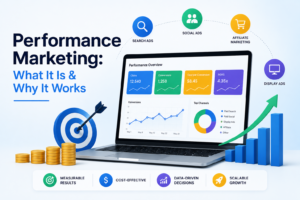
Performance marketing is a pay-for-results approach to advertising. Instead of paying for exposure, you pay for specific outcomes, such as a website visit, a lead, a sale, or an app install. As a result, businesses can measure campaign success more accurately and maximize their return on investment (ROI).
It’s the opposite of brand advertising, which focuses on awareness. Performance marketing focuses on action. Every campaign gets tracked, measured, and optimized based on real numbers, not assumptions.
Common things you can measure include:
- Website visits
- Leads
- Purchases
- App installs
- Form submissions
- Phone calls
- Email signups
Does It Guarantee ROI?
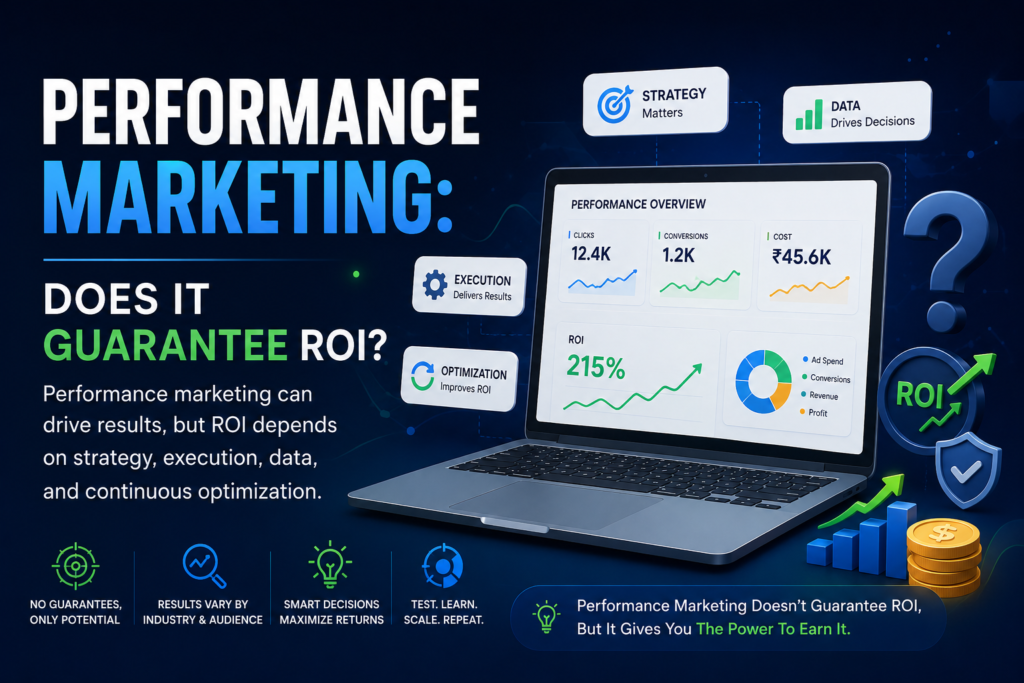
No — and anyone who tells you otherwise is overselling. No campaign can guarantee a return, because too many variables are out of your control: competition, market conditions, and how much people are actually willing to spend.
What performance marketing can do is stack the odds in your favor. It’s data-driven, testable, and transparent, which makes results far more predictable than traditional advertising.
Where Performance Marketing Happens
- Search ads – paid placements on Google and other search engines
- Paid social – ads on platforms like Facebook and Instagram
- Affiliate marketing – paying partners to promote your product
- Programmatic advertising – automated, algorithm-driven ad buying
- Native advertising – ads designed to blend into the platform they’re on
- Email marketing – direct outreach aimed at conversions
How to Measure Success
ROI is the core metric — it compares what you spent to what you earned:
ROI = (Revenue − Marketing Cost) / Marketing Cost × 100
Beyond that, a few key metrics matter:
- CPA (Cost Per Acquisition) – what it costs to land one customer
- ROAS (Return on Ad Spend) – revenue earned per dollar spent
- CAC (Customer Acquisition Cost) – total cost to acquire a customer
- LTV (Customer Lifetime Value) – total value a customer brings over time
- Conversion Rate – the percentage of people who take action after seeing your ad
Understanding Attribution
Attribution is how you figure out which ad actually gets credit for a conversion. The main models are:
- Last-click – full credit to the final ad before conversion
- First-click – full credit to the very first ad seen
- Linear – credit spread evenly across every touchpoint
- Time decay – more credit to ads seen closer to conversion
- Data-driven – credit assigned based on actual performance data
How to Actually Get Results
- Set clear goals – know what “success” looks like before you launch
- Track everything – you can’t optimize what you don’t measure
- Fix your landing pages – traffic means nothing if the page doesn’t convert
- Run A/B tests – let data decide what works, not guesswork
- Reallocate budget – double down on what’s performing
- Think long-term – factor in lifetime value, not just first-purchase cost
Common Mistakes That Kill ROI
- Skipping proper tracking setup
- Ignoring attribution entirely
- Poor audience targeting
- Weak landing pages
- Never testing new creative
- Scaling too fast, too soon
- Relying on a single channel
- Sloppy conversion tracking
Why It Works for Small Businesses Too
Performance marketing scales with you. You can start small, prove what works, and reinvest as results come in — no massive upfront budget required.
Whether CPA or ROAS matters more depends on your goals, and results won’t appear overnight. But with consistent testing and clean attribution, performance marketing becomes one of the most reliable ways to grow.
The Bottom Line
No one can promise you a guaranteed return — and you should be skeptical of anyone who does. What performance marketing offers instead is a system: track what matters, test constantly, and let the data guide your budget.
Done right, every click, impression, and conversion tells you something useful. That’s how you turn advertising from a gamble into a growth engine.