


Every startup founder reaches a point where they feel stuck. Their team is growing, but they are still wasting too much time on repetitive tasks. They are pasting leads between spreadsheets, chasing follow-ups, and updating deal statuses by hand. This is when becoming an Automation Expert becomes essential for every startup founder.
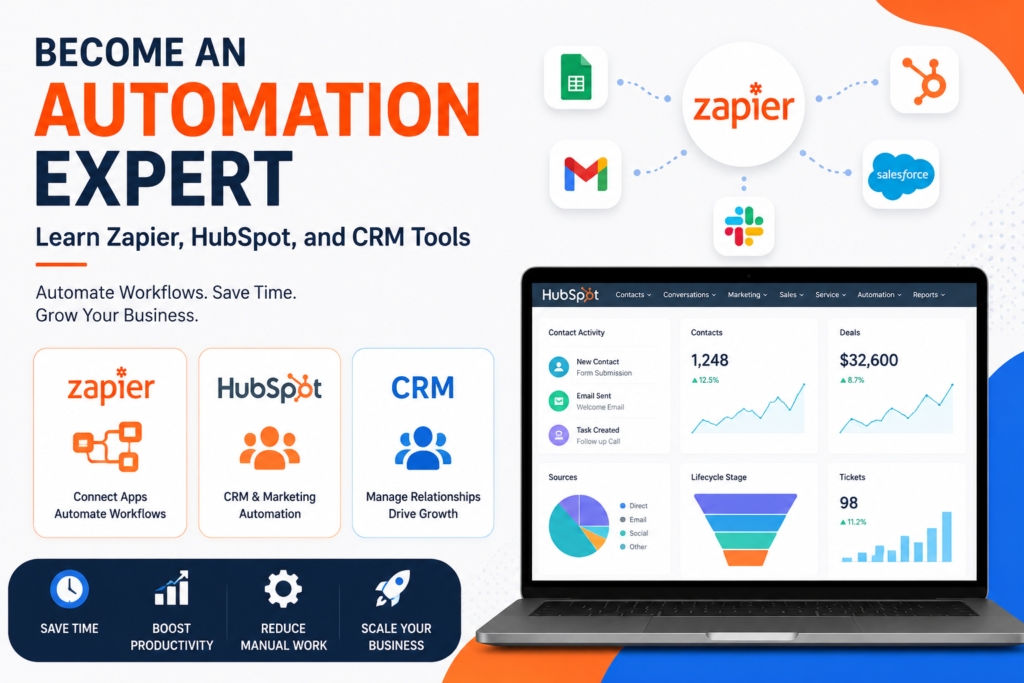
The good news is that a startup founder does not need a team of engineers to make this happen. Instead, by learning the skills of an Automation Expert, founders can use tools like Zapier, HubSpot, and modern CRM platforms to automate repetitive workflows and improve efficiency. Furthermore, an Automation Expert knows how to connect apps, streamline processes, and eliminate manual work, allowing startup founders to focus on strategy, sales, and product development. As a result, businesses become more productive and scalable. Ultimately, with the right automation skills, Zapier, HubSpot, and CRM tools become powerful assets for every growing business.
Learn more about becoming an Automation Expert by visiting: https://yourdomain.com/automation-expert
Why Automation Matters for Early-Stage Companies
Automation is not about replacing people. It is about removing tasks that’re prone to errors from their workload. A founder who automates lead routing, onboarding emails and deal-stage updates saves a lot of hours. This reduces the chance of a lead slipping through the cracks for the startup founder. Automation helps the startup founder in ways.
For startups automation delivers three benefits:
- Speed – the startup founder gets faster lead response times and shorter sales cycles
- Consistency – every customer of the startup founder gets the same onboarding experience
- Focus – the startup founder and early hires spend less time on admin tasks and more on growth for the startup
The Three Pillars: Zapier, HubSpot and CRM
Zapier connects all the apps of the startup founder. It links tools that do not talk to each other. For example “when a new row is added in Google Sheets create a contact in HubSpot.” The startup founder does not need to write any code to use Zapier.
HubSpot is a CRM, marketing and sales platform built for automation. It handles lead capture forms, email sequences and pipeline tracking for the startup founder. It works well with Zapier and other CRM tools.
CRM tools like HubSpot, Pipedrive or Attio are the system of record for customer relationships of the startup founder. Automation happens around the CRM – deal-stage triggers task assignments and reminders for the startup founder.
A Way to Get Started Map the process of the startup founder :
Write down every step a lead or customer goes through for the startup.
Identify steps that can be automated by the startup founder :
These are the automation candidates – anything that follows a simple “if this, that” pattern for the startup founder.
Build one automation at a time for the startup Start small
Zapier:
Connect the website form to the CRM of the startup founder.
HubSpot:
Set up an email sequence for the startup founder.
CRM:
Create a workflow that assigns a follow-up task to the startup founder.
Test with data for the startup founder :
Run test leads through the workflow before trusting it with customers of the startup founder.
Measure the impact on the startup founder :
Track time saved, response time improvements or conversion lift for the startup founder.
Common Pitfalls to Avoid
- Automating a process that’s not clear for the startup founder. If the sales process is unclear automation makes it worse for the startup founder.
- Over-engineering for the startup founder. Start simple. Add more automations later for the startup.
- Ignoring data hygiene for the startup founder. Bad data breaks workflows for the startup founder.
- No ownership for the startup founder. Assign someone to monitor and update automations for the startup founder.
Measuring ROI
Use a framework for the startup founder:
Time saved per week × hourly cost − tool cost = value for the startup founder.
If an automation saves the team of the startup founder five hours a week at $40/hour that’s $200/week for the startup founder. Compare this to the tool cost for the startup founder.
Conclusion
Becoming an automation expert does not require skills for the startup founder. It requires documenting the process starting small and iterating for the startup founder. Founders who treat automation as a discipline up time to focus on growth for the startup.
Start with one workflow this week for the startup founder. The time savings will make the case, for the startup founder.