

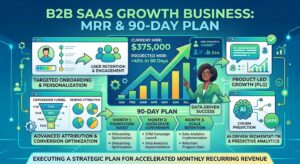
A B2B SaaS Growth Business depends on building a predictable Monthly Recurring Revenue (MRR) engine. MRR is the pulse of any B2B SaaS Growth Business — it tells you not just how much money is coming in, but how healthy your growth engine really is. Yet most companies chase MRR by throwing more spend at acquisition while ignoring the levers that actually compound: activation, retention, and expansion.
This guide breaks down a practical framework — Acquire, Activate, Expand — along with a 90-day action plan and the KPIs that matter most when evaluating a growth partner for your B2B SaaS Growth Business.
Why MRR Matters for Every B2B SaaS Growth Business
MRR is more than a revenue snapshot — it’s a leading indicator of product-market fit, customer health, and forecastability. Unlike one-time revenue, MRR compounds (or erodes) based on churn, expansion, and new logo velocity.
A business growing 10% month-over-month on paper can still be in trouble if churn is quietly eating away at the base. That’s why sophisticated growth teams look beyond top-line MRR to Net Revenue Retention (NRR) and Gross Revenue Retention (GRR) as the real signals of sustainable growth. Learn how NRR is calculated →
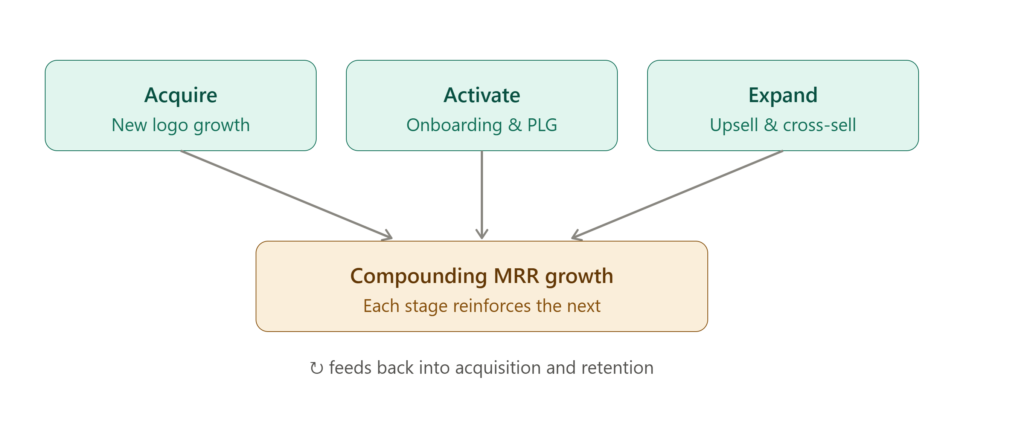
The Three Levers Every B2B SaaS Growth Business Needs: Acquire, Activate, Expand
Acquire
New logo acquisition still matters, but efficiency is king. Track CAC payback period (aim for 90–180 days) and LTV:CAC ratio (3:1 or better).
A growth partner can sharpen this by refining ICP targeting, tightening SDR/AE handoffs, and improving pipeline velocity. As a result, external partners often move faster than an in-house team can iterate alone, since they bring pattern recognition from dozens of similar engagements. See our CAC & LTV calculator →
Activate
Onboarding is where most SaaS companies leak revenue before it ever becomes durable MRR. Reducing time-to-first-value and clarifying the “aha moment” in your product can meaningfully lift activation-to-paid conversion.
Product-led growth (PLG) motions — in-app guidance, milestone-based emails, proactive CS outreach — all serve this goal. Additionally, a tight feedback loop between product and CS teams helps surface friction points early.
Expand
Expansion revenue (upsell, cross-sell, seat growth) is often the most underused lever, yet it can represent a large share of total MRR in healthy mid-market and enterprise accounts.
This is where customer success shifts from a cost center to a revenue driver — flagging usage signals, running QBRs with expansion framing, and aligning pricing tiers to natural growth paths.
B2B SaaS Growth Business: Services vs. In-House
In-house teams are often stretched thin across acquisition, product, and retention simultaneously. Growth services bring focused bandwidth, cross-client benchmarks, and the ability to run more experiments in parallel — pricing tests, onboarding redesigns, campaign iterations — which compresses the learning cycle considerably.
However, the goal isn’t replacing your team; it’s accelerating the flywheel while your team stays focused on the core product.
A 90-Day Growth Plan for Your B2B SaaS Growth Business
Days 1–30: Diagnose
- Audit current MRR composition (new, expansion, churned)
- Benchmark CAC, LTV:CAC, NRR, and activation rate
- Identify the top 2–3 churn drivers via customer interviews and usage data
Days 31–60: Experiment
- Launch pricing/packaging tests on a segment of new signups
- Redesign onboarding flow around a clearer time-to-value milestone
- Deploy targeted expansion campaigns for accounts nearing usage limits
- Refine SDR/AE messaging based on ICP insights
Days 61–90: Scale
- Roll out winning pricing and onboarding changes broadly
- Formalize a CS-led expansion motion with clear triggers
- Establish an ongoing forecasting cadence tied to MRR components
Mini Case Study: A B2B SaaS Growth Business in Action
A mid-market B2B SaaS Growth Business partnered with a growth services team after plateauing at flat MRR despite steady new logo growth. Diagnosis revealed weak onboarding (low activation) and no structured expansion motion.
Within 90 days, the team redesigned onboarding around a single core action, introduced usage-based upsell triggers for CS, and adjusted packaging to reduce friction at the entry tier. As a result, activation-to-paid conversion improved meaningfully, and expansion revenue began contributing a growing share of new MRR — turning a flat trajectory into consistent month-over-month growth. Read more customer stories →
KPIs Every B2B SaaS Growth Business Should Track
- MRR growth rate (month-over-month)
- Net Revenue Retention (NRR) and Gross Revenue Retention (GRR)
- CAC payback period and LTV:CAC ratio
- Activation rate and time-to-first-value
- Expansion ARR as a percentage of total MRR
- Logo churn vs. revenue churn
Getting Started With Your B2B SaaS Growth Business Plan
Sustainable MRR growth doesn’t come from a single campaign — it comes from a system where acquisition, activation, and expansion reinforce each other. If your MRR has plateaued or churn is outpacing growth, a focused audit is often the fastest way to find where the leaks are.
Ready to see where your B2B SaaS Growth Business is leaking revenue? Book a growth audit → to get a clear, data-backed 90-day roadmap tailored to your business.