

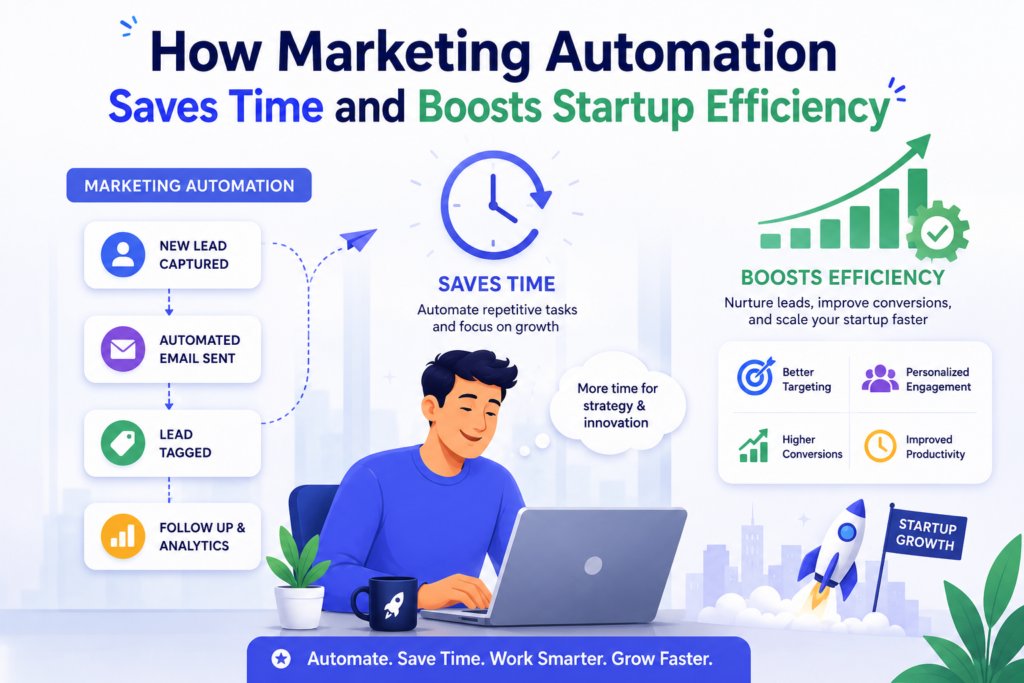
For founders, time is incredibly valuable. Marketing Automation helps eliminate repetitive tasks such as sending follow-up emails, updating spreadsheets, and managing customer communications. Every hour saved is an hour that can be spent on more important activities, such as improving products, talking to customers, or planning business growth. By using Marketing Automation, startups can increase efficiency, save valuable time, and focus on scaling their business faster.
This is why marketing automation is an investment for startups.
It helps them save time and focus on what matters most, such as growing their business with the help of marketing automation.
In addition, companies that use marketing automation often reduce the time spent on marketing tasks by 20–40%. As a result, their teams have more time to focus on the bigger picture and develop effective strategies. For startups, this can make a significant difference. Instead of spending hours on repetitive tasks, they can focus on business growth, customer engagement, and innovation. Ultimately, marketing automation allows businesses to work more efficiently and achieve better results.
What Does Marketing Automation Actually Do?
So, what does marketing automation actually do? In simple terms, it uses software to automate marketing tasks such as sending emails, scheduling social media posts, and managing ad campaigns. Additionally, it uses triggers and rules to send the right message at the right time. For example, when someone signs up, they automatically receive a series of welcome emails. Similarly, if someone downloads a resource from the website, they may be identified as a potential customer. Moreover, if a user has not been active for a while, the system automatically sends a re-engagement message.
As a result, businesses maintain consistent communication with their audience. No matter how busy the team is, every potential customer receives timely and high-quality follow-up. Ultimately, marketing automation helps startups save time, improve customer engagement, and grow their business more efficiently.
Areas where Marketing automation can save time.
There are areas where Marketing automation can save time:
- Lead nurturing and drip campaigns: Automated campaigns send a series of messages over time. This works better than sending one email. It gets people more engaged with the help of marketing automation.
- Onboarding and welcome series: A startup called Linear Labs used automation to welcome people. They saw more people activate their products and saved six hours a week all thanks to marketing automation.
- Audience segmentation: Automation platforms help segment contacts based on how they behave what company they work for or how engaged they are. This ensures that people get messages that’re relevant to them all with the help of marketing automation.
- CRM integration and sales handoff: Connecting the CRM to the marketing automation tool helps keep sales and marketing teams on the page. This leads to sales cycles and communication all thanks to marketing automation.
- Analytics and reporting: Automated dashboards provide real-time visibility into how the sales funnel’s moving all with the help of marketing automation.
Which Marketing Tasks Should Startsup Automate First?
- Onboarding sequences are a place to start: They provide a return on investment. They are easy to set up with marketing automation.
- Lead scoring is another one: It helps sales teams focus on the people who’re most likely to buy something all with the help of marketing automation.
- Post-demo follow-ups are also important: This is a moment where startups often lose momentum. Marketing automation can help.
- Re-engagement campaigns can help win back people who have not been active in a while all without a lot of effort thanks to marketing automation.
There are some pitfalls to avoid when using marketing automation.
- Do not automate things before mapping out the customer journey. Build a customer journey map first then use marketing automation.
- Do not overdo it with personalization. Many automated emails can feel robotic with marketing automation.
- Make sure sales and marketing teams are on the page. Automation should not create friction between teams rather it should help them work together with marketing automation.
- Do not just set things up. Forget about them. Workflows need to be reviewed and tested, with the help of marketing automation.
How to Measure the Success of Marketing Automation
To measure the success of marketing automation use a checklist.
- Track the hours spent on marketing tasks each week with marketing automation.
- Look at the conversion rate of leads to customers at each stage of the sales funnel.
- Track the length of the sales cycle.
- Calculate the cost per lead.
- Look at the revenue generated from marketing efforts as a percentage of the pipeline.
- See how much team capacity is freed up epic drop work on things all thanks to marketing automation.
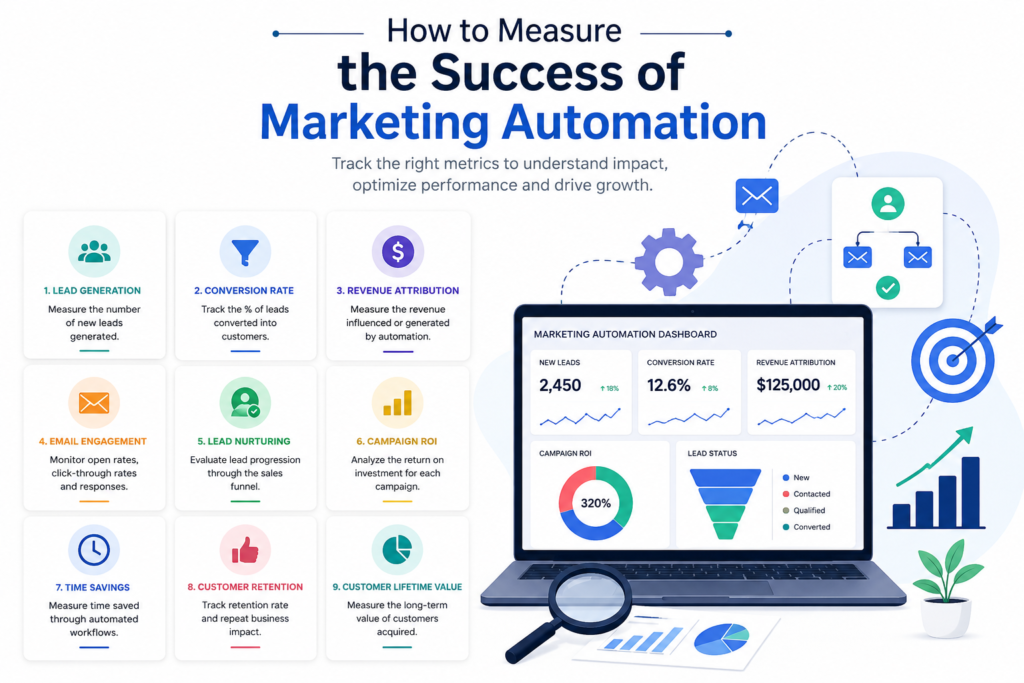
As a result, startups that track these metrics often see higher conversion rates and improved marketing performance. Ultimately, marketing automation helps businesses save time, increase efficiency, and achieve better results.
Marketing Automation Implementation Plan
To implement marketing automation follow a plan.
Days 1-30:
Map out the customer journey choose a platform and build a series with marketing automation.
Days 31-60:
Launch segmentation, drip campaigns and CRM integration with marketing automation.
Days 61-90:
After the demo, review your workflows, analyze performance, and refine your templates with the help of marketing automation. As a result, you can continuously improve your processes and achieve better marketing results.Finally, review your workflows after the demo, analyze your marketing performance, and refine your templates using marketing automation. This way, your automation strategy stays effective and cotinues to deliver better results.
Conclusion:
In conclusion, marketing automation is not about replacing your team. Instead, it gives your team the tools they need to work more efficiently and achieve better results. By automating high-impact tasks and connecting workflows to key performance metrics, startups can save valuable time and increase revenue. As a result, marketing automation helps businesses improve productivity, strengthen customer engagement, and support long-term growth.
Ready to get started? First, download the free workflow blueprint and the 30-60-90 day automation checklist to begin building your system this week. Alternatively, book a demo to see how marketing automation works for startups at every stage. This way, you can confidently take the first step toward saving time and growing your business.