
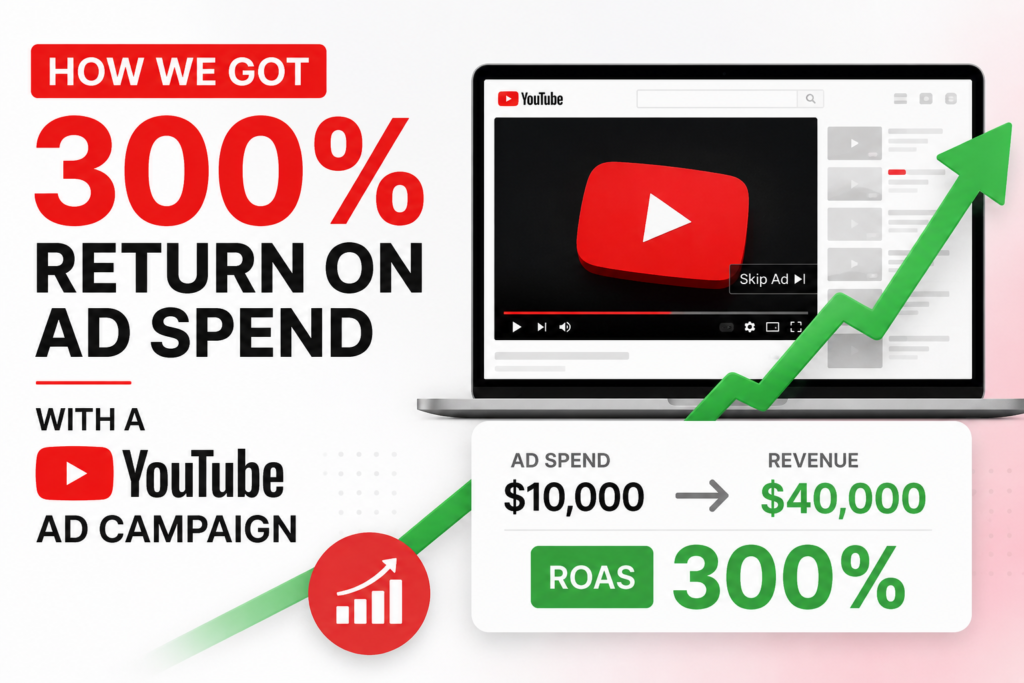
Most e-commerce brands think YouTube Ads are only for brand awareness. We believed the same until we launched a YouTube Ad Campaign for a skincare brand. Within 90 days, the campaign achieved a 300% ROAS, increased branded searches, and became one of the client’s best-performing marketing channels.Here is what we actually did including what did not work.
The Goal of the YouTube Ad Campaign
The client, a skincare brand that sells things online and makes around ₹40 lakh in revenue wanted to stop relying so much on Meta Ads, where the cost of ads had gone up 35% in a year. They asked us to build a YouTube channel that could give them at a 2x return on ad spend within 90 days without taking away from their existing branded search traffic.
We set three things we wanted to achieve from the start:
- Return on ad spend should be least 200% by day 90
- Cost per acquisition should be under ₹850
- No more than a 10% overlap with existing retargeting audiences
What We Thought Would Work
Before spending any money we made three guesses:
- Short ads that people can skip would do better than short ads for this price point (₹1,200–₹2,500 AOV) because the product needed a few seconds to make sense.
- Custom audiences built from competitor search terms would convert better than YouTubes native affinity segments.
- People got tired of the ads by day 12, much earlier than we expected.
Two of our three ideas worked successfully.
. The third thing did not. People got tired of the ads closer to day 12 half of what we had planned for.
YouTube Ad Campaign Strategy
- Campaign structure: We ran two types of campaigns at the time. One for people to consider our product and a smaller one to get people to take action.
- Budget split: 70% of our budget went to custom intent and in-market audiences 30% to people who had visited our site or added things to their cart but did not buy.
- Ads: We made four ads, each with a different start to see what would work best.
- Landing pages: We created a dedicated landing page for each ad to match its message.
- Measurement: We used Google Analytics 4 with tags to track what was working and what was not.
YouTube Ad Campaign Results
By day 90:
- Return on ad spend was 312% (we were aiming for 200%)
- Cost per acquisition was ₹690 which’s less than the ₹850 we wanted
- 22% of our sales came from people who saw our ads but did not click which we would not have seen if we only looked at clicks
- People searching for our brand went up 27% over the time, which means our ads were working
The overlap with our existing retargeting audiences was 6%, which is what we wanted.
What We Would Do Differently
Not everything went as planned. The short ads we made did not work well. We stopped using them by week 3. Our product needs more than +YouTube Ad Campaign for E-commerce Brand six seconds to make sense. We also did not realize how quickly one ad could become the one and carry all the spend. By week 6 one ad was getting 60% of our budget, which is not a good thing if it stops working.
Things to Check Before Starting a Campaign
Before starting a YouTube campaign for an e-commerce or online store make sure you have:
- At 3-4 different ads ready before you start not just one
- A way to track what is working and what is not including view-through conversions
- A page for each ad to match what the ad is saying
- A plan to change your ads regularly. People get tired of them quickly
- A clear idea of what you want to achieve before you spend any money so you can make good decisions
How to Test Your Ads
- Test the start of your ads, not the ad to see what works best.
- Run each ad until you have data to make a decision. At least 1,000 impressions.
- Get rid of ads that are not working fast. Do not wait for all the data if one ad is doing worse than the others.
- Add an ad every time you get rid of one. Never have less than three ads running.
- Check your ads every month even if they are still working because people can get tired of them before you notice.
What We Learned from the YouTube Ad Campaign
YouTube is not just for people to know about your brand. It can actually make you money.. You have to measure it differently than other channels. The brands that get return on ad spend, from YouTube are the ones that are willing to track everything change their ads often and use the first two weeks to learn what works and what does not.
If you have a store and are thinking about using YouTube, the biggest thing you can do is set up measurement correctly before you spend any money.A successful YouTube ad campaign is more than running video ads. It requires smart targeting, continuous testing, and accurate tracking. If you optimize your creative, audiences, and budget regularly, YouTube can become one of your highest-performing marketing channels.YouTube Ad Campaign for E-commerce Brand