

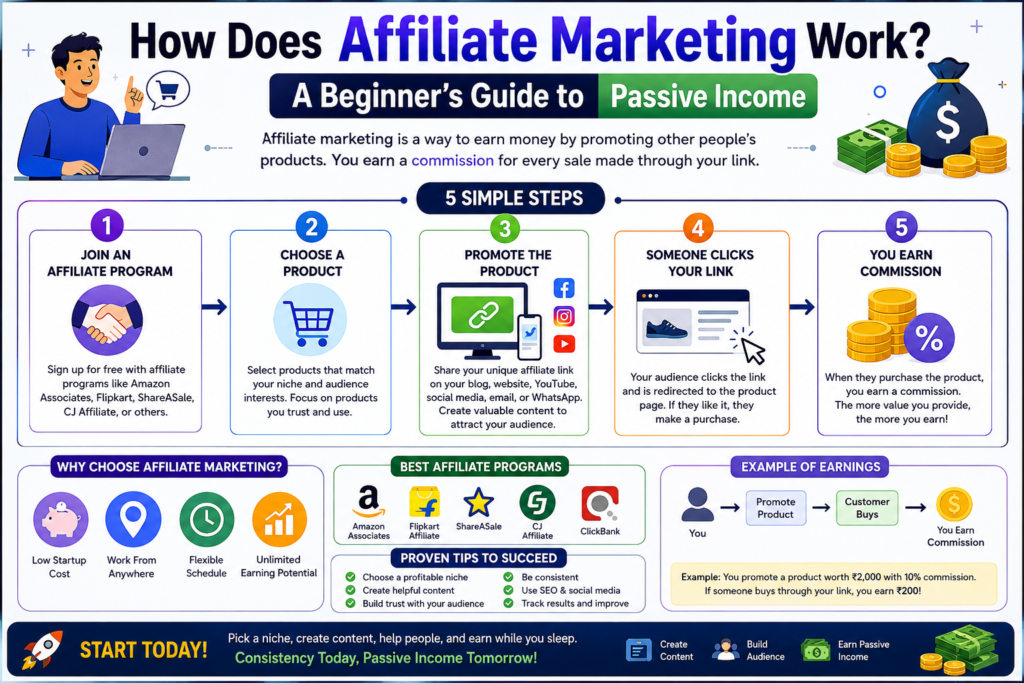
If you’ve spent time online you’ve probably clicked a link in a blog post or YouTube description that led you to buy something and the creator earned a small commission for it. That’s affiliate marketing in a nutshell, and it’s one of the most accessible ways for beginners in India to start building an income stream online, with low upfront cost and flexible hours.How Does Affiliate Marketing Work

This guide breaks down how affiliate marketing actually works, how to choose the right programs, how to drive traffic, and how to avoid the mistakes that trip up most newcomers.
What Is Affiliate Marketing, in Simple Terms?
Affiliate marketing is a performance-based partnership between three parties:
- The Advertiser (Merchant) — a brand or company selling a product or service.
- The Affiliate (You) — someone who promotes that product using a unique tracked link.
- The Customer someone who clicks your link and makes a purchase or takes a desired action.
When a customer buys through your link, the advertiser pays you a commission. No commission is paid without a sale or action, which is why it’s called performance marketing.
The flow looks like this:
Advertiser → Affiliate (You) → Customer → Purchase → Tracked via Cookie → Commission Paid
How Do Affiliate Programs Actually Track Sales?
This is the part beginners find most confusing. When you join a program, you get a unique affiliate link embedded with a tracking ID. When someone clicks it, a small file called a cookie is stored in their browser, recording that the visit came from you.
Each program sets an attribution window (also called a cookie duration) — the time period during which a purchase still counts as yours even if the customer doesn’t buy immediately. Amazon Associates, for example, uses a short window (often 24 hours), while many software and course affiliate programs offer 30, 60, or even 90 days. Longer windows generally favor the affiliate, since buyers often research before purchasing.
Common Commission and Payout Models
Not all affiliate programs pay the same way. The main structures are:
- CPA (Cost Per Action) — paid when someone completes an action, like signing up or filling a form.
- CPL (Cost Per Lead) — paid for generating a qualified lead, common in finance and education niches.
- CPC (Cost Per Click) — paid simply for driving traffic, regardless of conversion (less common, lower payout).
- Revenue Share — a percentage of the actual sale value, common with e-commerce platforms like Amazon Associates.
Understanding which model a program uses helps you estimate realistic earnings before committing your time.
How to Choose a Good Affiliate Program
With thousands of programs available, beginners should filter by:
- Relevance to your niche — promote products your audience actually wants.
- Commission structure and payout threshold — check minimum payout amounts and payment frequency.
- Reputation and reliability — established networks pay on time and offer good support.
- Cookie duration — longer windows generally mean more forgiving conversion tracking.
Popular global networks: Amazon Associates, ClickBank, CJ Affiliate, ShareASale, Rakuten Advertising.
India-focused options worth exploring: Amazon.in Associates, Flipkart Affiliate, EarnKaro, vCommission, and hosting/software affiliate programs (Bluehost, Hostinger, SEMrush) which tend to pay well in INR or USD and are popular among Indian bloggers and YouTubers.
Driving Traffic: The Real Engine of Affiliate Income
No traffic means no clicks, and no clicks mean no commissions. Beginners typically rely on a mix of:
- SEO and content marketing — blog posts, comparison articles, and how-to guides that rank on Google over time.
- YouTube and video content — product reviews, tutorials, and unboxings work especially well in India.
- Social media — Instagram Reels, Pinterest, and Telegram channels for niche communities.
- Email marketing — building a list lets you promote repeatedly without depending on algorithms.
SEO-driven content is often called the most “passive” traffic source, since a well-ranked blog post can keep earning commissions for years with minimal upkeep — this is where the “passive income” reputation of affiliate marketing really comes from.
Disclosure and Compliance
Transparency isn’t optional. Most countries, and increasingly Indian regulatory guidance from bodies like ASCI (Advertising Standards Council of India), require clear disclosure when content contains affiliate links. A simple line like This post contains affiliate links; I may earn a commission at no extra cost to you builds trust and keeps you compliant.
Common Beginner Mistakes to Avoid
- Promoting too many products across unrelated niches instead of focusing on one area of expertise.
- Choosing products based on commission size rather than genuine relevance to your audience.
- Ignoring analytics — not tracking which links or content actually convert.
- Skipping disclosure, which damages trust and can violate platform or advertising guidelines.
- Expecting fast results — most beginners see meaningful traffic and income only after 3–6 months of consistent content creation.
How Long Until You Start Earning?
Affiliate marketing isn’t instant income. Building an audience, ranking content, or growing a following typically takes a few months of consistent effort before results compound. Once a content base is established, though, earnings can become genuinely passive — old posts and videos keep generating clicks and commissions long after publishing.
Quick-Start Action Plan
- Choose a niche you understand and enjoy (tech, personal finance, beauty, fitness, etc.).
- Pick 1–2 reputable affiliate programs relevant to that niche.
- Create a simple content plan — a few blog posts, reels, or videos per week.
- Add tracked affiliate links naturally within helpful, honest content.
- Monitor performance weekly — clicks, conversions, and top-performing content.
- Double down on what works, and phase out what doesn’t.
Final Thoughts
Affiliate marketing works because it aligns incentives: advertisers get sales, affiliates get paid, and customers get honest recommendations. For beginners in India, it’s a low-cost way to start earning online but success depends on patience, consistency, and genuinely useful content rather than shortcuts. Start small, stay honest with your audience, and let your best content compound into passive income over time.Digital Marketing Guide