
Running influencer campaigns without a clear process is like driving without a map.
You might get somewhere. However, you’ll waste time, money, and energy along the way.
That’s exactly why brands need end-to-end influencer marketing. It covers every step — from strategy and creator discovery to activation, tracking, and post-campaign content rights.
In this guide, you’ll learn the full workflow. Moreover, you’ll get a practical framework you can start using right away.
What Does End-to-End Influencer Marketing Mean?
Simply put, it means managing every phase of an influencer campaign under one roof.
Most brands handle influencer marketing in pieces. They find creators here. They negotiate contracts there. Then, they track results somewhere else entirely.
As a result, things fall through the cracks. Deadlines get missed. Compliance gets ignored. Performance goes unmeasured.
An end-to-end approach solves this. It connects strategy, execution, and measurement into one seamless process. Therefore, nothing gets lost between stages.
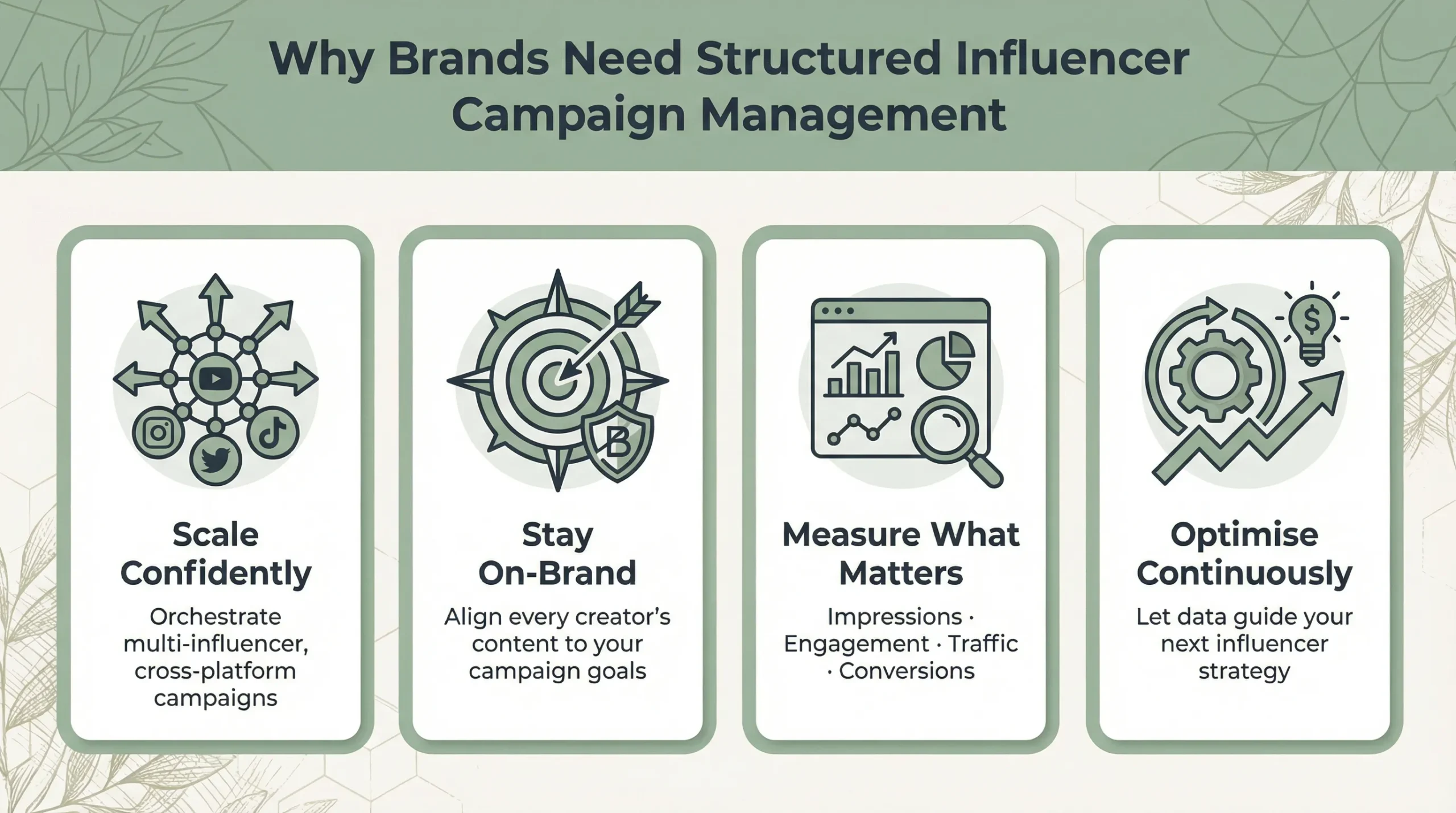
Why Brands Need a Structured Influencer Process
The influencer marketing industry has grown fast. Global spend now exceeds $20 billion annually. Moreover, roughly three-quarters of brands plan to increase their influencer budgets next year.
However, more spending doesn’t guarantee better results.
Without structure, common problems appear:
- Choosing creators who don’t match the brand
- Missing FTC compliance requirements
- Failing to track ROI properly
- Losing content usage rights after the campaign ends
Therefore, a structured end-to-end workflow isn’t optional anymore. It’s essential for protecting your investment and scaling with confidence.
The 7-Step End-to-End Influencer Marketing Workflow
Here’s the complete framework. Follow these steps in order for the best results.
Step 1 — Strategy and Goal Setting
Every campaign starts with clarity. Before you contact a single creator, define your objectives.
Ask these questions:
- Are you building brand awareness or driving direct sales?
- What platforms matter most for your audience?
- What’s your budget and timeline?
For example, a DTC skincare brand launching a new serum might prioritize Instagram Reels and TikTok. In contrast, a B2B SaaS company might focus on LinkedIn and YouTube.
Your strategy shapes everything that follows. Therefore, never skip this step.
Step 2 — Creator Discovery and Vetting
Finding influencers is easy. Finding the right ones is harder.
Use influencer discovery tools like Modash, CreatorIQ, or Upfluence to search by niche, audience demographics, and engagement rate.
In addition, manually review each candidate’s content. Check for:
- Brand value alignment
- Authentic engagement (not bot-driven)
- Past partnership quality
- Audience demographics that match your target market
Moreover, don’t rely on follower count alone. Micro-influencers often deliver higher engagement rates than mega-influencers. As a result, a blended approach usually works best.
Step 3 — Onboarding and Contracts
Once you’ve selected your creators, formalize the partnership.
Your influencer contract should cover:
- Deliverables — number of posts, formats, and deadlines
- Compensation — flat fee, commission, or product exchange
- Content usage rights — typically 6–12 months
- Exclusivity — can they work with competitors during the campaign?
- FTC compliance — mandatory disclosure of paid partnerships
This step protects both the brand and the creator. Therefore, always use a written agreement — even for smaller collaborations.
Step 4 — Briefing and Creative Guidelines
A clear brief sets creators up for success. However, don’t over-script them.
Your influencer brief should include:
- Campaign goals and key messages
- Product details and talking points
- Visual guidelines (dos and don’ts)
- Hashtags and tags to include
- Deadlines and approval process
At the same time, leave room for creative freedom. Audiences can tell when content feels forced. In contrast, authentic creator-led content performs significantly better.
Step 5 — Campaign Activation
Now, it’s go time. Launch the campaign and coordinate posting schedules.
Use a shared content calendar to keep everyone aligned. Moreover, stagger posts across creators and platforms for maximum impact.
During activation, monitor content in real time. For example, check that all posts include proper FTC disclosures. In addition, watch for early engagement signals — they’ll help you optimize later.
Step 6 — Performance Tracking and Optimization
Tracking starts on day one. Don’t wait until the campaign ends.
Measure these key metrics:
| Metric | What It Tells You |
|---|---|
| Engagement Rate | Audience interaction quality |
| Click-Through Rate (CTR) | Interest in your offer or landing page |
| Conversions | Actual sales, sign-ups, or downloads |
| Cost Per Acquisition (CPA) | Efficiency of your spend |
| Saves and Shares | Content value beyond surface engagement |
Use UTM parameters and trackable links for each creator. As a result, you’ll know exactly which influencer drives the most value.
If a particular creator or format underperforms, adjust mid-campaign. Therefore, real-time tracking isn’t just useful — it’s critical.
Step 7 — Post-Campaign Review and Content Rights
The campaign doesn’t end when the last post goes live.
Conduct a post-campaign review. Compare results against your original goals. Moreover, document what worked and what didn’t.
In addition, manage your content rights carefully. Many brands repurpose influencer content for paid ads, email campaigns, and website assets. However, this requires clear usage agreements established back in Step 3.
Finally, nurture strong creator relationships for future campaigns. Long-term partnerships often outperform one-off collaborations because trust deepens over time.
Quick-Reference End-to-End Checklist ✅
Use this before every campaign:
- Campaign goals and KPIs defined
- Budget and timeline confirmed
- Creators discovered and vetted
- Contracts signed with compliance terms
- Creative brief shared and approved
- Content calendar finalized
- UTM links and tracking set up
- Real-time monitoring active during launch
- Post-campaign report completed
- Content rights documented and managed
Mini Case Study: End-to-End Success
A mid-size fitness brand wanted to launch a new protein bar line. However, they had no influencer process in place.
They adopted the seven-step workflow above. First, they set clear goals — 10,000 website visits and 500 sales in 30 days. Then, they onboarded 12 micro-influencers across Instagram and TikTok.
Each creator received a detailed brief with creative freedom. Moreover, every post included tracked links and FTC-compliant disclosures.
Results after 30 days:
- Website visits from influencer content: 14,200
- Total conversions: 680 sales
- Average engagement rate: 3.8%
- ROI: 5.2x campaign spend
As a result, the brand now runs quarterly influencer campaigns using the same framework.
Conclusion
End-to-end influencer marketing removes the chaos from creator campaigns. It gives brands a repeatable, measurable process — from strategy to post-campaign content rights.
Without structure, you risk wasted budgets and missed opportunities. However, with a clear workflow, every step connects to real business outcomes.
Therefore, start with your goals. Follow the seven steps. Track everything. Moreover, treat influencer relationships as long-term assets — not one-off transactions.