
From Lead to Customer: Use Our Marketing Automation Setups to Improve Sales Founders and sales leaders do not usually stay up all night thinking about strategy. They stay up all night thinking about how to get things done. This means thinking about leads that go cold before anyone follows up. It means thinking about how marketing and sales teams do not work together. It means thinking about how it takes to close a sale. If this sounds familiar to you the solution is not to work. The solution is to build a marketing automation setup that does the follow-up and routing for you. This way your team can focus on closing deals not chasing leads.
This is what a built automation system can change: deals get done faster. Marketing and sales teams finally work together using the data. You can point to a number, not a feeling, when someone asks if the investment paid off.
What Marketing Automation Actually Does for Sales
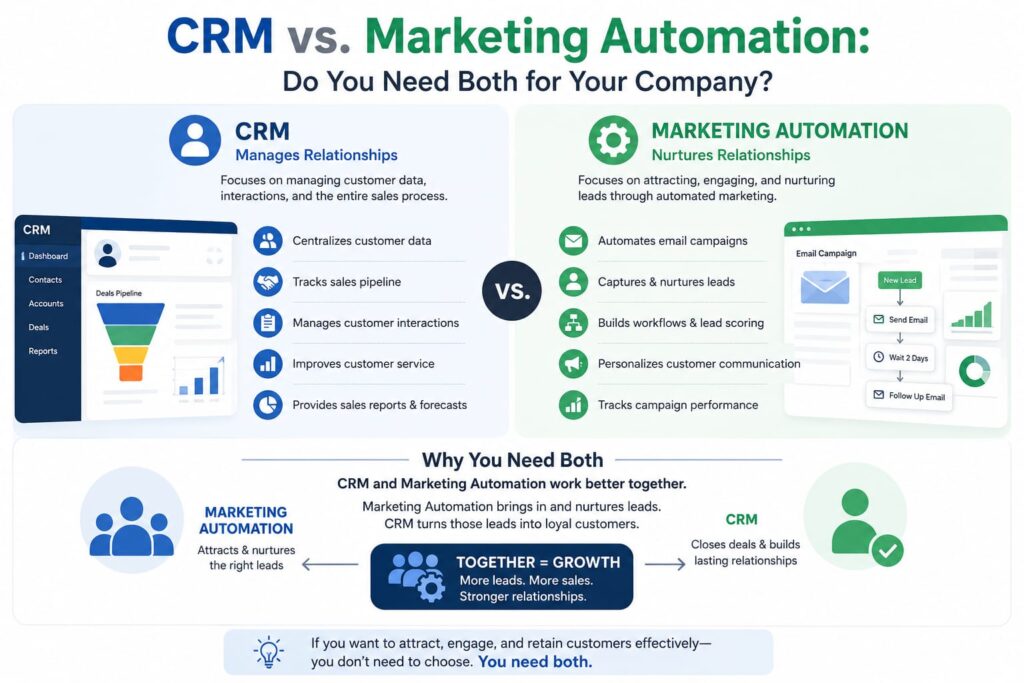
Marketing automation is a tool that handles marketing and lead-management tasks automatically. It sends emails at the time. It scores leads based on their behavior. It passes leads to sales teams when they’re ready. Of a sales representative manually checking who opened an email or visited the pricing page the marketing automation system tracks it scores it and triggers the next step on its own.
How Marketing Automation Improves Lead Management
For sales teams this means every lead gets followed up with including ones your team has not gotten to yet. Leads arrive pre-qualified so sales representatives spend time on people who’re ready to buy. Marketing and sales teams share the definition of what a “ready” lead looks like. This eliminates arguments over quality. Deals move through the funnel faster because nurturing happens all the time not sometimes.
Benefits of Marketing Automation for Sales Teams
Many businesses are using marketing automation now. Recent research shows that three-quarters of businesses are using it. Most marketers say they have used or plan to use a marketing automation platform. The bigger story is what happens after adoption: companies that use marketing automation to nurture leads report an increase in leads. Nurtured leads convert 23% faster than leads that are left to follow up. This is a deal. For a company with a six-month sales cycle that is six weeks back.
Building Sales-Ready Automation Workflows
The marketing automation setups that actually move sales numbers share a structure. Here is the framework we use with clients who are getting started:
- Map the buyers journey first: Before building a workflow define the stages a lead moves through. This includes visitor, subscriber, marketing-qualified lead sales-qualified lead, opportunity, customer. Every marketing automation workflow you build should move someone from one stage to the next.
- Score leads based on buying signals: Combine fit with signals into a score. This is what separates a “lead” from someone who is just browsing.
- Set a Service Level Agreement for handoff: Define when a lead becomes sales responsibility and how fast sales must respond once it does. Speed matters here. Buyers consistently choose the vendor that responds first.
- Automate the nurturing process, not the notification: Leads that are not sales-ready yet should not be ignored. Drip campaigns keep them engaged with content until they cross the scoring threshold.
- Close the loop with attribution data: Connect campaign activity back to revenue so you can see which channels and content actually produce customers not just leads.
CRM Integration: The key to Successful Marketing Automation
Why CRM Integration Matters
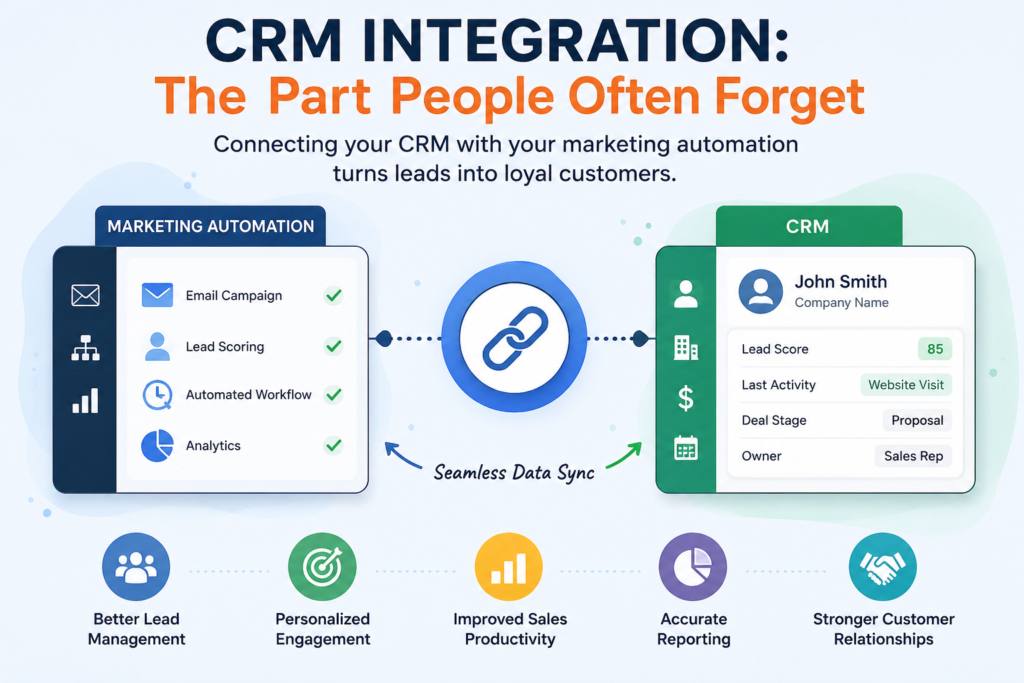
A marketing automation platform is only as useful as its connection to your Customer Relationship Management system. If lead scores, campaign activity and engagement history do not sync automatically into the CRM your sales team already lives in you have just built a system that nobody checks. The integration needs to work in both directions: marketing activity should update the CRM record in time. Sales activity should feed back into your scoring and attribution models. Most marketers now integrate their marketing automation tools with their CRM for this reason. It is what makes the handoff between marketing and sales seamless not an export-and-email process.
Marketing Automation ROI:
Timeline and Business Results:
How Long Does a Marketing Automation Setup Take?
A marketing automation setup, including workflows, lead scoring, CRM sync and a handful of core nurture sequences typically takes four to eight weeks to implement. This depends on how clean your existing data’s how many systems need to connect. Rushing this stage is the common way projects fail.
Return On Investment of Marketing Automation
The payoff tends to justify the timeline. Industry benchmarks put return on marketing automation investment at $5.44 for every dollar spent. Most companies see a return on investment within the year. Personalized behavior-triggered campaigns also outperform sends by a margin. Automated, segmented emails can generate hundreds of percent revenue than one-size-fits-all blasts. This is because they show up in front of the person at the right moment instead of everyone at once.
A Success Story: Shortening the Path from Lead to Close
How Marketing Automation Improved Sales Performance
The Challenge
One client, a growing Business-to-Business software company came to us with a problem: marketing was generating plenty of form-fills. Sales was drowning in unqualified leads and closing deals at a pace that lagged behind their pipeline growth. We rebuilt their marketing automation setup around a weighted lead-scoring model tied to CRM data added automated nurture tracks for leads not yet sales-ready and set a Service Level Agreement for handoff timing.
The Solution
Within the two quarters after launch their sales-qualified lead volume increased significantly. Their average sales cycle shortened. Their sales representatives reported spending less time chasing leads that were never going to convert. Just as important, marketing and sales stopped arguing about quality. This is because for the time they were both looking at the same score.
The Results
Every businesss numbers will look different. The pattern holds: when leads are nurtured automatically and handed off at the moment sales moves faster and marketing gets credit for the revenue it helped create.
Common Mistakes to Avoid
Automating a process if your sales
Automating a process if your sales and marketing teams do not agree on what a qualified lead looks like. Marketing automation will just make the disagreement worse.
Ignoring CRM Integration
Skipping the CRM integration. A platform that does not sync with your CRM creates work, not less.
Building Too Many Workflows at Once
Building workflows at once. Start with your highest-impact journey. Expand from there.
Never Updating Lead Scoring
Never revisiting lead scoring. Buying signals change as your product and market evolve. Scoring models need to be reviewed and updated, not set and forgotten.
Treating automation as Only a Marketing Project
Treating marketing automation as a marketing project. The setups that work best are built with sales teams, at the table from day one since they are the ones acting on the leads it produces.
Ready to See Where Your Process Stands?
If any of this sounds like your setup with leads slipping through the cracks, marketing and sales working from definitions of “ready” or a sales cycle that keeps getting longer the fastest way to find out what is fixable is a quick audit of what you already have. We offer a consultation to walk through your sales and marketing process. Show you exactly where a marketing automation setup would save your team the most time and win you the most revenue. Reach out. Let us map out what a faster more connected sales process could look like for your company.
Conclusion
Becoming an automation expert is one of the smartest career moves in today’s digital world. By mastering Zapier, HubSpot, and CRM tools, you can automate repetitive tasks, improve customer relationships, and help businesses save time while boosting productivity. Whether you’re a student, freelancer, marketer, or business owner, these in-demand automation skills can open the door to exciting career opportunities and higher earning potential. Start learning, practice with real-world projects, and keep improving your expertise to become a trusted automation professional.