
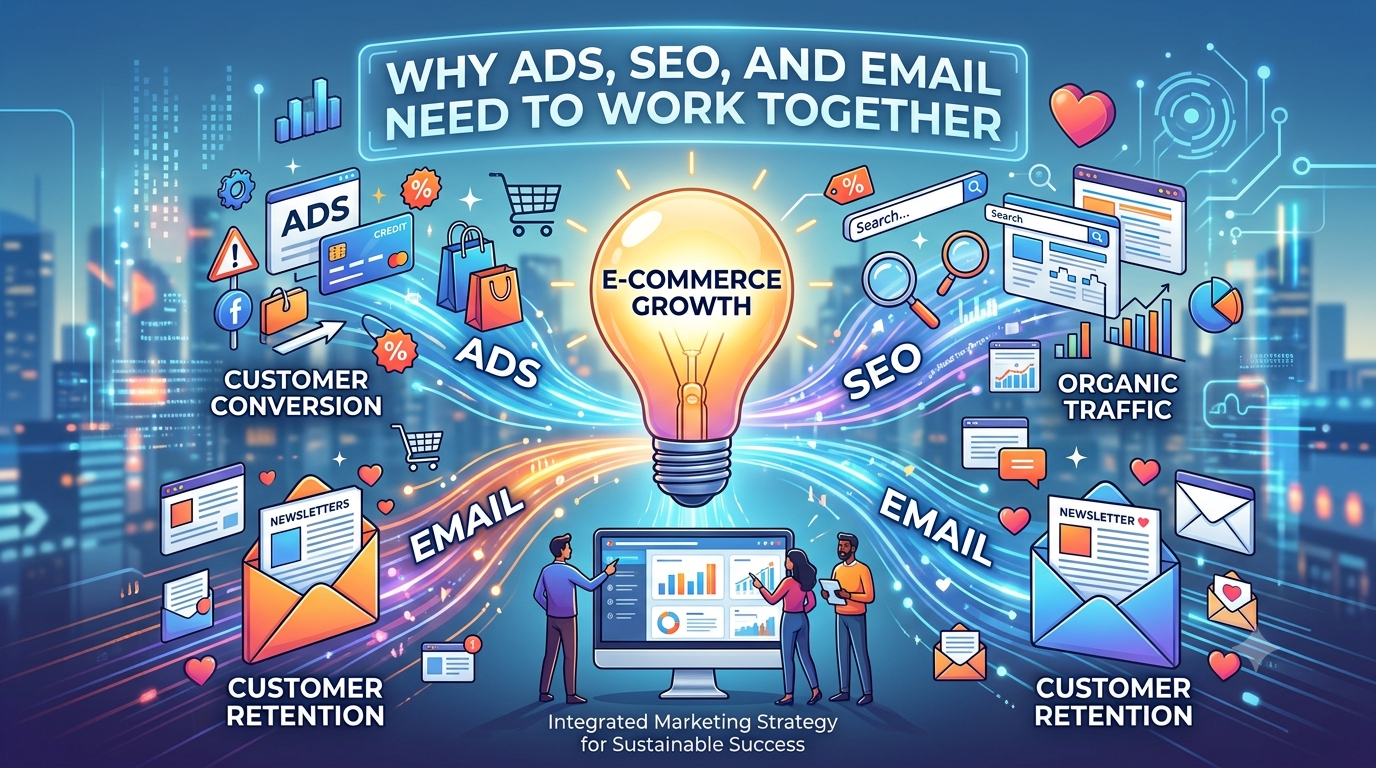
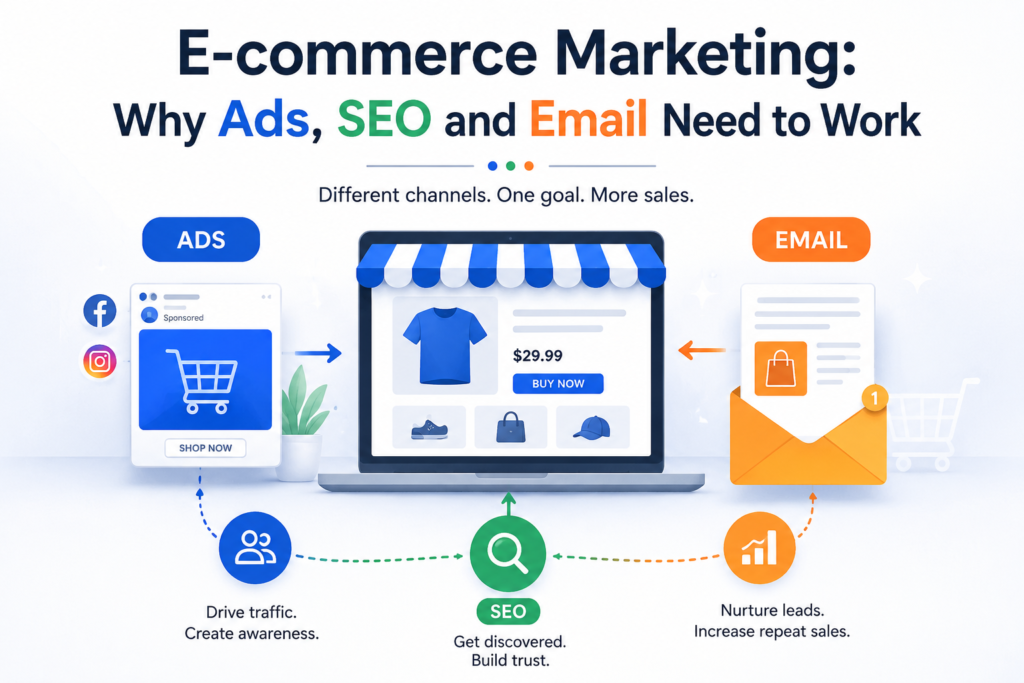
If you have an online store, you have probably heard pitches like “We will run your ads,” “We will fix your SEO,” or “Let us handle your email.” Each pitch sounds okay on its own. But this is not how effective e-commerce marketing actually works. Real e-commerce marketing is not three separate jobs. It is one job with three parts that need to work together.
I have seen brands spend a lot of money on ads. Then they lose those new customers because they never built a good welcome email sequence. I have also seen stores whose product pages rank high on Google. Yet these same stores still lose money because their checkout process scares people away. This is the core problem with e-commerce marketing: treating it as disconnected tasks instead of one connected system.
Why Doing E-commerce Marketing in Pieces Does Not Work
A customer does not experience your brand in pieces. They see an ad on Instagram. They click it. Maybe they do not buy right away. A few days later, another ad shows up. Eventually they make a purchase, and then they either become a repeat customer or disappear, depending on what happens next in their inbox.
When the people running your ads, SEO, and email do not talk to each other, your messages stop matching. Your ads promise 20% off. Your website shows the full price. Your abandoned cart email arrives too late. This is what happens when you split e-commerce marketing into separate departments instead of running it as one connected system.
Paid Ads in E-commerce Marketing: Getting People to Your Store Without Wasting Money
Ads are where store owners spend the most money. They also understand ads the least. Meta, Google, and TikTok all promise huge reach. But reaching people is not the same as making money.
A good paid ads strategy for e-commerce marketing needs several pieces working together:
- Show ads for your best products to new people
- Retarget people who visited but did not buy
- Show ads for the exact product someone looked at
- Keep testing new ad creative
Many store owners treat ads like a game of chance: put in money and hope something works. What actually works is grouping people by where they stand in the buying process, then matching each group with the right ad.
SEO’s Role in E-commerce Marketing: The Way to Get Paid Back Later
SEO is the quiet cousin of e-commerce marketing. It moves slower. It demands more technical work. It rewards patience. Ads stop working the moment you stop paying for them. SEO keeps working long after you stop spending money on it.
For e-commerce marketing, SEO usually comes down to:
- Writing original product descriptions instead of copying the manufacturer’s text
- Adding structured data markup to your website
- Organizing your site so both search engines and shoppers can navigate it easily
- Keeping your website technically sound
- Publishing content like buying guides that answer questions before shoppers are ready to buy
Many stores underrate SEO. But six months of steady SEO work can end up cheaper than a single month of ad spend. You build an asset instead of renting one.
Email Automation in E-commerce Marketing: Where the Real Money Is
Ads and SEO bring people to your website. Email is what brings them back. Most brands set up one welcome sequence and then forget email entirely.
A strong email setup covers several jobs:
- Trust-building messages introduce your brand
- Abandoned cart reminders bring shoppers back
- Post-purchase follow-ups keep the relationship alive
- Win-back emails reach customers who have gone quiet
- Behavior-based segments make sure each person gets the right message
Email delivers one of the best returns in e-commerce marketing, because you already own the attention of everyone on your list. You do not rent that attention from Google or Meta.
Why E-commerce Marketing Works Better as One System
Ads, SEO, and email start reinforcing each other once you manage them together. Someone who finds you through a blog post might see your ad a week later. Someone who clicks an ad but skips checkout might get a follow-up email about that exact product. Your best-performing ad creative can even point your SEO team toward what to write next.
That is the real value of running e-commerce marketing as one system. It is not just convenient. Data from one channel makes the other two channels sharper.
Where to Start With E-commerce Marketing
You do not need to overhaul everything at once:
- Fix your welcome and abandoned cart email sequences first — small changes here pay off fast
- Sharpen your retargeting ads before you spend on new customer acquisition
- Treat SEO as a long-term project running quietly in the background
Customers never notice which department sent an email or ran an ad. They only notice whether the whole experience felt like one brand, or like three companies competing for their attention.